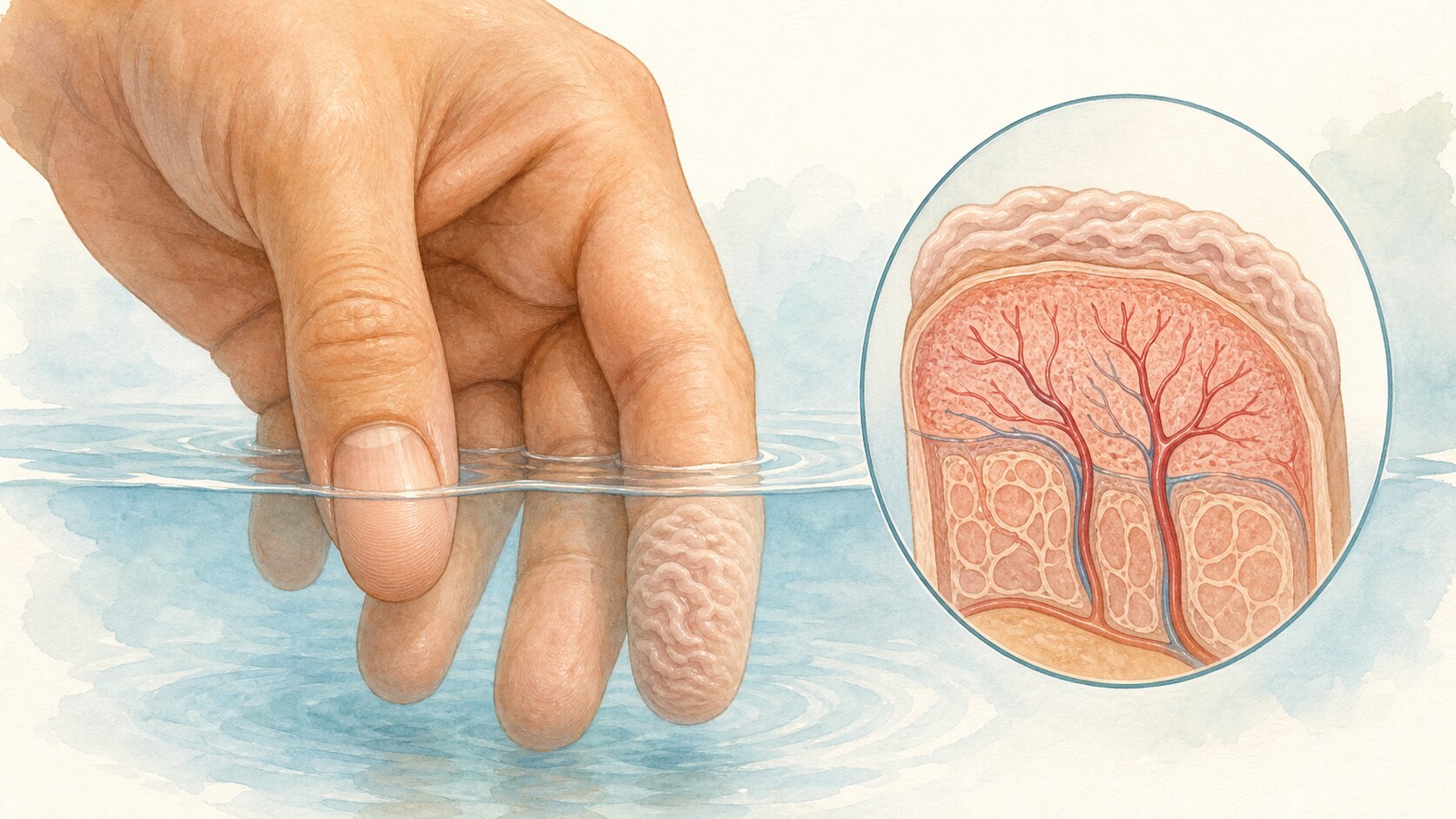
Wrinkles on water-soaked fingers and toes are not produced solely by skin absorbing water and swelling. The central process is an autonomic response carried by intact nerves: blood vessels in the digits constrict, reducing the volume beneath the surface while the outer skin folds into ridges and valleys.
On the hairless skin of palms and soles, contact with water changes local electrolyte conditions, and sweat ducts have been proposed as part of the signaling route. The response activates sympathetic nerves that narrow small blood vessels. Details of the initial sensing step remain under study, but nerve dependence and vasoconstriction are strongly supported.
As the vessels narrow, the volume of soft tissue in a fingertip decreases. The area of the outer skin does not shrink by the same amount immediately, so the remaining layer buckles into directional folds. This helps explain why the pattern is organized rather than the random puckering expected from a sheet simply becoming waterlogged.
Clinical observations reveal the importance of nerves. Where a nerve supplying a finger has been damaged, immersion may produce weak or absent wrinkling in the affected area. Clinicians have used the response as an additional check of peripheral nerve function. Temperature and testing conditions influence it, however, so it is not a stand-alone diagnosis.
The speed and extent of wrinkling vary with water temperature, salinity, immersion time and the individual. Extremely cold or hot water also changes vascular responses and can create separate safety concerns. After a person leaves the water, circulation and tissue volume return toward baseline and the folds disappear, making this normally a reversible change.
The drainage-like pattern has inspired a hypothesis that wrinkles evolved to improve handling in wet conditions. Evidence is not settled. In one study of 40 participants, wrinkling produced no improvement in manipulation dexterity or touch sensitivity for wet objects. Whether a benefit appears in particular tasks or environments remains an open question.
The best-established mechanism must therefore be separated from the proposed evolutionary function. Sympathetic vasoconstriction provides a well-supported account of how the folds form; it does not by itself prove that better wet grip caused the trait to be selected. Bathtub wrinkles are an active interaction among skin, nerves and blood vessels, not just passive soaking.
EDITORIAL RESPONSIBILITY
FactosBrain Editorial Desk
The FactosBrain Editorial Desk researched and reviewed this article under our editorial policy. We assess error reports under our corrections policy.