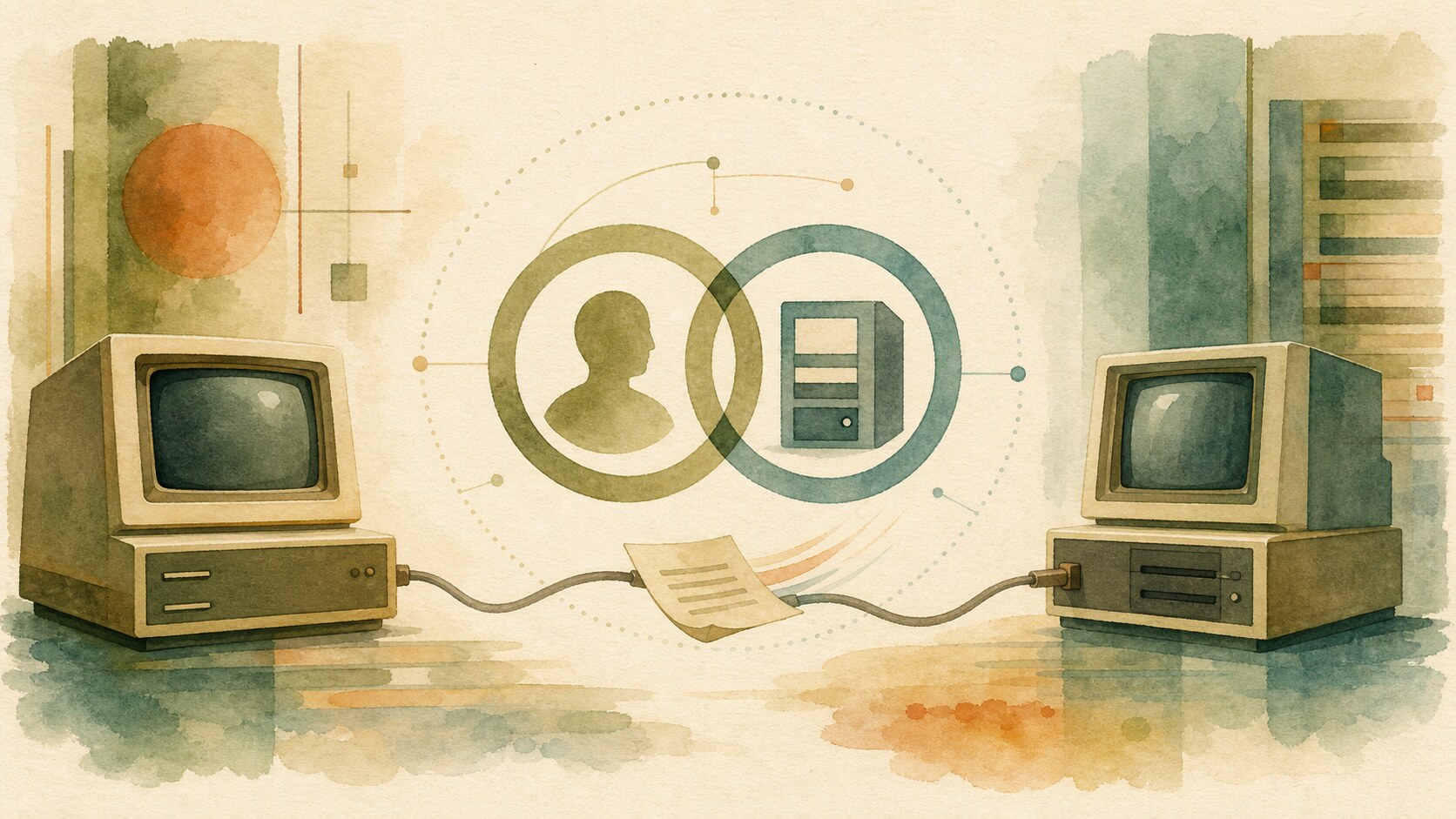
The @ in an email address was not invented for the Internet. It already appeared in commercial writing to mean a price per unit and was available on typewriter keyboards. In 1971 engineer Ray Tomlinson selected this existing but rarely conflicting character as the separator in a network-mail address.
Programs already let people leave messages for other users of the same computer. Tomlinson combined existing software so a message could travel to a user on another machine connected through ARPANET. The new task required one address to distinguish the recipient's name from the computer containing that mailbox.
Because @ is read as “at,” `user@host` naturally meant a user at a host. The symbol was already present on the keyboard and seldom appeared in login names or relevant operating-system commands. That reduced ambiguity and avoided distributing a new character or complicated notation.
The choice divided an address into two domains of responsibility. The local part on the left identifies a mailbox as interpreted by its mail system. The domain on the right identifies the Internet domain responsible for that mailbox. Even when the left side resembles a person's name, only the final service defines what it actually means.
To deliver a message, a mail system normally asks DNS for the domain's MX records and uses them to locate receiving servers. SMTP also defines an implicit-MX rule when no MX record exists, allowing the domain's address record to serve as the destination. Saying every message follows an explicitly published MX record would therefore be too simple.
It is also inaccurate to say Tomlinson invented electronic messaging itself. Same-computer mail and other precursors came first. His pivotal contribution was network mail between hosts and the `name@host` convention. Modern SMTP requires software to preserve local-part case, although many providers do not distinguish it in practice, so mailbox equivalence remains the receiving system's decision.
The lasting value of @ did not come from visual novelty. It expressed “which person at which system” in one available character while avoiding conflicts with existing software. The right side later evolved from a single host label into the modern domain and mail-server system, but the separator retained its purpose and became the central hinge of email-address syntax.
EDITORIAL RESPONSIBILITY
FactosBrain Editorial Desk
The FactosBrain Editorial Desk researched and reviewed this article under our editorial policy. We assess error reports under our corrections policy.