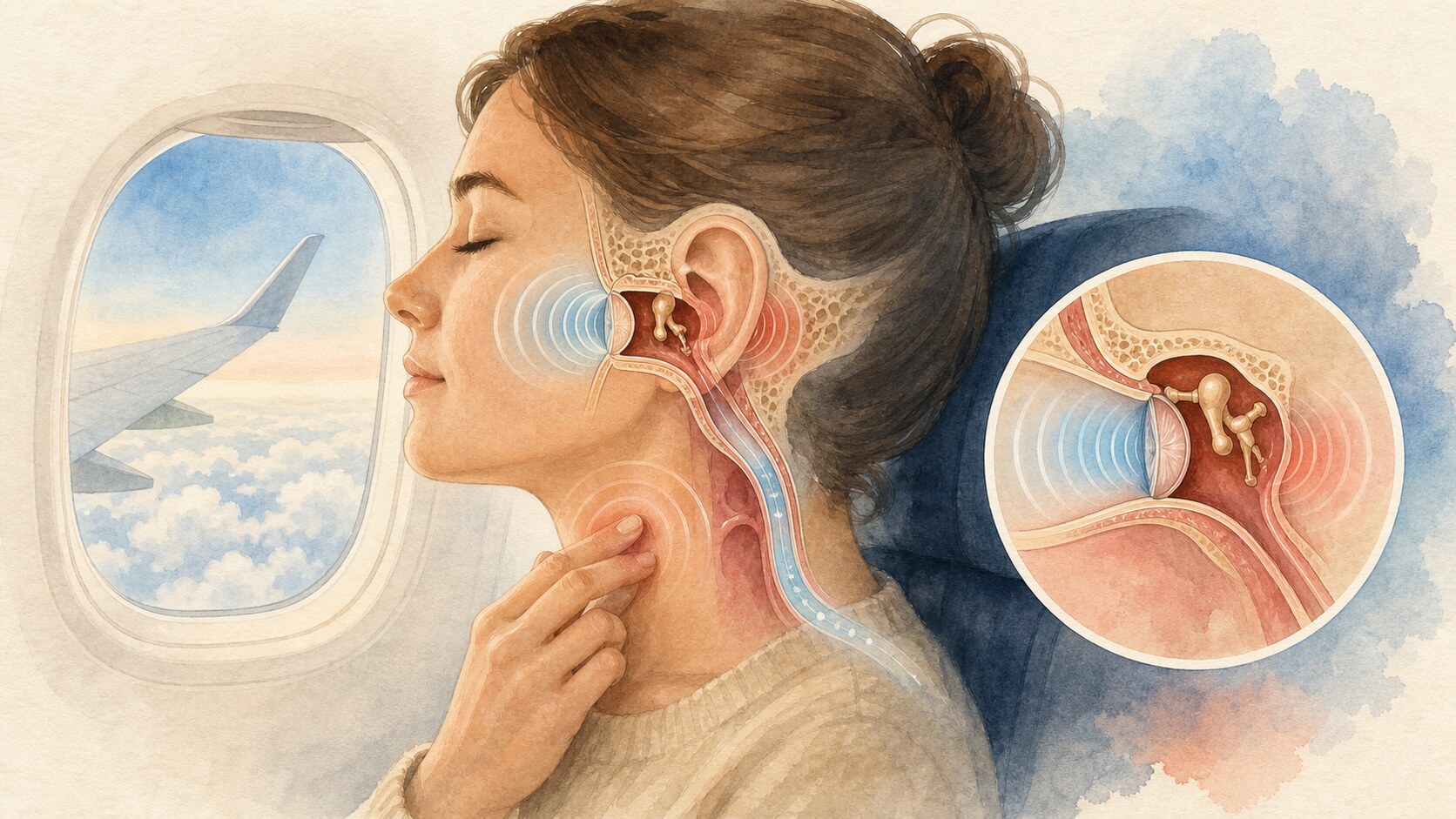
The pop in an airplane ear is the moment pressure in the middle ear moves closer to the pressure in the cabin. The outer side of the eardrum faces cabin air, while the middle ear behind it is a small air-filled space. When those pressures differ, the eardrum bends, producing fullness or pain; equalization can be felt or heard as a pop.
The middle ear connects to the back of the nose through the Eustachian tube. This narrow passage is not held wide open. It normally stays closed and opens briefly during swallowing, yawning and certain throat-muscle movements. Air can then move through it and reduce the pressure difference across the eardrum.
During ascent, cabin pressure falls and air in the middle ear expands relative to its surroundings. That expanding air can push outward through the tube fairly easily. During descent, cabin pressure rises and air must travel in the opposite direction, from the back of the nose into the middle ear. The tube is harder to open that way, so discomfort is often worse while landing.
Swallowing, yawning, chewing gum or sipping water repeatedly activates muscles that open the tube. If that is not enough, closing the mouth, pinching the nose and trying to exhale very gently against it—the Valsalva maneuver—may help. Force is not better: blowing hard against a blocked ear can cause injury, so the maneuver should stop if it increases pain.
A cold, sore throat, sinus problem or allergy can swell tissue around the tube and make equalization difficult. The U.S. Federal Aviation Administration notes that a severe ear block can cause intense pain, temporary hearing loss and fluid in the middle ear, and can occasionally damage the eardrum. Decongestants are not a guaranteed solution and may be unsuitable or produce side effects for some people.
Ordinary pressure fullness usually clears after equalization. Pain or hearing loss that persists after landing, or symptoms such as dizziness, bleeding or drainage, deserve medical assessment rather than repeated forceful attempts to pop the ear. The sound itself is not the cabin pressure cracking something; it is evidence that the Eustachian tube briefly opened and allowed the two sides of the eardrum to approach the same pressure.
EDITORIAL RESPONSIBILITY
FactosBrain Editorial Desk
The FactosBrain Editorial Desk researched and reviewed this article under our editorial policy. We assess error reports under our corrections policy.