Look a little closer
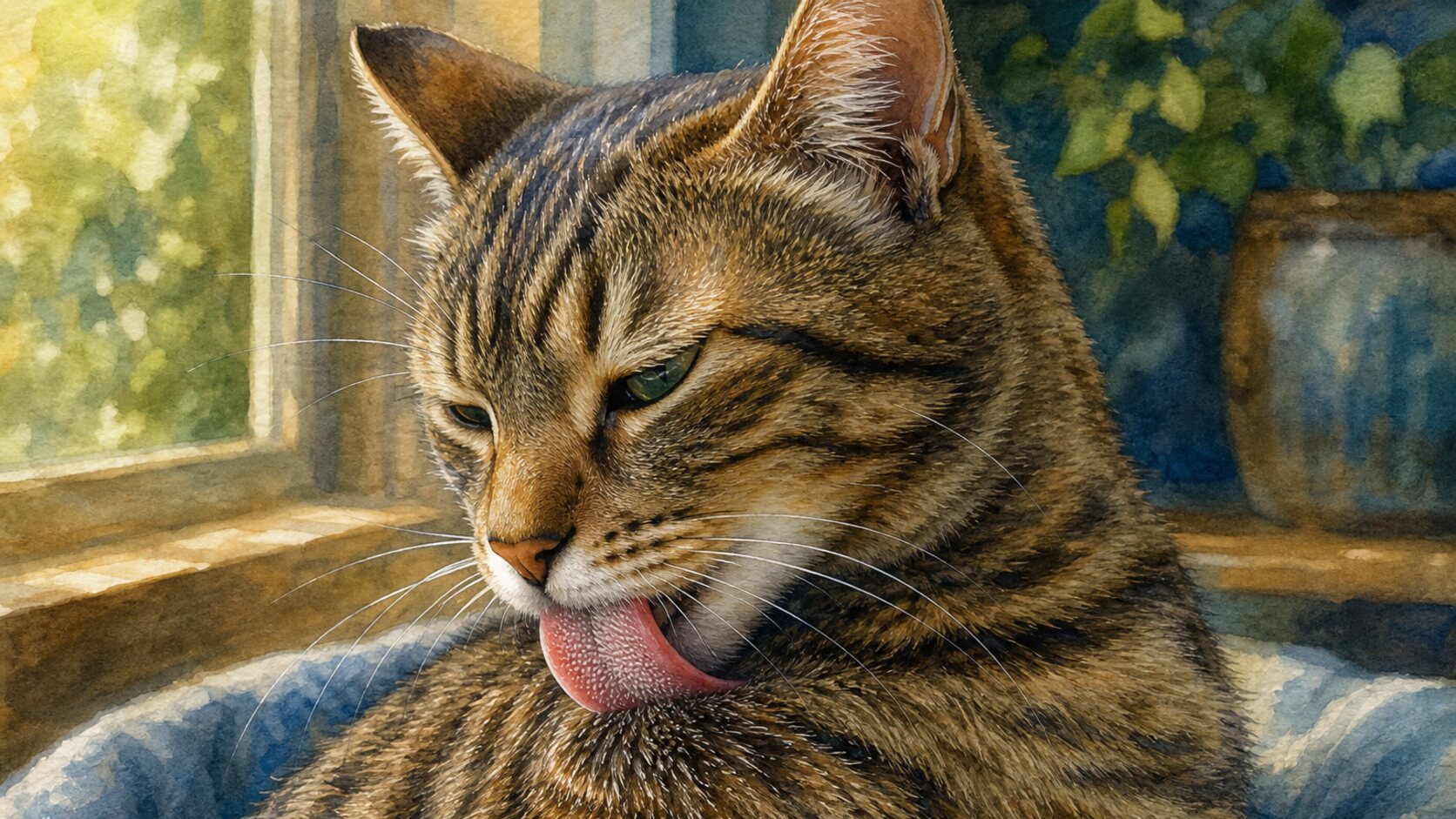
A cat's tongue feels like sandpaper because hundreds of stiff, keratin-covered filiform papillae project from its upper surface and point toward the throat. These structures are not primarily taste organs. They form a directional grooming tool that combs through fur and carries saliva below the coat's outer layer. Their orientation also makes contact feel different depending on direction: the points catch much more readily when rubbed against their backward slant.
The word papilla does not mean that every bump on a tongue contains taste buds. Cats have gustatory papillae of other types, while the dense filiform papillae across the center of the tongue are chiefly mechanical. Their surface epithelium is heavily keratinized, using the structural protein found in hair and claws to maintain a hard point. Calling them “tongue teeth” is catchy but anatomically wrong. They are specialized parts of the oral lining, not separate enamel-and-dentin teeth.
Backward orientation turns the surface into something more useful than a brush with neutral bristles. During a grooming stroke, the flexible tongue spreads and the papillae enter the coat, where their tips engage loose and tangled hairs. As the tongue retracts, the slant directs captured material toward the mouth. The same motion inserts the comb, collects debris, and withdraws it without a handle or a second grooming surface.
In 2018, Georgia Tech researchers filmed domestic-cat grooming at high speed and micro-CT scanned postmortem tongue tissue from six felid species: domestic cat, bobcat, cougar, snow leopard, tiger, and lion. What had looked like a solid cone contained a U-shaped cavity near the tip. When domestic-cat and tiger papillae touched dyed water, capillary action wicked liquid into the groove in about 0.1 second. Pressing the tongue against fur then released the held fluid onto hairs.
The cavities carry only a small fraction of the saliva on the tongue. In the domestic-cat specimen analyzed, roughly 290 papillae held about 5 percent of the liquid available on the tongue's upper surface. Placement matters more than volume. Fluid coating a relatively flat tongue wets mostly the outer fur, whereas projecting papillae deliver their tiny reservoirs through compressed hair toward the roots. The researchers tested this idea with an automated grooming machine that pulled a wetted tongue over fur while measuring force and fluid transfer.
Deep delivery helps collect debris and loose hair, arrange the coat, and wet regions close to the skin. Evaporation from those regions can also remove heat. A physical model in the 2018 study estimated that saliva deposited by papillae could supply part of a cat's cooling requirement. That is not a universal percentage for every cat and day. Coat length and density, ambient humidity, grooming time, and the animal's condition all change how much evaporative cooling is possible.
The papillae are not rigid nails locked upright. Their bases flex within the tongue, allowing the points to change angle as they encounter fur and to rotate when trapped hairs are removed. The researchers used this combination as a model for a tongue-inspired grooming brush, placing 3D-printed papilla shapes in a flexible silicone base. Its easier hair removal and lower grooming force showed why sharpness alone is an incomplete explanation: directional geometry, compliance, and fluid transport work together.
This efficient comb has limits. Loose hair carried backward is difficult to return out of the mouth and may be swallowed; Cornell's Feline Health Center connects those backward-slanted papillae with the formation of hairballs. A very long or dense coat can also be deeper than the papillae can penetrate effectively, leaving mats that self-grooming does not resolve. A rough tongue is not a guarantee of complete coat care, and a sudden increase in licking or hair loss should not automatically be dismissed as ordinary cleanliness.
The sandpaper sensation therefore comes from one surface performing several jobs at once. Keratinized tips separate hairs, their backward slant gathers loose material, and their U-shaped grooves place small amounts of saliva closer to the roots. What a human hand feels as roughness is the tactile signature of that combined comb and liquid-delivery system. Cats groom effectively not simply because their tongues are wet, but because the tongue carries moisture precisely where a smooth surface could not reach.
EDITORIAL RESPONSIBILITY
FactosBrain Editorial Desk
The FactosBrain Editorial Desk researched and reviewed this article under our editorial policy. We assess error reports under our corrections policy.