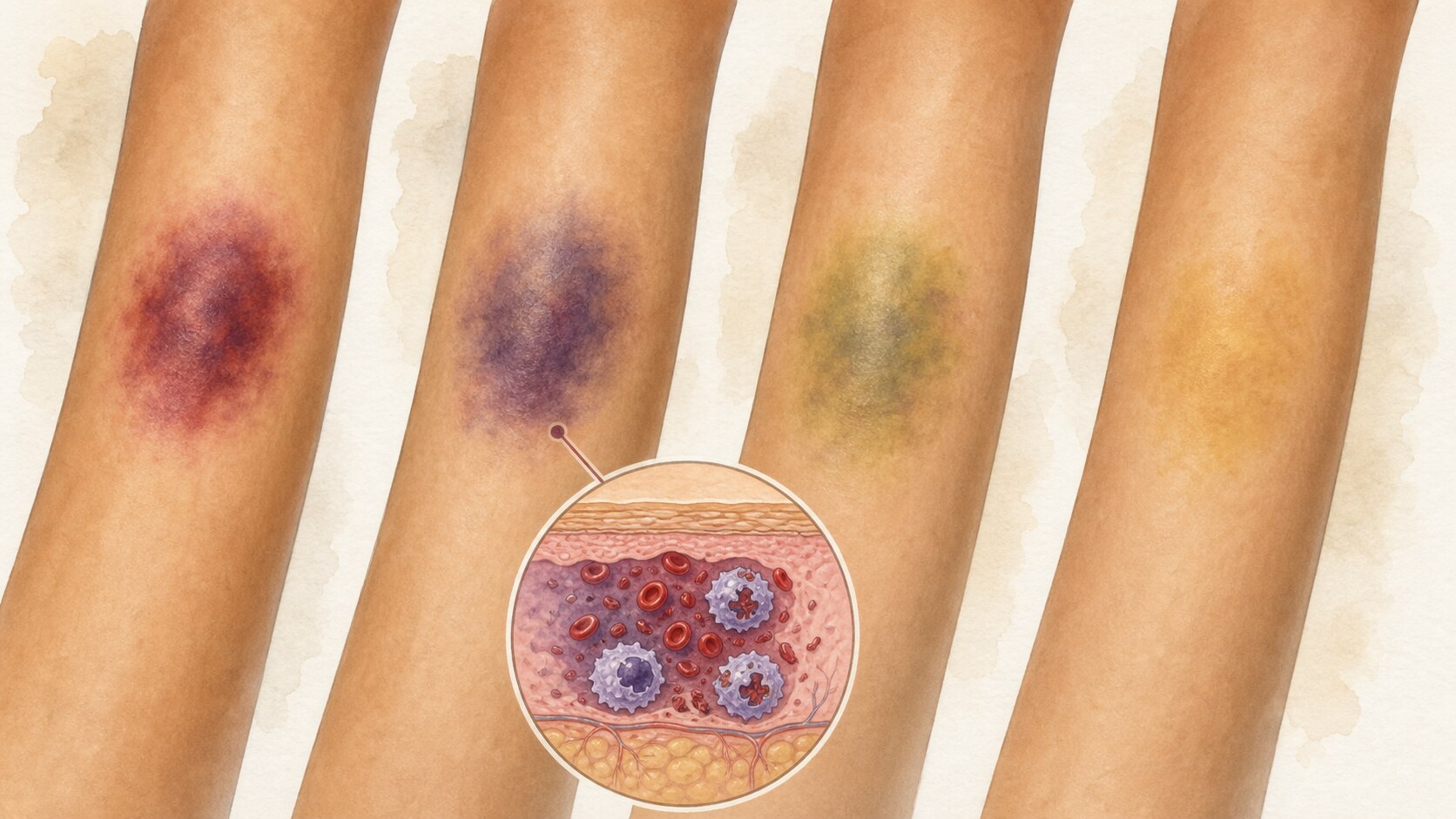
A bruise changes colour because blood that has leaked beneath the skin is dismantled and cleared in stages rather than disappearing all at once. An impact can rupture small blood vessels without breaking the skin. Blood collects in the surrounding tissue, and the red cells and pigments within it become visible through the layers above.
A fresh bruise may look red or pink because of newly escaped blood and oxygen-bearing haemoglobin. As oxygen conditions change and blood spreads or clots within the tissue, the area can appear blue, purple or dark brown. The apparent colour also depends on bruise depth, lighting and the person’s skin tone, so the same process does not look identical on everyone.
Immune cells move into the injured area and process the escaped red cells. Heme from haemoglobin is acted on by heme oxygenase, producing the green pigment biliverdin while iron is recovered for reuse. A green area in a healing bruise is therefore associated with one of the intermediate products created as the body breaks down blood outside its vessels.
Biliverdin is then converted by biliverdin reductase into bilirubin, a yellow pigment. This helps explain why yellow can appear at the edge of a bruise or across part of it later in healing. As these products are carried away through blood and lymph and the tissue repairs itself, the discoloration gradually fades toward the surrounding skin.
The changes do not follow a perfectly tidy red-to-purple-to-green-to-yellow sequence. Different depths and amounts of blood within one bruise can produce several colours at the same time, and subtle changes may be harder to see in darker skin. Colour is evidence that blood pigments are being processed, not a precise biochemical clock.
For that reason, clinicians cannot reliably date a bruise from colour alone. Studies comparing direct observation and photographs have found poor agreement between observers, while the same colours can occur in recent and older bruises. Even with information about location, size, pain and the reported event, timing should be assessed cautiously rather than assigned from a colour chart.
Most minor bruises fade without treatment, but unexplained repeated bruising, a very large or painful area, severe pressure, or signs of infection warrant medical attention. Medicines that affect clotting can also make bruising easier. Understanding the pigment changes can make an ordinary recovery less mysterious, but colour alone cannot rule out a more serious injury or an underlying problem.
EDITORIAL RESPONSIBILITY
FactosBrain Editorial Desk
The FactosBrain Editorial Desk researched and reviewed this article under our editorial policy. We assess error reports under our corrections policy.