Look a little closer
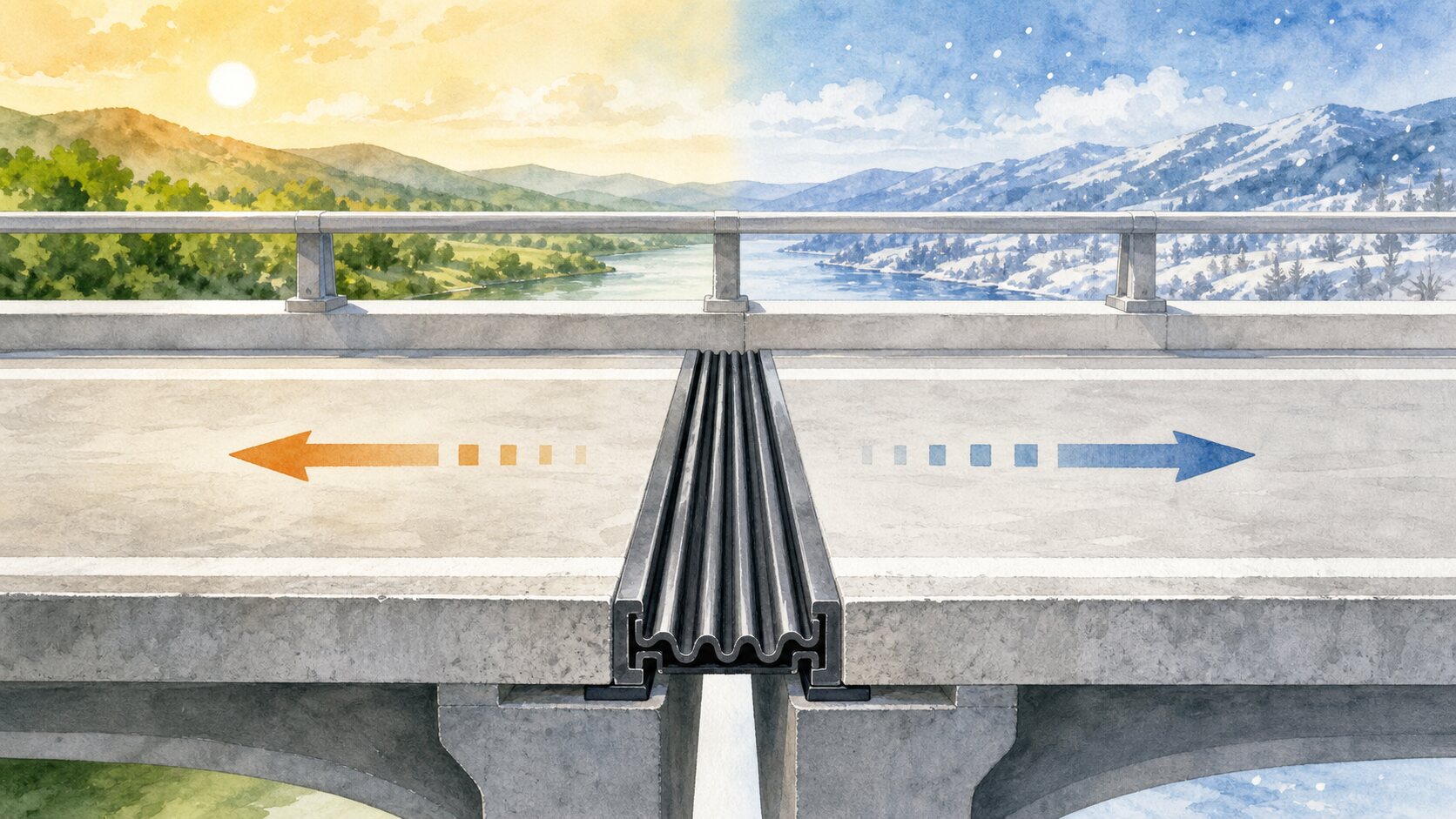
The rubber or metal gap visible in a bridge roadway is not an unfinished piece of construction. It is an expansion joint. A bridge becomes slightly longer and shorter as temperatures change from day to night and from season to season. Concrete and steel may look rigid, but they expand when warmed and contract when cooled. If a long structure has no safe place for that movement, forces can build up at particular locations and contribute to cracking, lifting or damage to bearings. An expansion joint does not make a bridge weak by cutting it apart. It gives a moving structure a controlled amount of room.
Temperature is the most obvious reason for movement, but it is not the only one. Bridge decks bend and rotate as vehicles pass. Concrete can also change slowly through drying shrinkage and creep, while foundations and adjacent spans can move by small amounts. Federal Highway Administration material notes that deck expansion joints accommodate thermal movement, and designers choose a system based on the bridge form and expected range of movement. The position and opening of a joint are therefore engineering decisions, not arbitrary gaps left by builders.
An expansion joint usually combines a space between deck sections with components that let traffic cross the space smoothly. For smaller movements, a flexible seal may be used. For larger movements, bridges can use interlocking metal plates or finger-like devices. Whatever the form, the goals are similar: allow the bridge sections to move as they push and pull against one another, and limit the passage of water and debris toward bearings, piers, reinforcing steel and other vulnerable components below the deck.
That is why joints are more than empty spaces and can be demanding maintenance components. If a joint tears, leaks or becomes clogged, rainwater, deicing salts, sand and debris can reach parts of the structure where they accelerate concrete deterioration or steel corrosion. The repeated impact and wear from vehicle wheels also take a toll. Research on bridge joints treats them as common maintenance weak points for these reasons. A bump felt by a driver does not automatically mean a bridge is unsafe, but the drainage, sealing and wear of joints deserve regular inspection.
Not every bridge has many visible gaps. Modern designs often try to reduce joints through continuous spans or integral-abutment bridges. In those designs, the deck, supports and foundations are designed more carefully to accommodate thermal forces and movement together. Removing a joint can reduce leaking and improve the ride, but it does not eliminate thermal expansion. It changes where the movement is managed: at a dedicated joint or through the flexibility and strength of the broader structure and its supports.
A bridge joint is a reminder that even apparently still concrete changes over time. Summer heat, winter cold, traffic loads and slow material deformation all alter a structure's length and internal forces by small amounts. The joint is a compact buffer that keeps those changes from accumulating invisibly as damage. It may look like a gap, but it is actually a carefully designed space that lets a bridge move safely through the seasons.
EDITORIAL RESPONSIBILITY
FactosBrain Editorial Desk
The FactosBrain Editorial Desk researched and reviewed this article under our editorial policy. We assess error reports under our corrections policy.