Look a little closer
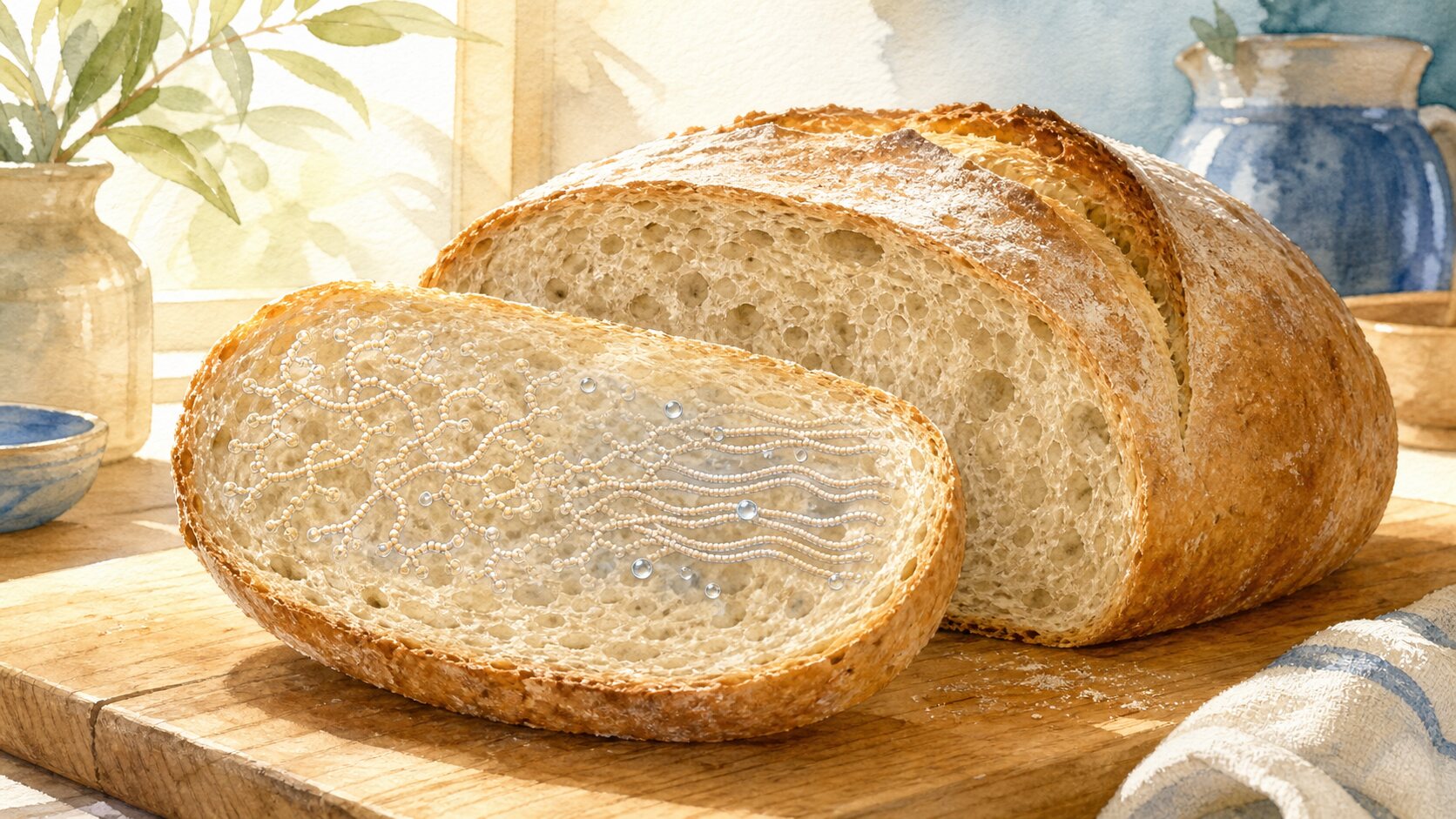
Bread can become firm while retaining plenty of water because starch molecules reassociate and moisture is redistributed between crumb and crust. This collection of changes is called staling, and it is not the same as simple drying. The crumb may lose resilience without becoming water-free, while a once-crisp crust can absorb moisture from inside the loaf and soften at the same time.
During baking, starch granules in flour encounter heat and water and lose much of their original crystalline order. They swell, take up water, and release some molecular material, helping create a soft gel-like matrix around the expanding gas cells. Gluten proteins set into a supporting network. Fresh crumb is flexible not only because it is moist but because heated starch chains have been disrupted from their tightly organized state.
Cooling starts a gradual return toward more ordered arrangements. Amylose, the less-branched starch fraction, reassociates relatively quickly and contributes to early setting. Branch-rich amylopectin changes more slowly over hours and days as portions of neighboring chains align into double helices and small crystalline regions. This process is called starch retrogradation. The slower reorganization of amylopectin is a major contributor to the progressive firming of stored bread crumb.
Reordering changes texture even when total moisture changes little. More associations between amylopectin branches make the starch network less mobile, so compressed crumb springs back less readily. Developing crystallites can incorporate water and shift how it is distributed between starch and the gluten matrix. Researchers track the change by compressing standardized crumb samples, measuring heat absorbed as storage-formed crystalline regions melt in differential scanning calorimetry, and observing increasing order with X-ray diffraction. Correlation among those measurements and firming supports retrogradation, but it does not eliminate contributions from moisture migration and gluten changes. Sample temperature and formulation must also be controlled. A moisture measurement for the whole slice can therefore remain fairly high while the water is less effective at plasticizing the structures that make fresh bread feel soft.
Water also moves through the loaf. Immediately after baking, the crumb contains more moisture than the crust, creating a drive toward the outer layers and eventually the surrounding air. As the dry crust gains water, it moves away from a brittle, glassy state and loses its crisp fracture. The crumb simultaneously surrenders some moisture and undergoes retrogradation. A stale loaf can consequently develop the seemingly contradictory combination of a firm interior and a leathery crust.
Refrigeration reveals why staling is not merely evaporation. Cold storage can slow mold growth, yet in the cool range above freezing it often accelerates amylopectin retrogradation in wheat bread compared with ordinary room temperature. The crumb may firm sooner even when wrapped. Deep freezing greatly reduces molecular mobility and slows those changes. Formulation, packaging, refrigerator humidity, and storage duration still matter, so drying and aroma loss can accompany the temperature effect.
Reheating temporarily softens stale crumb because heat disrupts some amylopectin crystallites and increases water mobility. An oven or toaster can also drive moisture from the surface and restore crispness to the crust. The improvement is neither permanent nor a complete reversal. Water and volatile aromas already lost to the air do not reappear, and repeated heating introduces additional changes. Rewarmed bread can resemble fresh bread for a while without becoming identical to its post-baking state.
Recipes age at different rates. Fats and emulsifiers can change interactions among starch chains and water; baking enzymes can alter the starch structures available to firm during storage. Sugar, acidity, protein networks, baking conditions, and package permeability add further effects. Gluten-free bread relies on different proportions of starch and structure-building ingredients, so a result from one wheat loaf cannot be generalized without qualification. A baguette, sandwich loaf, and enriched brioche are distinct materials.
Staling must also be separated from microbial spoilage. Staling is mainly a physicochemical decline in texture and flavor involving starch, protein, and water, whereas mold is growth by living organisms. A storage choice can slow one problem while worsening another quality. Bread that firms despite remaining moist makes the broader point visible: freshness depends not only on how much water a food contains, but on where that water resides and how its large molecules are arranged.
EDITORIAL RESPONSIBILITY
FactosBrain Editorial Desk
The FactosBrain Editorial Desk researched and reviewed this article under our editorial policy. We assess error reports under our corrections policy.