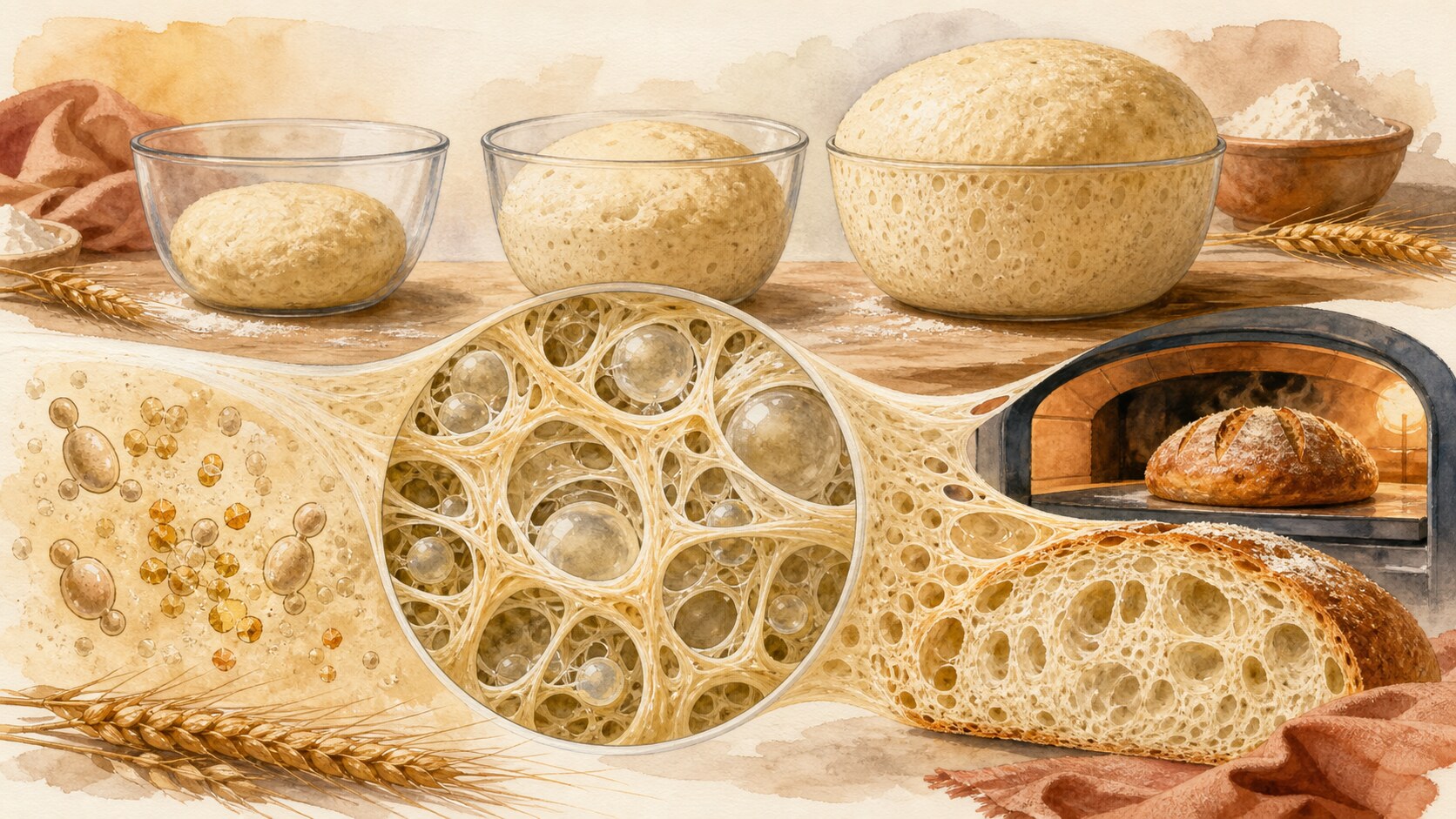
Bread dough rises because carbon dioxide made by yeast enlarges bubbles inside it. Gas production alone is not enough, however. A stretchable structure formed when flour meets water must retain that gas for the dough as a whole to gain volume.
Enzymes in flour gradually make some of its starch available as sugars that yeast can use. The yeast metabolizes those sugars, producing carbon dioxide and ethanol; other fermentation products also influence bread's aroma and flavor. Yeast cells are not tiny balloons that swell and physically push the dough upward.
When wheat flour is hydrated and mixed, proteins composed mainly of gliadin and glutenin connect into a gluten network. Kneading, folding and resting help this viscoelastic network stretch without breaking too readily. Small air pockets incorporated during mixing become starting sites into which carbon dioxide can move.
As fermentation continues, carbon dioxide enters gas cells and their walls extend, so the dough expands. A successful rise therefore depends on both the rate of gas production and the dough's ability to retain it. A weak network leaks gas or allows bubbles to merge and collapse; an excessively rigid one cannot expand enough.
Time, temperature, hydration, salt and sugar concentration all alter the process. Cool dough ferments slowly, while excessive heat can injure yeast. Salt contributes flavor and affects dough structure, but high levels can slow fermentation. A very sugary dough can also ferment more slowly because dissolved sugar reduces the water readily available to yeast.
During the first part of baking, dissolved carbon dioxide, gas already in the bubbles and water vapor expand as they warm. Yeast may briefly produce more gas before heat inactivates it, contributing to the rapid increase called oven spring. That expansion does not continue throughout the entire bake.
As temperature rises further, proteins set and starch granules absorb water and gelatinize, fixing the expanded crumb structure. Overproofed dough or a weak matrix can fail before that structure sets. Gluten-free dough can still be leavened by yeast, but starches, proteins and hydrocolloids must provide another framework capable of holding its bubbles.
EDITORIAL RESPONSIBILITY
FactosBrain Editorial Desk
The FactosBrain Editorial Desk researched and reviewed this article under our editorial policy. We assess error reports under our corrections policy.