Look a little closer
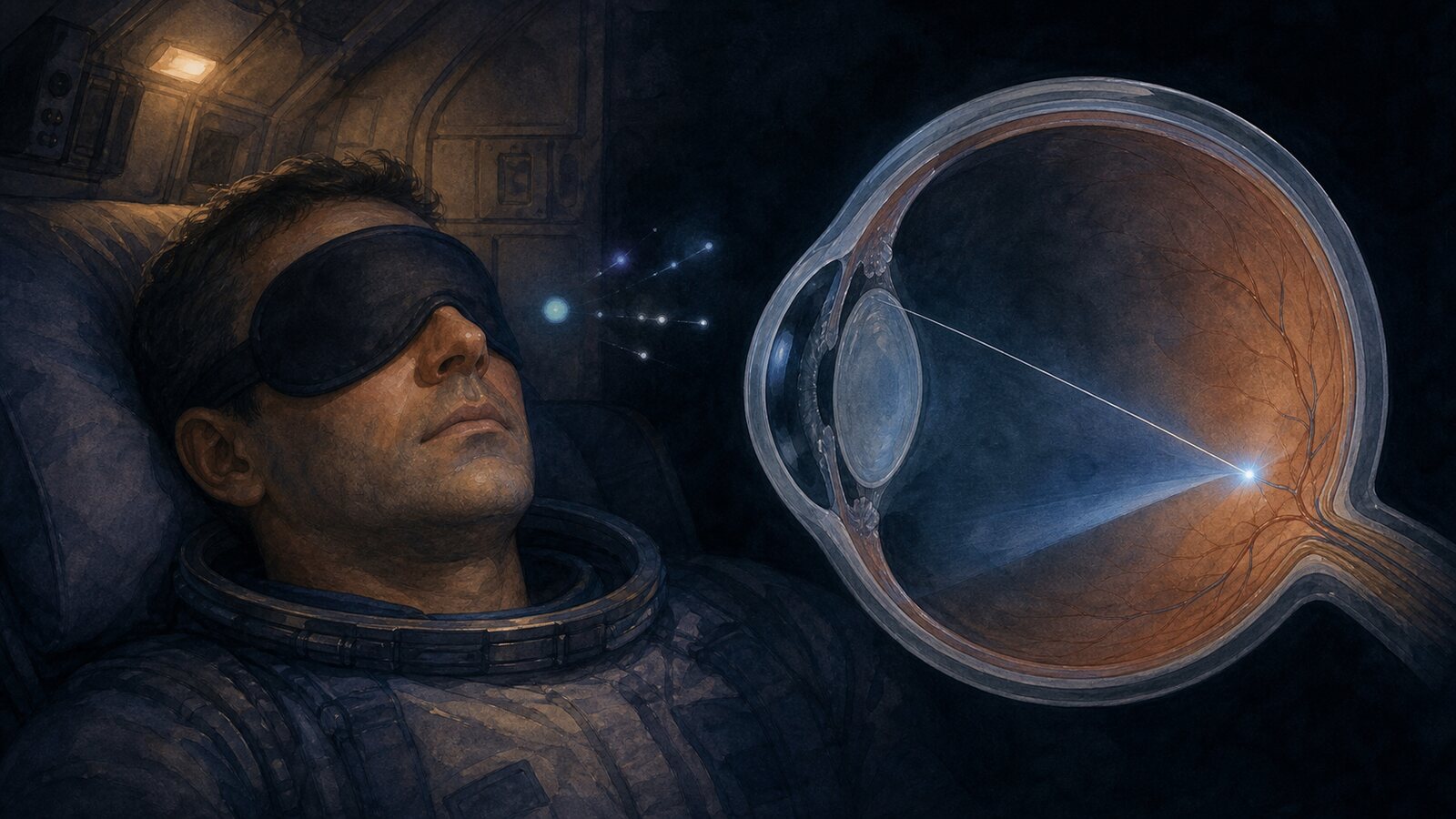
Astronauts can see brief dots, streaks, or clouds with their eyes closed because energetic particles in space radiation interact with the eye and visual system. The particles may directly stimulate retinal tissue or generate faint Cherenkov light inside the eye, while other parts of the visual pathway may sometimes contribute. The observer is not seeing a cosmic ray as an ordinary illuminated object; the brain is interpreting a particle-induced signal as light.
A perception of light without external photons is called a phosphene. Pressing or rubbing an eye can produce one because mechanical or electrical disturbance of the retina is still delivered through pathways the brain normally uses for vision. Spaceflight flashes belong to that broad family, but their trigger is radiation: fast protons, heavier atomic nuclei, and secondary particles produced when primary radiation strikes spacecraft material.
On the ground, Earth's atmosphere and magnetic field deflect or absorb much of the relevant particle radiation. The International Space Station in low Earth orbit retains some magnetospheric protection, but its environment is more particle-rich than the surface. A lunar voyage travels beyond much of that shield and encounters galactic cosmic rays more directly. Spacecraft walls reduce exposure, yet sufficiently energetic particles can penetrate them or collide with the structure and generate secondary particles.
Beginning with Apollo 11, crews reported flashes while resting in dark cabins or closing their eyes. Descriptions included single stars, commas, long streaks, paired points, and diffuse clouds. A particle's path across or near the retina, the location where it deposits energy, and whether its trajectory involves one or both eyes could help produce different shapes. Reported rates also varied substantially among astronauts, missions, orbital locations, and observation conditions.
One plausible pathway is direct biological stimulation. A charged particle ionizes molecules as it passes and deposits energy near photoreceptors or the retinal neural network. If that disturbance initiates signals carried by the optic nerve, the brain can interpret them as a flash even though no normal image entered through the pupil. A grazing trajectory along the retina has been proposed as one way to produce a streak rather than a point.
Cherenkov radiation offers another pathway. If a charged particle moves through the eye's transparent medium faster than light propagates through that medium, it can create a very faint cone of visible light. Laboratory work showed that this mechanism can account for some diffuse, often bluish sensations. It cannot comfortably explain every report: flashes can occur below relevant thresholds, and several observed forms point toward direct retinal or neural effects. Current accounts therefore allow multiple mechanisms rather than one universal process.
Apollo 16 and 17 tested the link with the Apollo Light Flash Moving Emulsion Detector. An astronaut wore a masklike detector that recorded particle tracks while reporting the timing and appearance of flashes, allowing physical trajectories to be compared with subjective events. Skylab observations showed strong relationships between flash frequency and particle flux, particularly through the South Atlantic Anomaly. Later SilEye and ALTEA experiments aboard Mir and the ISS used silicon detectors, button reports, and electrophysiological measurements to reconstruct particles passing through the head and eyes.
Closed eyes help reveal the event because the eyelid itself is glowing. In darkness, adaptation makes the visual system more sensitive to weak internal signals, and an external scene is not competing with the brief perception. Not every particle generates a report, nor does every astronaut experience the same rate. Charge, energy, trajectory, shielding, orbital location, dark adaptation, attention, and individual sensory thresholds all affect what is noticed.
A single flash should not be treated as proof that one retinal cell has died or as a personal radiation dosimeter. The flash is a transient perception and has not been tied one-for-one to visual injury. It is nevertheless vivid evidence that energetic particles can traverse living tissue. Cancer, central-nervous-system effects, and ocular risks on long missions must be assessed from the full particle spectrum and accumulated exposure with dedicated instruments, not by counting phosphenes alone.
The closed-eye flash is consequently closer to the visual system acting as an improvised particle detector than to an astronaut hallucinating a nonexistent star. Reports from Apollo led to track-recording masks and later orbital detector systems. The broad cause—space radiation interacting with vision—is well supported, while the share contributed in each event by direct retinal excitation, Cherenkov light, chemical responses, or other neural pathways remains unresolved. That boundary makes the flashes valuable both for sensory science and for understanding the biological reach of space radiation.
EDITORIAL RESPONSIBILITY
FactosBrain Editorial Desk
The FactosBrain Editorial Desk researched and reviewed this article under our editorial policy. We assess error reports under our corrections policy.