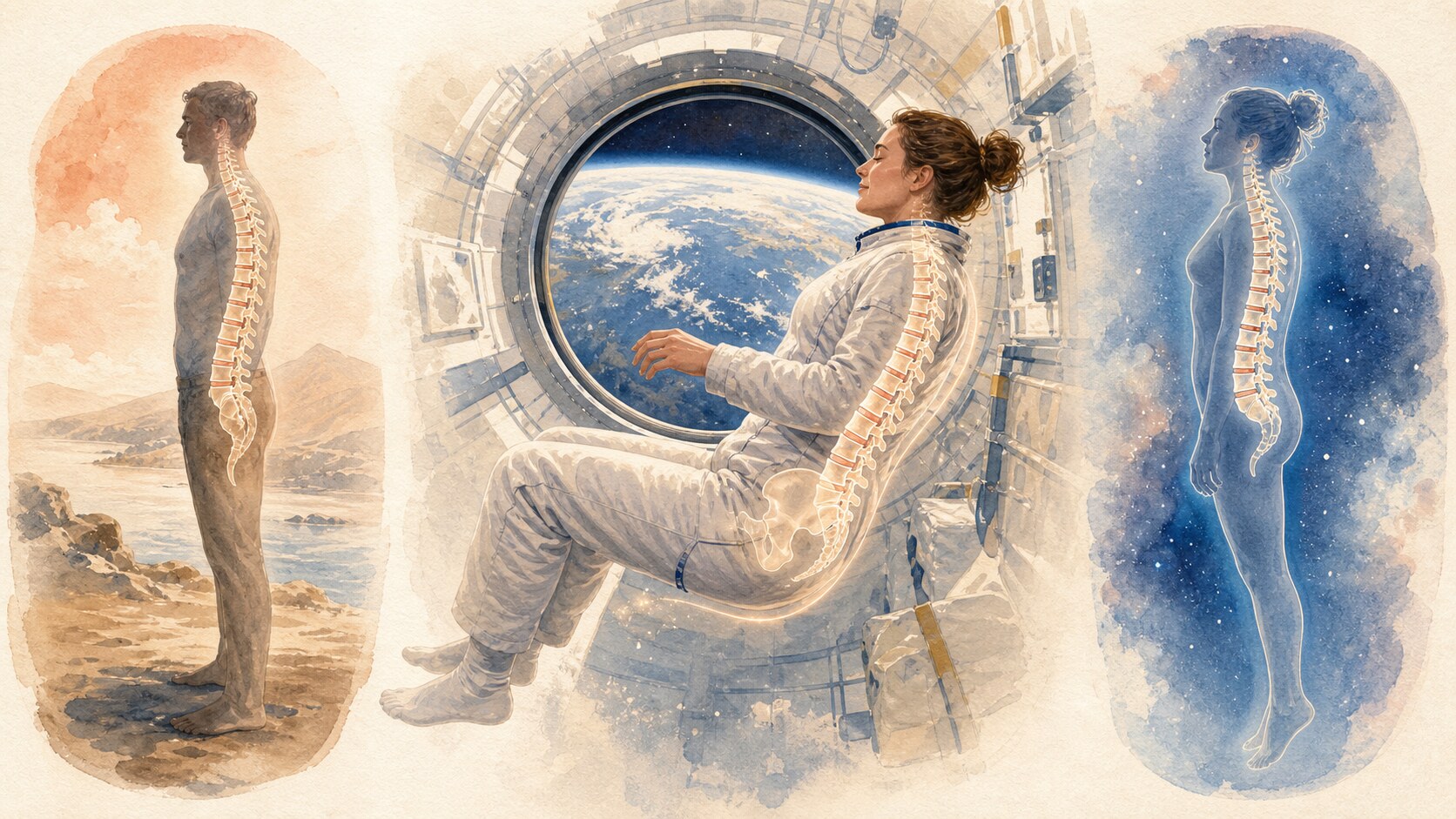
Astronauts become taller in orbit without growing longer bones. Microgravity removes much of the head-to-pelvis load on the spine, allowing it to lengthen. The natural curves of the neck and lower back change as well, along with the muscles that normally support those curves.
On Earth, the spine carries body weight while standing and walking. Discs, joints, ligaments and surrounding muscles share that load and maintain spinal curvature. Being slightly taller after lying down overnight is an everyday example of what reduced axial compression can do, although the orbital change is larger.
Aboard a space station, the feet do not continuously bear against a floor, so axial loading drops sharply. NASA says the spine can straighten and elongate enough for stature to increase by as much as about three percent on a long mission. That maximum is roughly five centimeters for a 180-centimeter person, but changes vary widely.
Disc swelling was often presented as the main explanation. Research on astronauts after long-duration missions, however, did not find a consistent increase in intervertebral disc height. Reduced lumbar curvature was more closely associated with changes in supporting muscle. Disc behavior remains relevant to spine health, but expansion should not be described as a single mechanism confirmed in every astronaut.
The extra height is neither permanent growth nor evidence of better health. After return, the spine and posture readapt under gravity and stature generally moves back toward its preflight value. Meanwhile, microgravity weakens bone and muscle and is associated with back discomfort and postflight disc concerns, which researchers address through exercise and medical imaging.
Body length also matters for equipment. Spacesuits, seats and sleeping areas must accommodate changes in seated height and posture rather than relying only on a standing measurement made on Earth. Fluid shifting toward the head and loss of limb muscle occur at the same time, but they are distinct adaptations from spinal elongation.
Reloading and discomfort after landing are not identical for everyone. Mission duration, previous spine condition and exercise can influence the response, so a simple “gain five centimeters and lose it again” story cannot describe individual health consequences. The firm conclusion is unloading-related spinal elongation and altered curvature; the contribution of each tissue remains an active research question.
EDITORIAL RESPONSIBILITY
FactosBrain Editorial Desk
The FactosBrain Editorial Desk researched and reviewed this article under our editorial policy. We assess error reports under our corrections policy.