Look a little closer
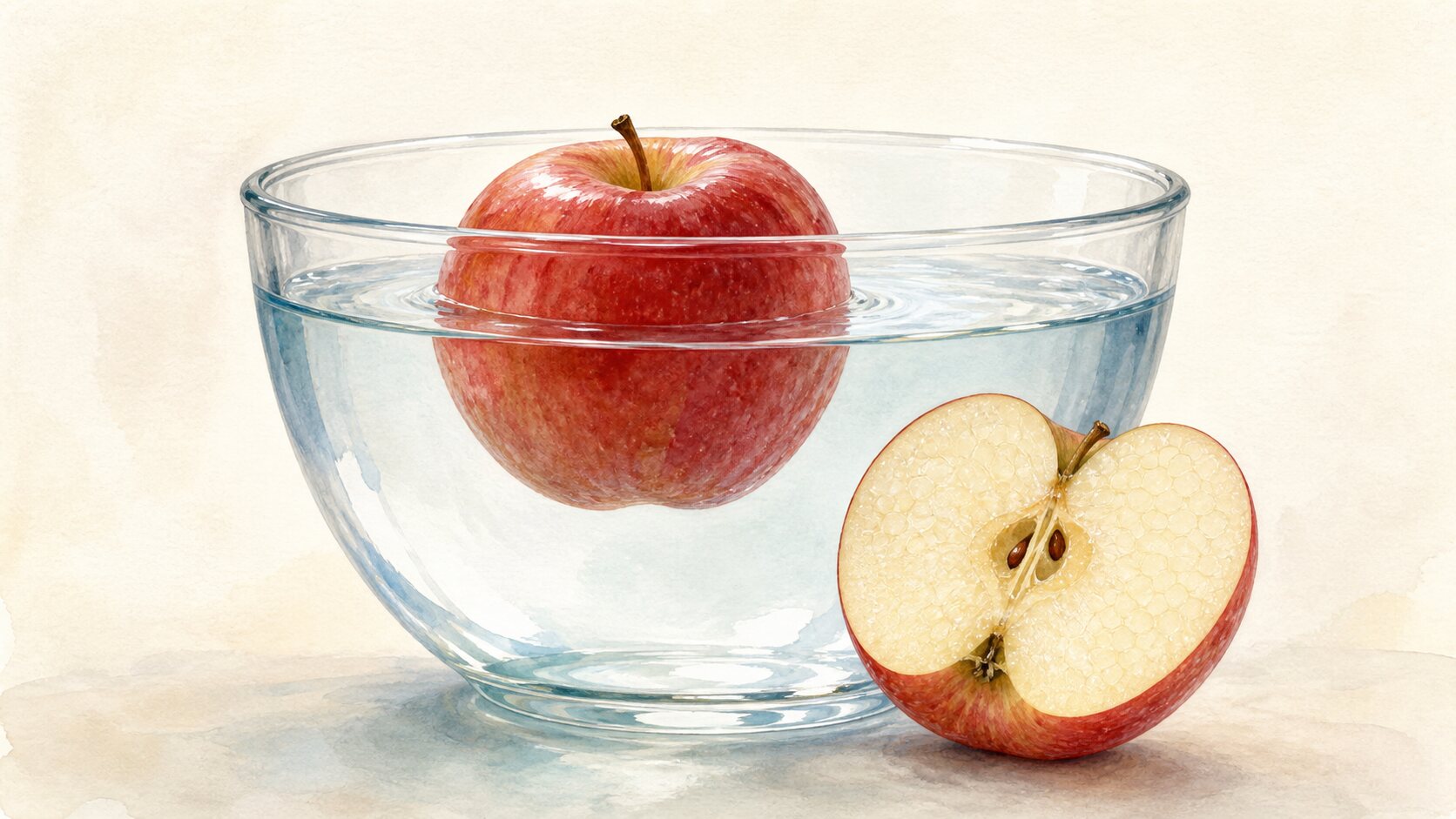
An apple can look firm and surprisingly heavy in your hand, yet it usually bobs at the surface when dropped into water. The immediate reason is simple: the apple's average density is lower than the density of water. A submerged object pushes water aside, and the displaced water pushes back upward. That upward buoyant force grows as more of the object is submerged. An apple settles when the weight of the water it has displaced is equal to the apple's own weight, usually with part of the fruit remaining above the surface.
The useful surprise is that an apple is not a solid block of wet plant material. Its flesh is built from cells, but those cells do not pack together without gaps. Between them lies a network of tiny spaces and passages containing gases and water vapor. A cut apple does not look like a sponge with obvious holes, because the spaces are microscopic and distributed through the tissue. At the scale of the whole fruit, however, their combined volume is large enough to matter.
Plant scientists call this network intercellular air space, or porosity. Its amount varies with cultivar, place within the fruit, fruit size, and growing conditions. Measurements and X-ray studies of apples show that the air-filled spaces can make up roughly a fifth to a third of an apple's volume in normal fruit. Air has far less mass than the same volume of water. Mixing that air volume with water-rich cells, sugars, and cell walls lowers the average mass per unit volume of the whole apple enough for many apples to float.
That is different from saying that the peel alone makes an apple float. The peel helps protect the fruit and slows exchange with its surroundings, but floating is governed mainly by total mass divided by total volume. A peeled piece of apple can still float if it retains enough of its internal air spaces. Conversely, when apple is chopped, crushed, or cooked into sauce, much of the air can be driven out. In home canning, that released air is one reason apple products may behave differently in a jar than intact fruit does in a tub of water.
The amount of apple visible above the water is also a density lesson. The fruit sinks only until the submerged portion displaces water equal in weight to the fruit. It is not gripping the water or being held up by surface tension; it is simply occupying space that water would otherwise fill. A lighter apple needs to displace less water and rides higher. An apple whose average density is closer to that of water sits deeper. The liquid matters too: dissolved salt or sugar makes water denser, so the same apple can float a little higher in a denser solution. Temperature can make small changes to water density as well. That familiar observation does not, however, predict one exact floating height for every apple, because individual fruits differ in mass and internal structure.
It would be a mistake to turn the observation into a rule that every fruit floats if it contains air. Different fruits have different cell structures, proportions of water and sugar, and amounts of intercellular space. Even apples are not identical. Their internal air spaces also do biological work: they help gases move between the outside and living cells that are still respiring after harvest. In a condition called watercore, for example, liquid can fill spaces that are normally air-filled, changing the appearance and gas movement within the flesh.
So an apple is not floating because it is hollow in the everyday sense, nor because it has a miniature boat hidden in its peel. It floats because a living fruit has a light, porous internal architecture, and water responds to its overall density with buoyancy. The Halloween game of bobbing for apples is therefore a compact demonstration of both plant anatomy and Archimedes' principle: invisible air spaces change the balance between an apple's weight and the water it must displace.
EDITORIAL RESPONSIBILITY
FactosBrain Editorial Desk
The FactosBrain Editorial Desk researched and reviewed this article under our editorial policy. We assess error reports under our corrections policy.