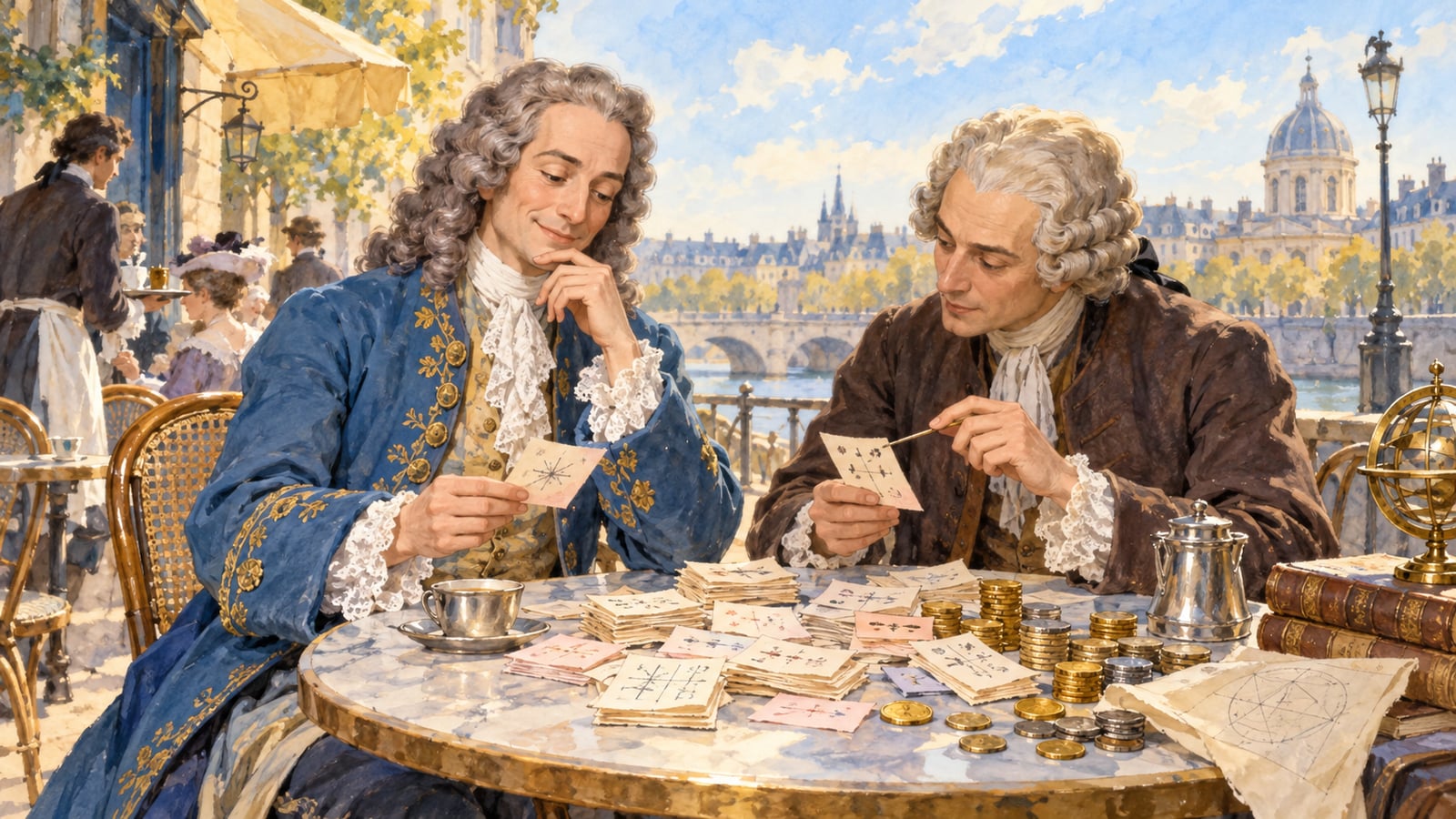
Ask someone who made a fortune in a lottery how they did it, and the answer usually involves a lucky ticket. For Voltaire, the more useful question is how many tickets his group could acquire. In 1729, the French writer joined a mathematician and other associates in a scheme to make the lottery pay them repeatedly.
This was not a modern lottery open to anyone buying a numbered slip. Participation was tied to bonds issued by the municipality of Paris. A bond represented money that its holder was entitled to recover. The authorities proposed using a lottery to redeem these debts. Bondholders could purchase tickets at prices related to the value of the holdings they wanted repaid, and successful tickets would bring cash.
The government also added money to make the arrangement attractive. Voltaire and the mathematician Charles-Marie de La Condamine saw an opportunity in the relationship between what tickets cost and what the scheme would distribute. Acquiring enough of them could make financial sense. A purchase too large for one person could become possible through a group pooling its resources.
In his later account, Voltaire explained the idea in a few sentences: the scheme had been arranged so that a group buying all the tickets could profit, and he had joined a substantial association. Surviving draw records show familiar names winning again and again. What was supposed to create a succession of fortunate participants was directing money toward an organized group.
The distinction matters. They did not need to tamper with a draw or predict the next winning number. If enough of the tickets belonged to their side, the precise identity of a winner became less important. The remaining evidence does not reveal every detail of the operation, however. A neat modern formula should not be mistaken for a complete record of how the group obtained tickets and managed its money.
The authorities eventually objected. An attempt to treat the syndicate's conduct as illegal failed, because it had operated within the rules. Those rules were changed, and the lottery was brought to an end. The embarrassing problem lay in the arrangement that had been offered to participants.
Winning did not cause Voltaire to retire from financial activity. He pursued other investments too. After his return from England, he wrote history, tried to recover pensions, and looked for financial opportunities. Earning money and producing books occupied him at the same time.
Calling Voltaire a lucky lottery winner misses the unusual part. While an ordinary participant wanted to choose the right ticket, he was interested in whether the people selling the tickets had done their sums correctly.
EDITORIAL RESPONSIBILITY
FactosBrain Editorial Desk
The FactosBrain Editorial Desk researched and reviewed this article under our editorial policy. We assess error reports under our corrections policy.