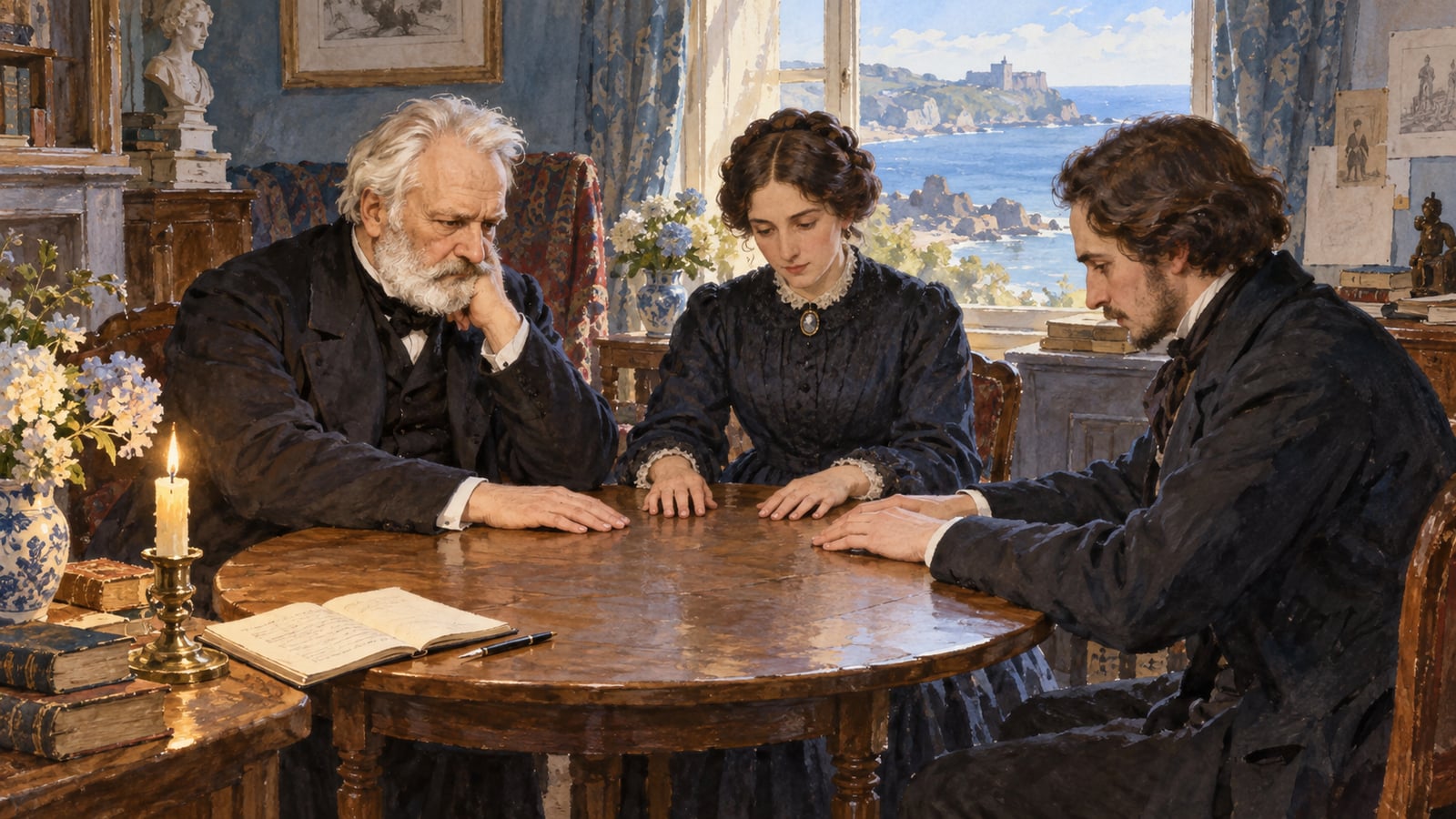
Someone asked a question. A table knocked, the sounds were interpreted as letters, and a participant recorded the reply. In 1853, at Victor Hugo's home in exile on Jersey, family and friends came to regard such exchanges as conversations with the dead.
Delphine de Girardin introduced the practice during a visit. Early attempts were unsuccessful. Auguste Vacquerie later recalled that when one table remained unresponsive, Girardin obtained another. The furniture itself could be blamed when communication failed.
The gathering of September 11 acquired a particular significance. According to the accounts, participants understood some of the responses as referring to a dead daughter. They thought of Léopoldine, whom Hugo had lost ten years earlier. He asked whether she was happy and where she was. Whatever the source of the supposed replies, the questions were those of a bereaved father.
The record of that first successful evening was compiled afterward, rather than written down as the exchange occurred. Subsequent sessions, however, generated extensive notes. For roughly two years, the household returned to the practice, recording dates, questions, and answers. Hugo's son Charles served as a medium. This was a collective activity involving relatives and friends, not simply the novelist sitting alone with a piece of furniture.
The identities attributed to the speakers became increasingly grand. Shakespeare and Dante appeared in the records, as did abstractions such as Death and Drama. Participants questioned the voices represented by those names. For writers who believed that dead literary figures might be producing new sentences, it offered an extraordinary kind of gathering.
Hugo was not without questions about what was happening. In remarks reported by Vacquerie, he considered whether the intelligence attributed to the table existed independently of the people present, or arose from their own minds intensified by emotion. He also admired the language being produced. His interest occupied a space between beliefs about another world and the experience of literary creation.
Publication itself became a subject for consultation. In an 1855 letter to Girardin, Hugo said that the tables demanded silence and secrecy. Accumulating pages did not mean immediately releasing them as a book. The surviving records eventually became material for studying his beliefs and creative life.
They do not establish that dead authors returned to speak. They show whom the participants believed they were hearing, and what they wanted to ask. Among the illustrious names and sweeping pronouncements, one of the most understandable questions remains a small one: a father wanted to know whether his daughter was happy.
EDITORIAL RESPONSIBILITY
FactosBrain Editorial Desk
The FactosBrain Editorial Desk researched and reviewed this article under our editorial policy. We assess error reports under our corrections policy.