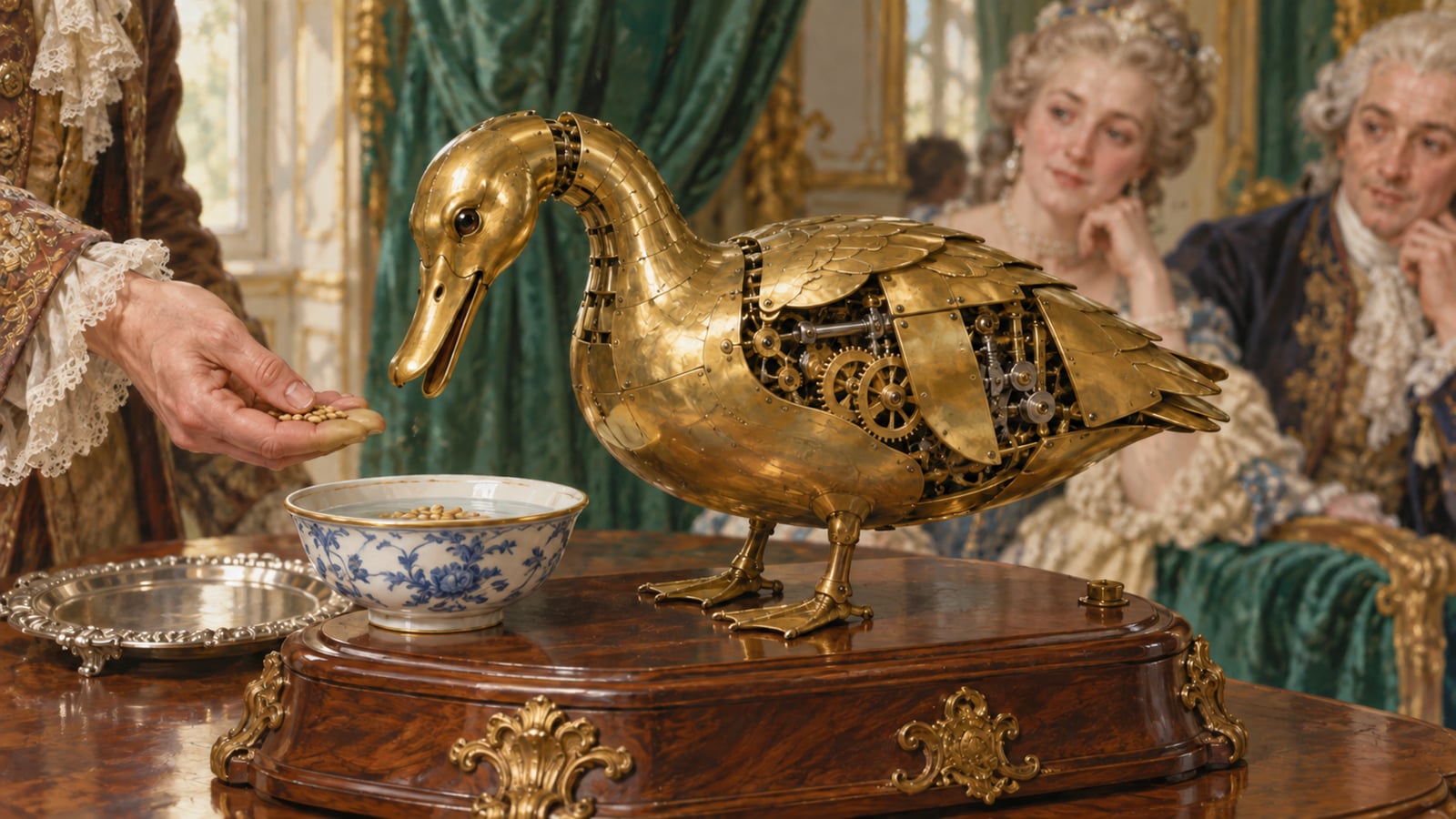
After the duck swallowed its food, something emerged at the other end. It was caught on a silver salver and passed around for inspection. That is how the magician Robert-Houdin later described a demonstration of a celebrated mechanical duck. An ordinary bird's droppings would hardly merit such treatment. These were presented as evidence that a machine had digested its meal.
The duck was the work of Jacques de Vaucanson, an eighteenth-century French inventor whose attractions also included mechanical musicians. His flute player did more than hold an instrument while music came from somewhere inside. Air, artificial lips and moving fingers actually produced notes on the flute. The same maker proposed to demonstrate an animal's eating and excretion through machinery.
Simply putting grain in one end and delivering something from the other would have made a less compelling show. The duck stretched its neck to take food and moved its throat as if swallowing. It dabbled in water, moved its wings and raised its body. The actions advertised for it were the small habits by which people recognized a living duck. Their coordination mattered as much as any individual motion.
Considerable attention went into the wings. Period descriptions discussed the imitation of bones and their joints, and emphasized that the mechanism could be inspected. Viewers were invited to consider how the motions were produced, not merely admire a finished bird. Exposing gears and linkages could make the achievement more interesting rather than spoil it.
The boldest part concerned what supposedly happened to the food. It would break down inside and pass through tubes before emerging in a changed form. Vaucanson did not claim to reproduce every function of living digestion. The machine was not making blood and nourishment to sustain an animal. His stated aim was narrower: swallow food, alter it, and expel the altered material. Even that was an ambitious performance for a mechanical body.
Roughly a century later, someone who had admired the account gained access to the machinery. Robert-Houdin was an automaton maker as well as a conjurer. In his memoir, he recalled seeing the machine exhibited as Vaucanson's duck in Paris in 1844. After a wing was damaged, it came to him for repair. The admired invention had become something he could examine on a workbench.
His explanation of the supposed digestion was straightforward. Water and seed entered a pipe beneath the bill and fell into a separate box, which was emptied every few days. What came out at the rear was different material altogether. Breadcrumbs, colored green in advance, were expelled by a pump. No transformation connected the meal the spectators had seen going in with the substance they saw coming out.
In that account, the silver salver held a prepared prop rather than the product of an artificial stomach. Watching the feeding first and inspecting the apparent result afterward encouraged the audience to supply the missing connection. The convincing movements of the bill and throat helped establish a process whose crucial middle stage had never occurred.
Robert-Houdin was recalling a much later repair, not reporting an inspection at the moment of the duck's original construction. His reaction nevertheless makes an apt final act. He admired Vaucanson's mechanical skill and now credited him with a trick a conjurer could appreciate. Opening the bird to fix its wing had revealed no more elaborate stomach. The meal was collected in one place, while the result prepared for the audience came from another.
EDITORIAL RESPONSIBILITY
FactosBrain Editorial Desk
The FactosBrain Editorial Desk researched and reviewed this article under our editorial policy. We assess error reports under our corrections policy.