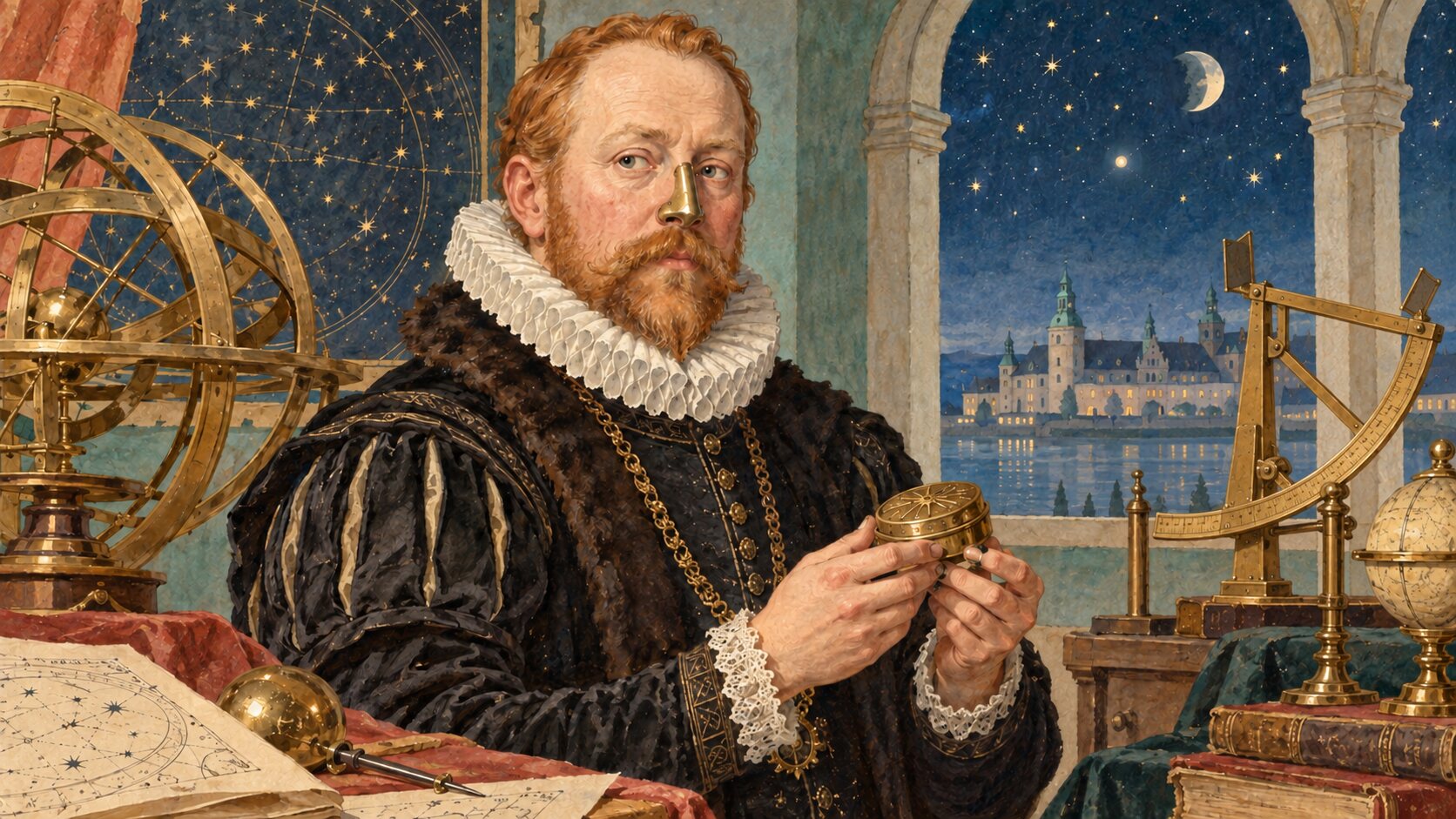
Tycho Brahe carried a small box in his pocket containing a sticky, ointment-like substance. He frequently applied it to his nose. Part of that nose was artificial: a metal replacement for the piece he had lost in a student sword fight.
The injury was in the middle of his face, where a sleeve could not conceal it. Brahe covered the damage with a prosthesis. The pocket-box detail, passed down by someone who had lived alongside him, makes the object less remote than a curious feature in an old portrait. It needed to be worn and attended to.
The fight took place in Rostock in 1566. Brahe was a Danish nobleman who had just turned twenty that December, studying abroad at a succession of European universities. His royal observatories still lay in the future. In Rostock, he was a young student whose quarrel with another Danish nobleman ended in a facial injury.
The old biographical account describes a dispute that developed over several encounters. In his 1890 life of Brahe, J. L. E. Dreyer followed the earlier biographer Pierre Gassendi: on December 10, Brahe and Manderup Parsberg attended a betrothal celebration at a professor's house and quarreled. The argument broke out again at a Christmas gathering on December 27.
Two days later, at seven in the evening, they fought with swords in darkness. The account does not establish whether they had arranged to meet or encountered each other by chance. It leaves the exchange of blows undescribed. What it does report is the result: Brahe lost part of his nose.
The precise words that carried the argument from a celebration to a sword fight are not supplied by this record. The aftermath is more tangible. Brahe obtained an artificial replacement, and his portraits show an unusual join around the nose. Those pictures cannot reliably tell us exactly how much tissue he lost.
Tradition described the replacement as a mixture of gold and silver. Gassendi also recorded the little box, attributing the detail to Willem Janszoon Blaeu, who had spent two years with Brahe. The exact recipe of its contents is not given. What survives is the description of Brahe repeatedly applying the substance to his nose.
Long before this, Brahe had been fitting astronomy around the legal education his family intended for him. In Leipzig he observed while his tutor slept and spent available money on astronomical books and instruments. The injury did not end that work. When he returned to Rostock, he resumed recording the positions of stars and planets.
Centuries later, the nose became the subject of a different measurement. When Brahe's grave in Prague was opened in 1901, no prosthesis was found. Greenish marks remained around the nasal area. During another examination in 2010, researchers took a small bone sample there and found traces of copper and zinc. They interpreted these as evidence of brass, rather than the precious metals of the familiar story.
The finding did not recover the missing object or inventory every replacement Brahe might have owned. It identified traces the artificial nose had left behind. For the metal nose that began with a student's sword fight, traces on the face supplied an answer that the old biography could not.
EDITORIAL RESPONSIBILITY
FactosBrain Editorial Desk
The FactosBrain Editorial Desk researched and reviewed this article under our editorial policy. We assess error reports under our corrections policy.