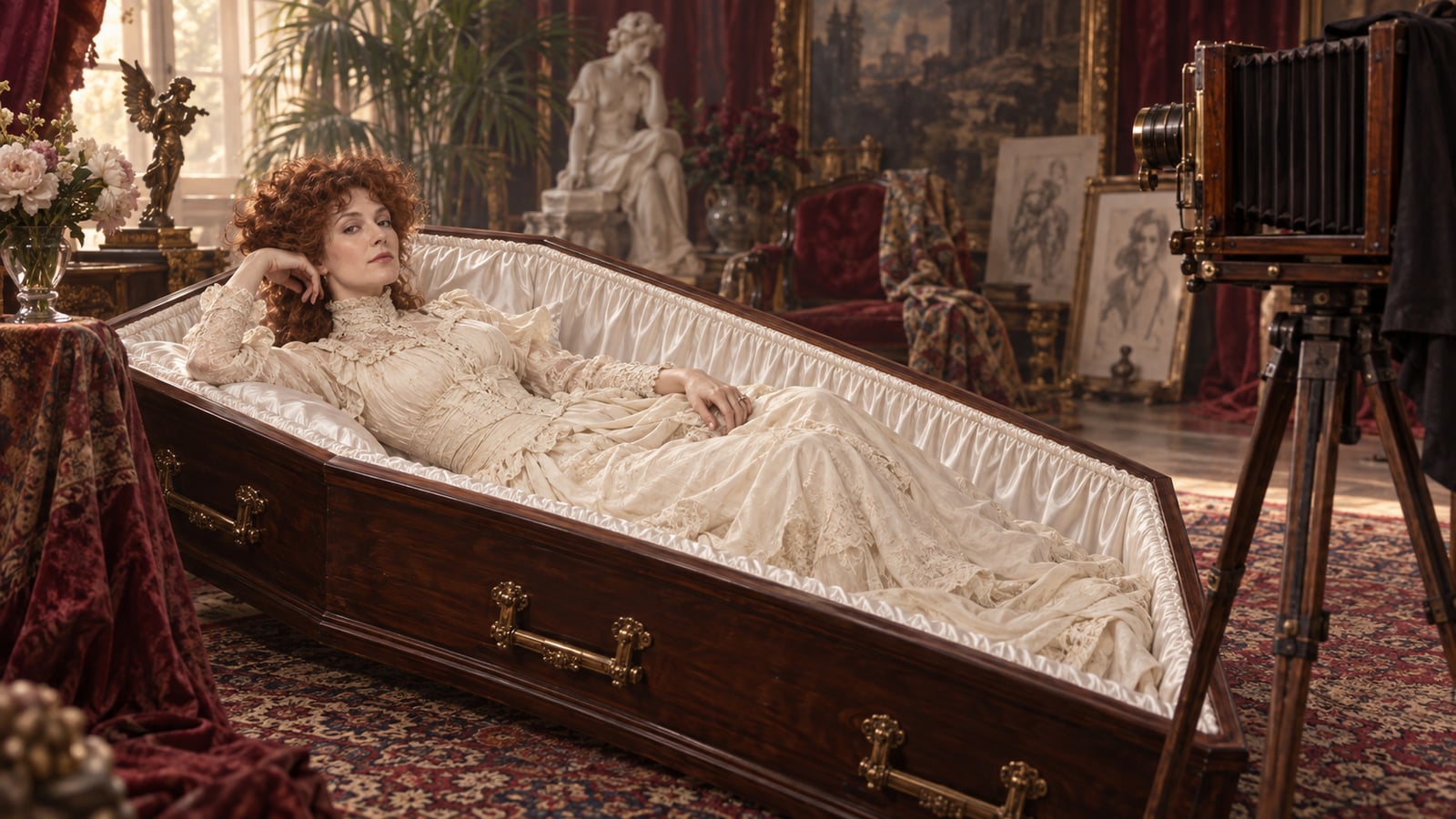
Sarah Bernhardt kept a coffin in her bedroom. It stood by the window, lined with white satin, and the French actress sometimes settled inside it to learn her parts. A photograph of her lying in a coffin survives too. This was a remarkably effective way for a living performer to become the subject of conversation without stepping onto a stage.
But did she actually sleep in it? In her memoir, Bernhardt said she did. Her explanation, however, begins with a sick sister and a cramped room, rather than a nightly ritual of rehearsing death. The coffin was already part of the furniture when her younger sister Régina came to stay.
Bernhardt described the apartment in the rue de Rome as very small. She had moved there after a fire destroyed her furniture, books, pictures and other possessions. A large bamboo bed occupied most of her tiny bedroom. When she brought Régina home, she gave her that bed. She wanted to remain beside her sister at night, but there was no room to install another one.
There was, of course, the coffin. According to Bernhardt, sleeping in its satin interior seemed an entirely reasonable arrangement to both sisters. Régina was already accustomed to seeing it. Within the household, the problem of where everyone should sleep had apparently been settled. Someone arriving from outside was less prepared to take it in stride.
In the memoir, a manicurist came into the room one morning and was asked by Régina to be quiet because Sarah was still asleep. The visitor looked towards the armchair, expecting to find her there. Instead, she discovered the actress in the coffin and fled screaming. Bernhardt identified this encounter as the moment the story escaped into Parisian gossip.
The celebrated photograph by Achille Mélandri gave the public something more substantial than a rumor. The Petit Palais dates it to about 1880 and explains that Bernhardt used the gossip as an opportunity, asking the photographer to make the portrait. The resulting image was successful enough to bring income to them both. An object that might have been hidden from visitors became a setting in which the actress offered herself to the camera.
That does not make the photograph a record of every night of her life. Her account of sleeping beside an ill sister is more specific than the sweeping claim that she always used a coffin as a bed. Even the origin of the coffin is uncertain. What survives is Bernhardt's own explanation of how it fitted into her home, alongside her willingness to be photographed inside it.
Régina eventually died. Bernhardt recalled that, when the undertakers arrived to remove her sister's body, they found two coffins and sent for a second hearse. She had been attending to her mother, who had fainted. Returning to the room, she stopped the men from carrying away her own coffin as well. The extra hearse was dismissed, but the incident, she wrote, reached the newspapers and brought another round of criticism.
In telling that story, Bernhardt insisted she was not responsible for the mistake. Yet she also included a photograph of herself in the coffin in the same memoir. Her defense against the gossip and the image that would keep it alive were bound between the same covers.
EDITORIAL RESPONSIBILITY
FactosBrain Editorial Desk
The FactosBrain Editorial Desk researched and reviewed this article under our editorial policy. We assess error reports under our corrections policy.