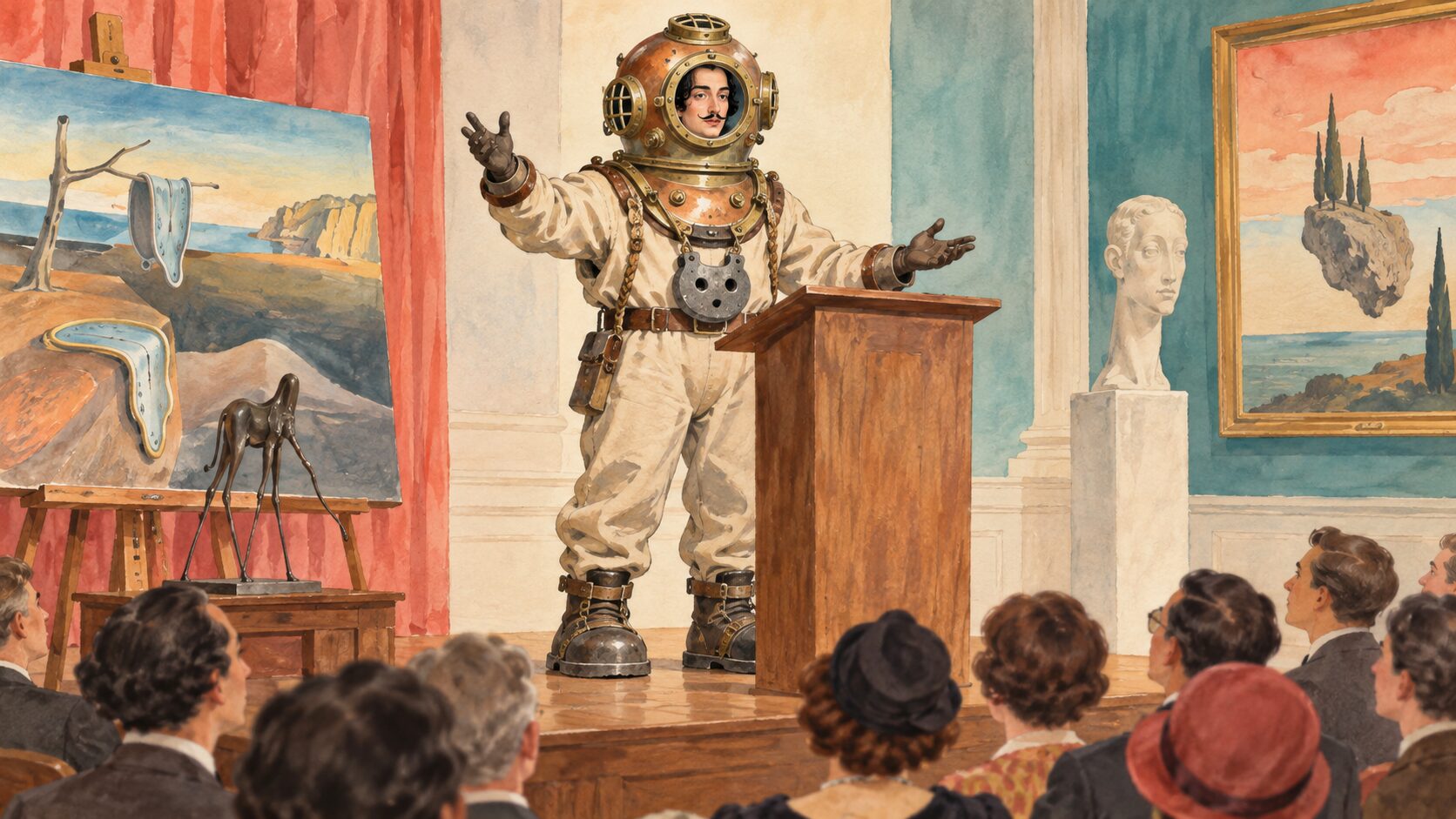
Salvador Dalí arrived for his lecture equipped for a trip beneath the sea. He had a heavy diving suit, a metal helmet, a billiard cue and two dogs on leads. His destination was a platform at London's International Surrealist Exhibition. The date was July 1, 1936.
The costume was meant to help explain what he wanted to say. Dalí would be exploring the subconscious, and a diver's descent offered a way to make that invisible journey visible. For this particular exhibition, the outfit was hardly the only unusual sight.
A woman whose face disappeared beneath flowers had appeared in Trafalgar Square. Inside the galleries she carried a prosthetic leg. This was performer Sheila Legge as the “Surrealist Phantom,” bringing something that might belong in a strange painting into the streets and among the visitors. Dalí's equipment joined an exhibition already spilling beyond its picture frames.
Getting into the suit was one thing; getting anywhere in it was another. Dalí later recalled that the lead soles of his boots were so heavy that he could barely lift them. Friends had to help him reach the platform. The descent into the mind began with the awkward business of moving across a room.
Once he was in position, the helmet was fitted and screwed tight. The audience could see his face through the glass. Hearing him was more difficult. The microphone could not properly carry the words from inside the equipment, leaving the lecture with a speaker in full view whose voice was hard to make out.
His patron Edward James was helping with the lecture and its translation. Then the difficulties became much more urgent than a badly delivered speech. Inside the helmet, Dalí was struggling to breathe. In his later account, an air supply had not been connected.
Some spectators took his distress for part of the performance. Dalí, meanwhile, wanted to be let out. The same equipment that had made his entrance impressive now stood between him and the people trying to help.
The helmet could not simply be lifted away like a hat. The fastening that had been tightened before the lecture had to be undone. James was among those who intervened, and a spanner was used to release Dalí from the helmet.
Once freed, he went on with the lecture, using slides to show pictures. The surviving translation suggests that the words were scarcely more conventional than the costume: Dalí told a story about a philosophy student eating a glass-fronted wardrobe, connecting it with the idea of making a hole in the world by consuming it.
The pictures did not all appear as intended. Contemporary reports describe slides projected sideways or upside down. According to one report, Dalí saw a wrongly projected image, said that it did not matter, and continued.
EDITORIAL RESPONSIBILITY
FactosBrain Editorial Desk
The FactosBrain Editorial Desk researched and reviewed this article under our editorial policy. We assess error reports under our corrections policy.