Theodore Roosevelt began by asking his audience to excuse a shorter speech than usual. He had a convincing reason: someone had just shot him in the chest. The address that followed lasted about eighty minutes.
It was October 14, 1912, and the former president was campaigning in Milwaukee. Roosevelt had broken with the Republicans and was running as the Progressive Party's candidate. As he greeted a crowd from a car outside his hotel, a gunman fired at him. A metal spectacle case and a folded, fifty-page speech in his pocket slowed the bullet. They did not keep it out of his body.
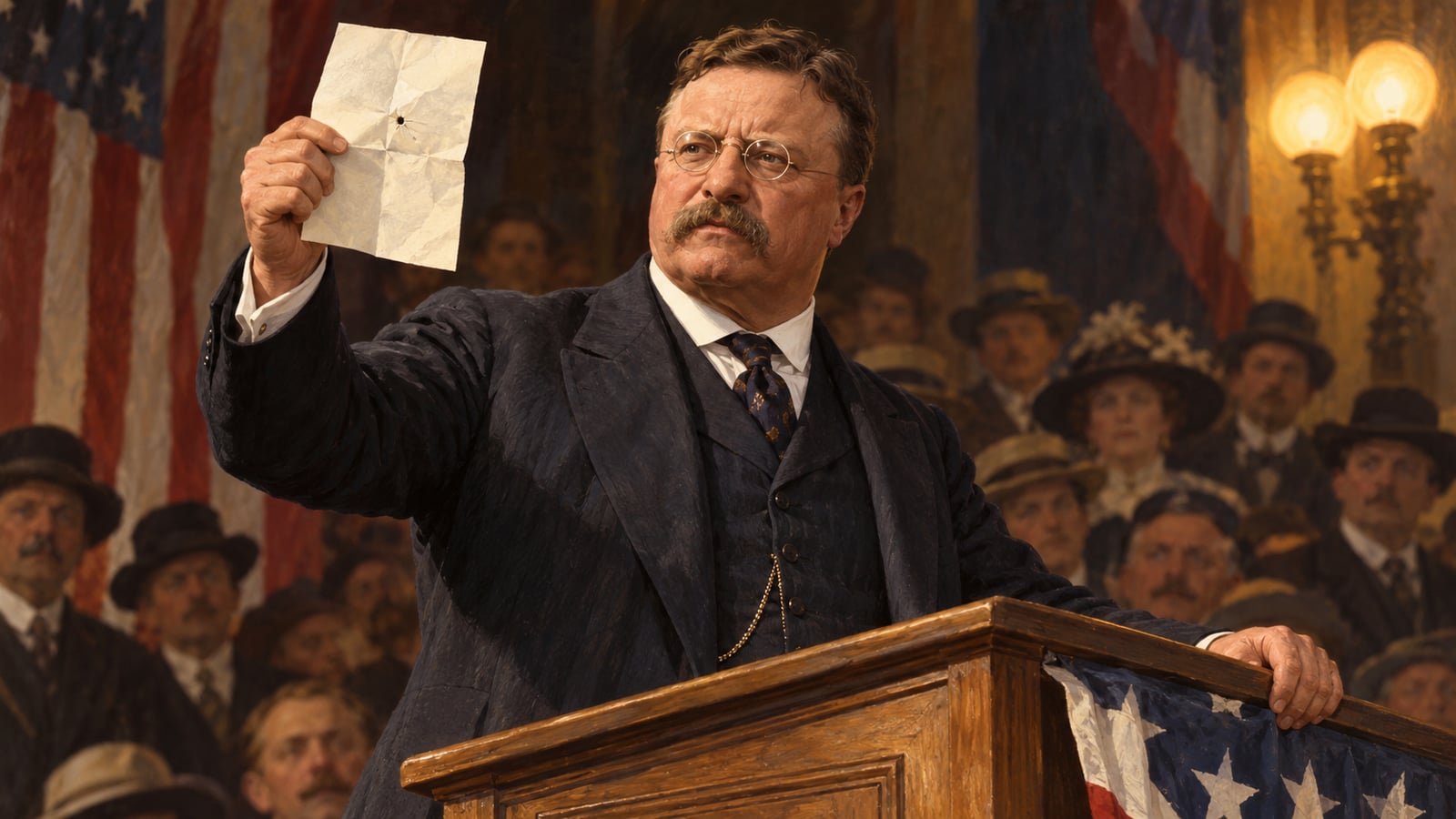
The attacker was caught, but Roosevelt insisted on going to the hall. He was examined before taking the stage and nevertheless went ahead. Once in front of the audience, he explained what had happened and displayed the damaged manuscript. A document meant to carry his arguments had already served an entirely different purpose. Now its bullet hole helped him explain the extraordinary circumstances in which he was speaking.
The surviving transcript makes clear that this was much more than a brief appearance to reassure supporters. Roosevelt declared that the Progressive cause mattered more than any individual. He then moved into the business of his campaign: working hours, child labor, the rights of immigrants, and the power of large corporations. He argued that ordinary people needed government to protect them against concentrated economic power. Being wounded had not made him abandon the policies he had arrived to promote.
His listeners and companions had more immediate concerns. Throughout the address, Roosevelt returned to assurances that he was all right. At one point he suggested that the people near him seemed more nervous than he felt. He also joked that the audience was not going to escape hearing his speech. The man who needed treatment was trying to settle everybody else down long enough to finish making his case.
His promises of brevity proved flexible. He said that he would leave out part of a comparison with Woodrow Wilson, then continued discussing differences between them. Later, he explained that doctors were unlikely to let him speak again soon, so he wanted to get a few more things said. Each concession to his condition became a reason to continue. The transcript records a politician still arguing, digressing, and trying to persuade, even as the circumstances made an ordinary campaign address impossible.
Afterward, Roosevelt went to the hospital. X-rays located the bullet, which was left in his body. He returned to campaigning before election day, but the remarkable appearance did not deliver the presidency. Wilson won.
The perforated manuscript became far more memorable than the proposals it contained. Yet the speech itself preserves something stranger than a single display of endurance. Roosevelt repeatedly acknowledged that he should stop, then found another point he wanted his audience to hear.
EDITORIAL RESPONSIBILITY
FactosBrain Editorial Desk
The FactosBrain Editorial Desk researched and reviewed this article under our editorial policy. We assess error reports under our corrections policy.