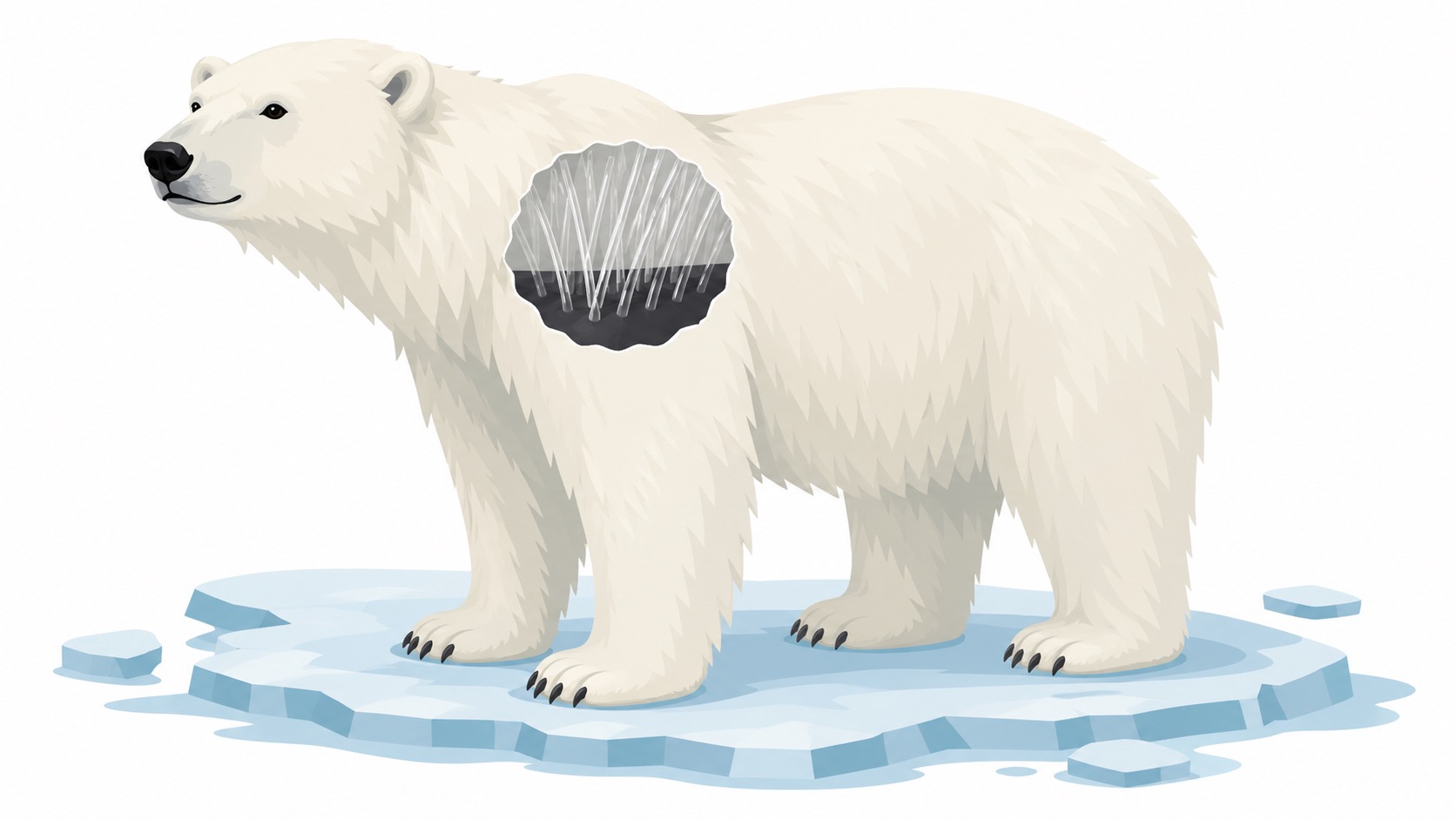
Polar bear fur looks white even though individual hairs contain little or no white pigment. The long guard hairs are largely colorless and translucent, and a dense insulating undercoat lies beneath them. When light meets this crowded structure, it is scattered in many directions, so the coat returns a broad mixture of visible wavelengths that our eyes perceive as white.
Calling every hair perfectly transparent can be misleading. A single strand transmits some light but also reflects and scatters it at its surfaces and within the coat. The white appearance is a collective optical effect created by many hairs, air spaces, their arrangement and the lighting around the animal—not a layer of white dye.
Beneath the fur, polar bear skin is dark. Dark skin can absorb light that reaches it, but the animal's survival in Arctic cold depends much more on insulation from a thick coat and a substantial layer of body fat. The coat also sheds water, helping reduce heat loss after swimming.
The fur does not act like a simple bundle of fiber-optic cables that channels large amounts of sunlight directly to the skin, an explanation sometimes repeated in popular accounts. Measurements and biological descriptions support a more ordinary combination of scattering, reflection and insulation. The visual effect and the thermal function should not be collapsed into one mechanism.
A polar bear can appear creamy or yellowish depending on staining, age and illumination. In some captive settings, algae have even grown inside hairs and given the coat a green cast. Those changes are possible precisely because the hair itself is not filled with permanent white pigment.
White-looking fur improves camouflage on snow and sea ice, while the dense coat and fat address the separate problem of conserving heat. The same body covering can serve both roles without using the same physical process: scattering shapes what an observer sees, and trapped air plus biological insulation shape how quickly the bear loses warmth.
EDITORIAL RESPONSIBILITY
FactosBrain Editorial Desk
The FactosBrain Editorial Desk researched and reviewed this article under our editorial policy. We assess error reports under our corrections policy.