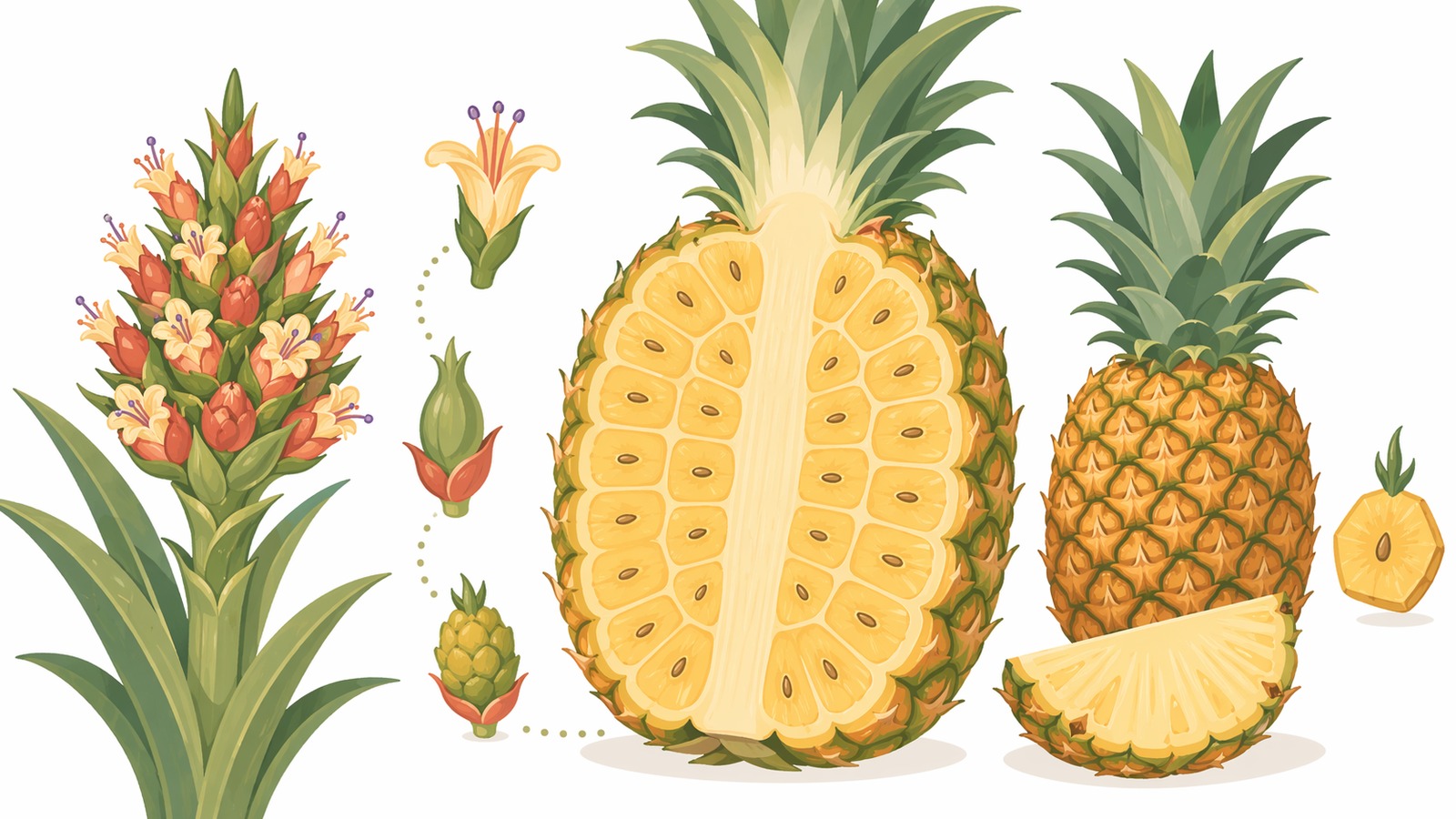
At the table, a pineapple is one large fruit. In botany, it is a multiple fruit: a structure made by many flowers acting together. When the plant flowers, its tip produces an inflorescence rather than a single bloom. Dozens, and in some cultivars well over a hundred, flowers are packed around that axis. Each can form a small fruitlet. As they develop, the fruitlets and parts of the flower stalk enlarge and fuse into the firm structure sold as one pineapple.
The term multiple fruit distinguishes pineapple from two other familiar patterns. A peach is a simple fruit, developing from the ovary of one flower. A raspberry is an aggregate fruit: one flower has many ovaries, and each makes a small unit in the cluster. A pineapple begins with many separate flowers in one inflorescence. The crucial difference is not whether the final product looks like a single lump, but whether its starting parts belonged to one flower or to a whole group of flowers.
The polygonal eyes on a pineapple rind preserve a record of that beginning. Each eye broadly corresponds to the site of one flower and the fruitlet it produced. Their diagonal, spiral pattern is not decorative carving; it reflects how the flowers were closely arranged around the growing stem. Looking at the skin before it is peeled is a useful way to see the hidden flower cluster. What looks like a repeating pattern is a map of many individual flowers that grew together.
More than the ovaries take part in the fusion. University of Florida growing guidance describes the ripe fruit as including fused ovaries, the bases of sepals and bracts, and tissues around the central core. That helps explain why a lengthwise cut reveals a firmer core running through the middle. The separate fruitlets are not merely placed next to one another like raspberry drupelets. They become integrated around the inflorescence axis, making the finished pineapple difficult to divide into its original units.
The leafy crown at the top is another clue to the plant's architecture. The inflorescence axis continues above the fruit and produces a tuft of vegetative leaves. A crown can be planted to start another pineapple plant, and growers also use shoots for vegetative propagation. This is useful for maintaining a chosen cultivar's traits. The crown is therefore more than a decorative handle: it is a living continuation of the stem that bore the flower cluster and fruit.
Many market pineapples have few or no seeds, but that does not mean flowers were absent from their formation. Common cultivated varieties are self-incompatible, so pollen from the same variety does not readily produce seeds; seed formation is more likely when compatible varieties flower nearby. Flesh development and seed production are not identical processes. A seedless pineapple still develops from its many flowers and still belongs in the botanical category of multiple fruits.
So is a pineapple one fruit or many? In a grocery basket it is sensibly counted as one. In botanical development it is the joined result of many flowers. Those answers do not compete. The eyes on the rind, the central core and the leafy crown all preserve different parts of the same history. Inside the sweet flesh is the compressed record of an entire flower cluster, which is why pineapple is one of the clearest everyday examples of a multiple fruit.
EDITORIAL RESPONSIBILITY
FactosBrain Editorial Desk
The FactosBrain Editorial Desk researched and reviewed this article under our editorial policy. We assess error reports under our corrections policy.