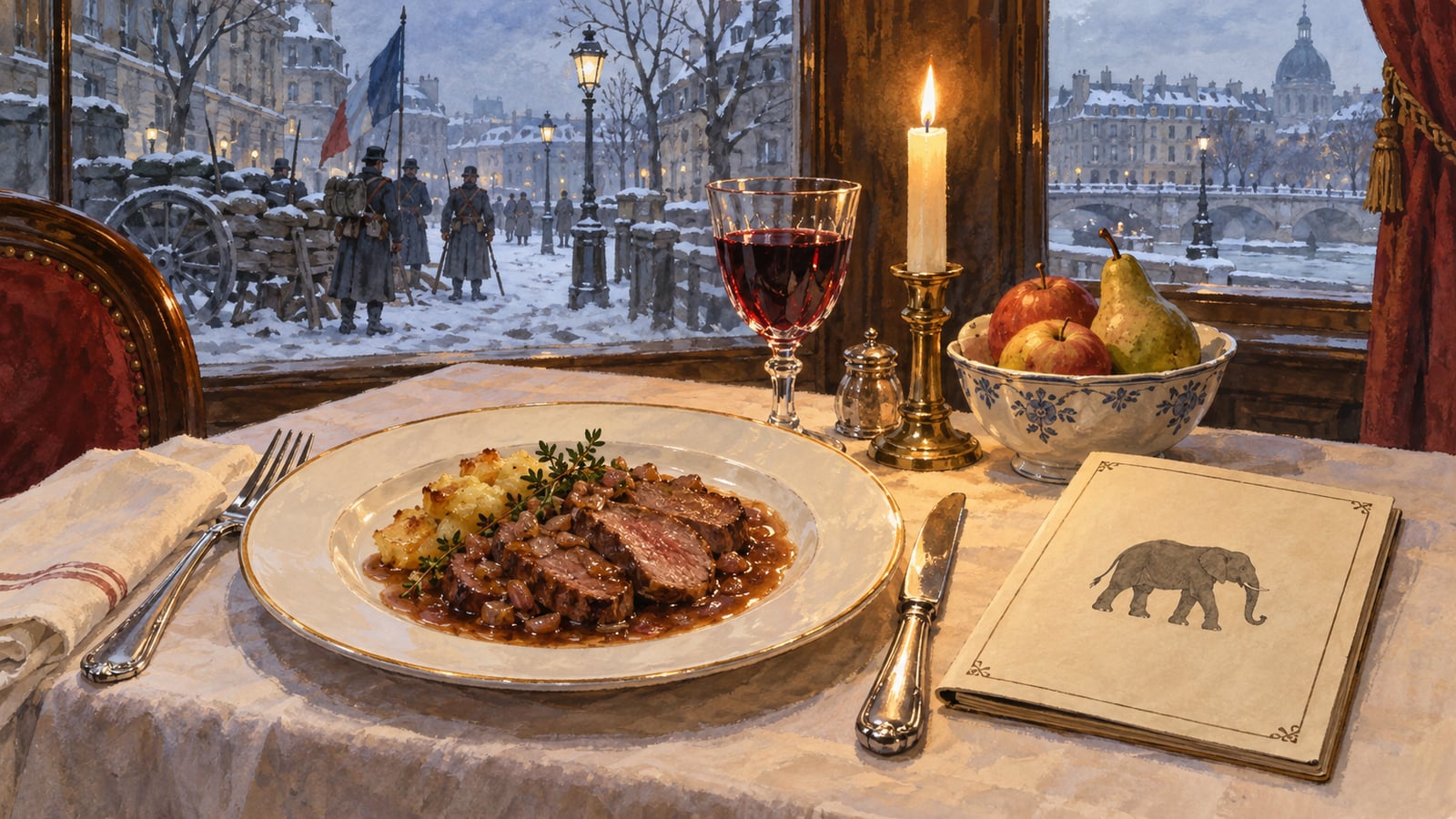
The elephant came sliced, with a shallot sauce. Monkey soup was also on the menu, along with roast bear. This was not a meal eaten by explorers far from home. It was a dinner for twenty at the Paris restaurant Noël Peter's on the last day of 1870. Apples and pears appeared among the courses too: familiar fruit beside animals the guests would normally have expected to see in a zoo.
Paris had been under siege since the autumn. Prussian and other German forces surrounded the city during the war with France, cutting it off from outside supplies. There were still mouths to feed, but the food available to feed them was dwindling. Meat that had once been an ordinary market purchase became increasingly difficult to find.
Horse meat took a larger place in the diet. As the siege continued, dogs, cats and rats were sold for food as well. Animals that had shared the city with its residents were becoming cuts of meat. And Paris had places where many more animals lived together: its zoos.
The zoos were trapped inside the same blockade. Feeding their animals was a burden in a city running short of food for people. Some animals were slaughtered, and their meat reached butchers and restaurants. Kangaroo and antelope became ingredients. The city did not eat every zoo animal, but the divide between those spared and those sold was severe.
Nor did all this meat go to people on the edge of starvation. Restaurants serving customers with money offered rare animals as dishes. A shortage that was disastrous for the city could become an extraordinary dining opportunity for a few. With a sauce and a succession of courses, even a besieged capital could hold a banquet.
Two elephants killed during the siege were called Castor and Pollux. Animals visitors had known by name were butchered and sold. A piece of Pollux reached the table of Henry Labouchere, a British journalist who was keeping a record of life in Paris. He included the meal in his account.
Writing on January 6, 1871, Labouchere described eating Pollux the previous day. His verdict was unenthusiastic: the meat was tough, coarse and oily. He would not recommend elephant to English households while beef and mutton remained available. An unusual ingredient did not necessarily make a desirable dinner.
It was not cheap either. Labouchere recorded a price of ten francs a pound for the meat, with the trunk fetching forty-five. An animal once admired for its enormous size was now divided into portions with very different prices.
Outside these unusual meals, the winter was much less remarkable and much harder to endure. Labouchere also wrote about cold women and children and the difficulty of finding food and fuel. People with money could buy remaining provisions and coal. Those without it faced hunger and cold together. The novelty of an elephant dinner tells only a small part of what eating in Paris had become.
Even restaurants faced another obstacle as the winter continued: having meat did not mean having a fire to cook it over. Some closed for lack of fuel. Small spirit lamps were suggested as an alternative, but Labouchere was doubtful. Cooking an elephant with a spirit lamp, he thought, would test even Parisian ingenuity beyond its limits.
The siege ended in late January 1871. Its menus survived as records of astonishing meals. The journalist who actually tasted the elephant left a less glamorous impression: the meat was tough and oily, and the city was running short of the fuel needed to cook it.
EDITORIAL RESPONSIBILITY
FactosBrain Editorial Desk
The FactosBrain Editorial Desk researched and reviewed this article under our editorial policy. We assess error reports under our corrections policy.