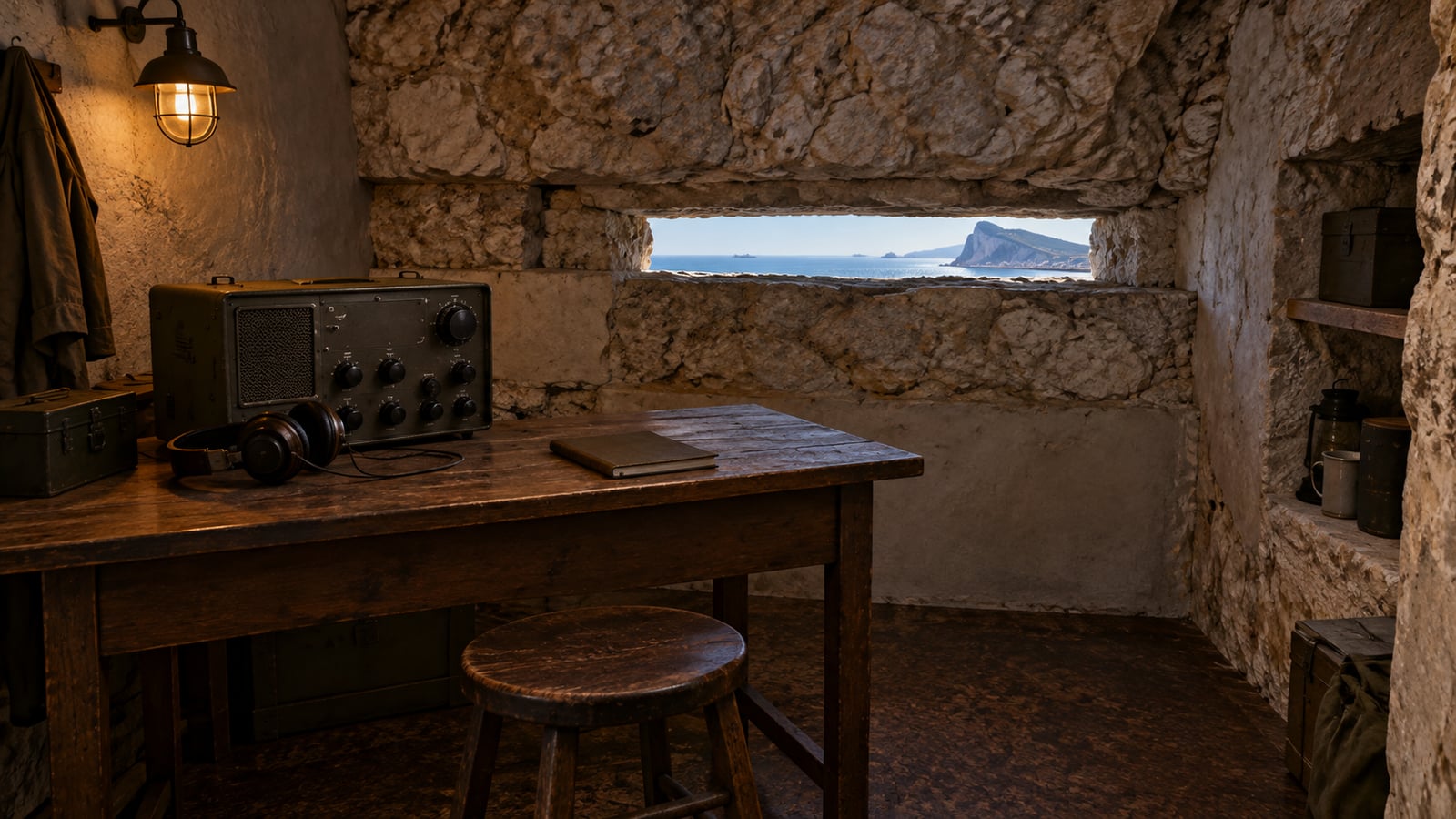
The room had water, toilets and radio facilities. There were openings through which its occupants could watch the world outside. Its entrance, however, was to be bricked up. During the Second World War, Britain prepared a hidden observation post inside Gibraltar's Rock, intended for six men whose presence would remain a secret.
The Rock already contained an extensive military tunnel network. This chamber served a different contingency: it would become useful if Gibraltar fell. Men left inside could observe shipping and send reports to Britain while enemy forces controlled the territory around them. The plan was called Operation Tracer.
One recruit was naval doctor Bruce Cooper. Approached while on leave in 1941, he was asked to suggest another doctor before learning the full assignment. He recommended Arthur Milner, a medical-school friend. The eventual team comprised two doctors, three radio operators and a commander. They were preparing for prolonged isolation, rather than a brief visit behind enemy lines.
Their hiding place also had to be a place to live. Water and sanitation were provided, alongside a radio room. Separate observation points looked east and west. One was a narrow slit; the other led toward a small ledge outside the Rock. Being sealed in did not mean a chamber without light or ventilation. It meant losing an ordinary doorway to the outside world.
Sound mattered, too. Cork covered the floor, and a bicycle-powered generator offered electricity for the radio equipment. A leather belt replaced the bicycle's chain to reduce noise. The arrangements had to support the occupants' work without advertising that people were living behind the walls.
The operation never went into use. The men did not spend a wartime confinement secretly watching from the chamber. Once the post was no longer required, its entrance was blocked. After the war, rumors of a hidden room persisted, and explorers searched the tunnels for evidence.
In the 1990s, the Gibraltar Caving Group found the concealed complex. A draught behind rusty metal sheeting drew attention to a brick wall and a hidden doorway. Beyond it were living quarters, smaller rooms and observation points. The supposed secret had left physical evidence, including toilets and traces of radio facilities.
Cooper returned to Gibraltar in 2008 and confirmed that this was the chamber prepared for him and his colleagues. During the war, entering it might have meant having the entrance closed behind him. Decades later, he could identify the room and leave again.
EDITORIAL RESPONSIBILITY
FactosBrain Editorial Desk
The FactosBrain Editorial Desk researched and reviewed this article under our editorial policy. We assess error reports under our corrections policy.