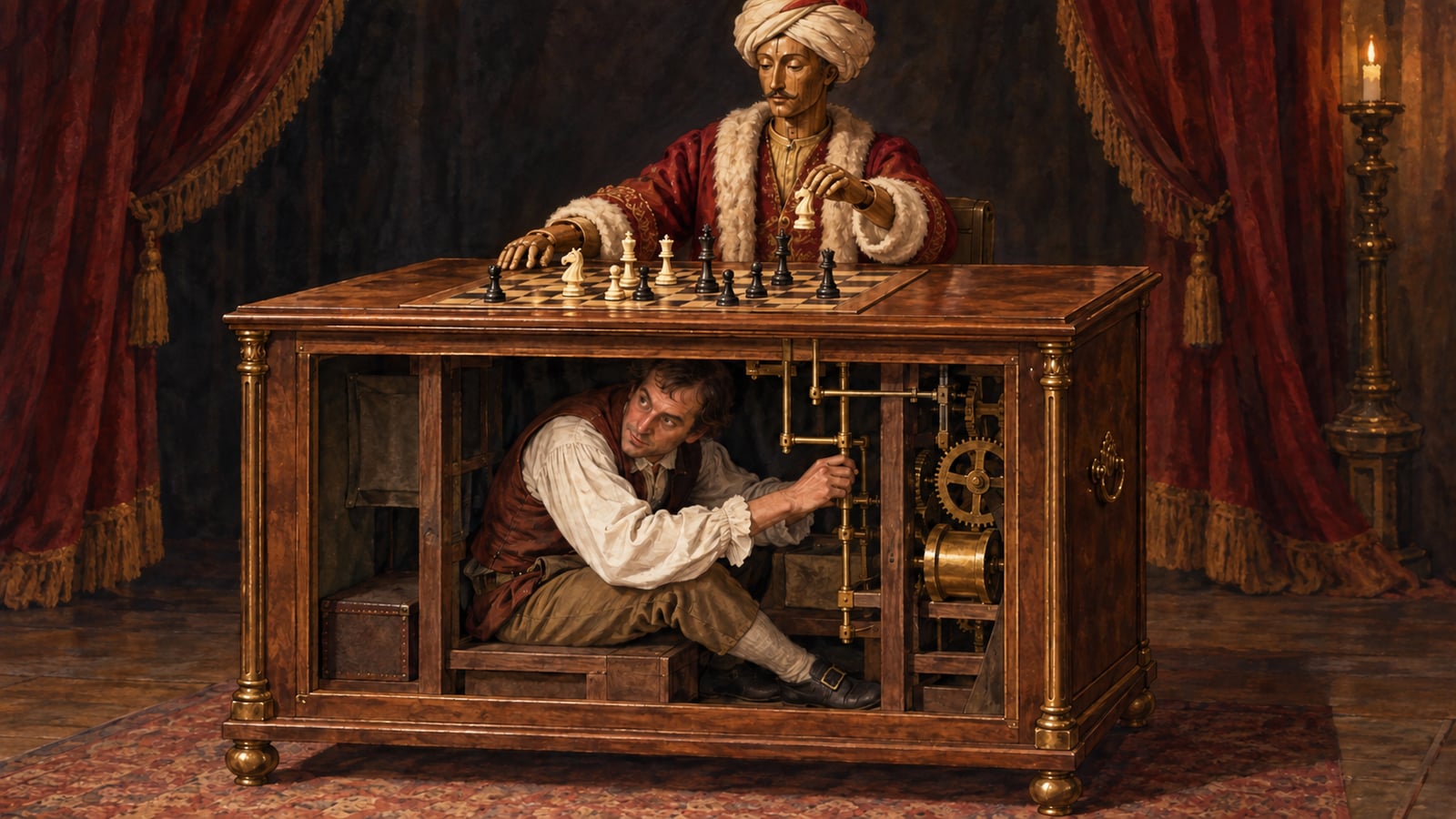
Before the game began, the showman opened the machine. Gears and levers crowded a wooden cabinet. He opened a door at the back and held up a candle, letting light shine through. Other doors and a drawer followed. By the end of the inspection, spectators had good reason to feel they had seen inside. A chess player was hiding there throughout.
A chessboard stood on top of the cabinet, with a life-size figure in a turban seated behind it. This was the Turk, built by the eighteenth-century inventor Wolfgang von Kempelen. Its arm lifted pieces and answered an opponent's moves. Unlike a mechanical toy repeating a routine, it responded to decisions made by someone outside the apparatus. Challengers could lose. The machine appeared to be thinking.
After Kempelen's death, Johann Maelzel acquired the device and exhibited it in Europe and America. Edgar Allan Poe's 1836 essay describes the presentation in detail. The figure arrived on a cabinet fitted with casters. Spectators could see the gap underneath it, and the apparatus could be moved around the room. A concealed assistant reaching through the floor was a less convincing explanation once the whole thing rolled elsewhere.
Poe paid particular attention to the order in which the doors opened. The front and back of one compartment were displayed; its rear door was then shut before another section was revealed. Spectators remembered seeing everything, but did not actually see every space at the same time. Could someone change position inside during that sequence? Poe concluded that a person was concealed there and worked through possible places for his body and legs.
Identifying a hidden player was not the same as explaining the whole apparatus. Poe thought the operator could look through the figure's clothing to see the board. Magnetism actually helped communicate the moves. Pieces above the board affected indicators beneath it, allowing the operator to follow changes outside. What appeared to be an ordinary playing surface also served as a means of passing information into the cabinet.
Moving a piece presented another problem. Choosing a good move was useless if the figure's hand went to the wrong square. Mechanical linkages allowed the concealed player to control the arm and fingers. When Germany's Heinz Nixdorf MuseumsForum later built a working reconstruction, it used a linked lever mechanism to transmit the operator's movements. Putting someone in a box was only part of the engineering required.
Poe also described mistakes. Occasionally the mechanical fingers failed to grasp a piece. The empty hand continued to the intended square and returned. Maelzel then carried out the move that the gesture had indicated. The demonstration could survive a handling error without interrupting the game. Its presenter was also there to keep play moving.
In the performances Poe described, the opponent and the automaton used separate boards. Maelzel walked between them, transferring moves from one to the other. His gestures near the cabinet could themselves become objects of suspicion. Was he secretly controlling it? Was someone inside? Could it really be an ingenious machine? Watching the chess and investigating the illusion were two entertainments taking place at once.
Poe's essay was not a flawless technical solution. He even argued that a genuine machine should always win. But his attention to the inspection sequence exposed an essential feature of the performance. Showing the cabinet was not merely a preliminary reassurance. The carefully managed display helped conceal the person who made the chess possible.
The original Turk burned in a Philadelphia museum in 1854. Without precise construction plans, the later reconstruction required experiments, including how to make the hand grasp a piece. Spectators had once wondered how a machine could think. Rebuilders already had someone to do the thinking; their challenge was to let that person move the figure's hand while remaining unseen.
EDITORIAL RESPONSIBILITY
FactosBrain Editorial Desk
The FactosBrain Editorial Desk researched and reviewed this article under our editorial policy. We assess error reports under our corrections policy.