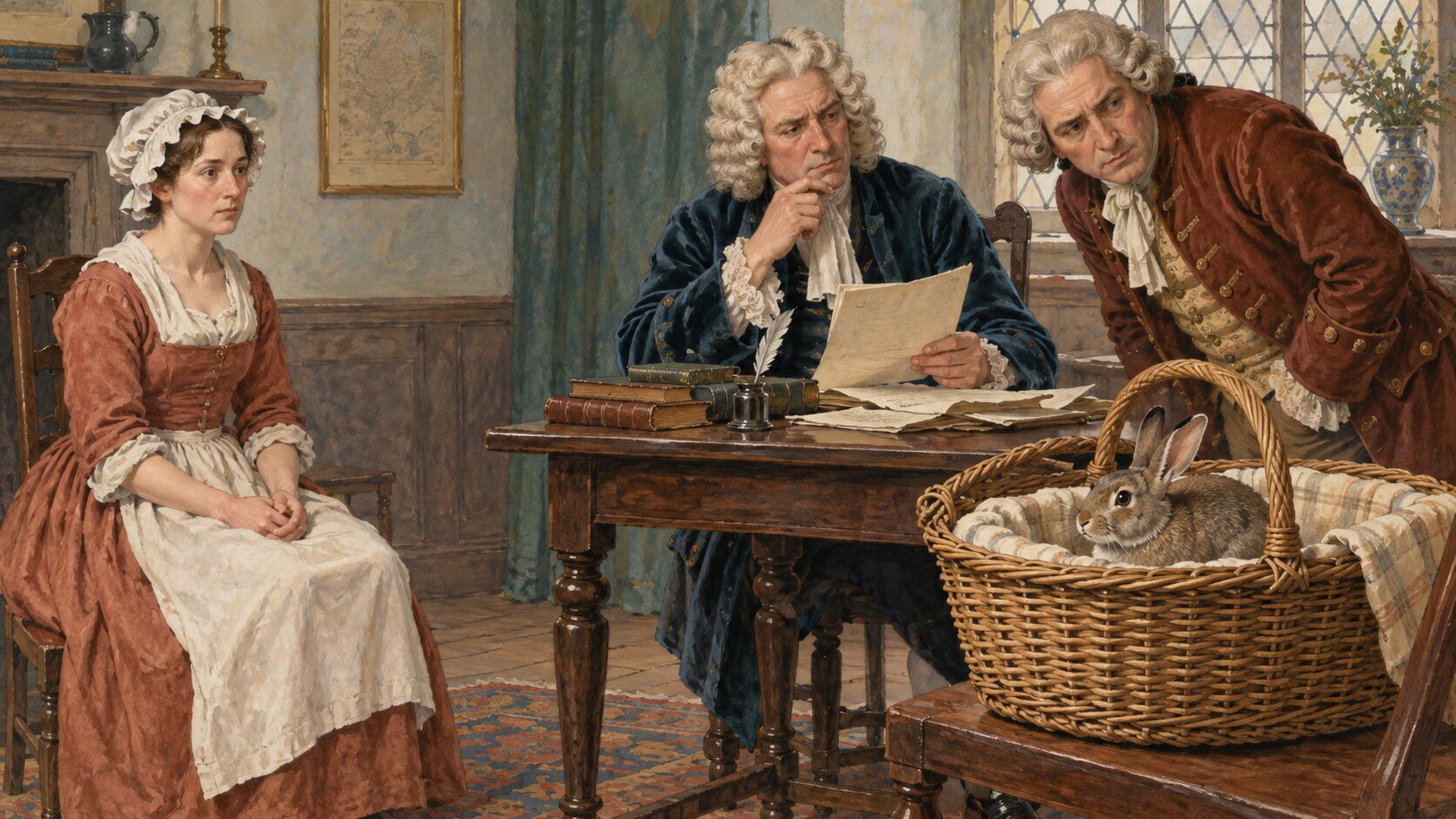
Reports that an English woman was giving birth to rabbits reached the royal court in 1726. The royal surgeon Nathaniel St. André went to investigate, returned to London with animal specimens and compared them with ordinary rabbits before the king. The woman he had examined, Mary Toft, was not giving birth to rabbits.
The story began in Godalming, Surrey. Local surgeon John Howard reported animal parts emerging from Toft's body and sent letters to London describing further rabbit deliveries. St. André's account explains that Howard moved her to nearby Guildford to make attending her easier. A village story acquired the form of observations supplied by a medical practitioner.
Toft explained that she had chased rabbits in a field earlier that year without catching them, dreamed of them that night and developed a longing to eat rabbit that poverty prevented her from satisfying. A contemporary belief held that a pregnant woman's powerful impressions could mark her unborn child. Her explanation fitted that belief; the claim that imagination could turn a human foetus into a rabbit was false.
The investigators did more than listen. Arriving in Guildford on 15 November, St. André examined Toft with Samuel Molyneux, secretary to the Prince of Wales. He recorded what he inspected and the animal parts he obtained.
He put pieces of lung in water, examined the heart and other organs, and dissected ordinary rabbits for comparison. In his interpretation, the specimens combined the outward appearance of grown animals with internal features of foetuses. He treated that discrepancy as evidence of an unusual production rather than evidence of a deception.
St. André presented specimens before the king and prepared his observations for publication. Another royal surgeon, Cyriacus Ahlers, reached a different conclusion. He too examined Toft and took animal parts back to London.
Ahlers described marks on bones and muscles that appeared to have been made by a sharp instrument. In pellets of rabbit dung, he found hay, straw and pieces of grain. Evidence that the rabbit had eaten food was difficult to reconcile with its supposed development inside a human body. He wrote that he had sufficient grounds to suspect an imposture.
The dispute extended to what the investigators had said at the bedside. St. André's narrative included statements claiming that Ahlers had accepted the rabbit births while in Guildford. Ahlers answered in his own preface that those statements misrepresented his conduct. The origin of the rabbits was now entangled with an argument over the surgeons' accounts of one another.
On 29 November, Toft was brought to Lacy's Bagnio, a London bathhouse, for closer observation. Doctors waited for another production. She experienced symptoms that resembled labour, but no new rabbits appeared. Richard Manningham's diary records repeated examinations followed by symptoms subsiding without a delivery.
On the evening of 4 December, the bathhouse porter Thomas Howard gave a statement to a magistrate about secretly obtaining a rabbit. The relative nursing Toft acknowledged procuring it but said it was for eating. Toft offered the same explanation. A rabbit brought in from outside had entered the investigation of rabbits supposedly emerging from within.
Toft did not immediately confess to the entire deception. On 6 December, Manningham pressed her and threatened a painful procedure if she refused to tell the truth. He recorded his own threats in his diary. On the following morning, 7 December, she admitted participating in a hoax.
Her statements described animal parts being placed inside her body and their removal being presented as births. Accounts of who initiated the scheme and who assisted changed across the confessions. Descriptions of pain recur. The rabbit births were false, but that does not make every bodily experience involved in the deception a performance.
Toft was imprisoned, and doctors published explanations of their conduct. St. André placed a defensive advertisement in a newspaper on 9 December. The case he had recently demonstrated before the king had become something for which he had to defend his own judgment.
William Hogarth's satirical print appeared that December. It gathered the doctors and investigators around Toft's bed. The people who had waited for another rabbit continued to circulate in print long after the rabbits had stopped appearing.
EDITORIAL RESPONSIBILITY
FactosBrain Editorial Desk
The FactosBrain Editorial Desk researched and reviewed this article under our editorial policy. We assess error reports under our corrections policy.