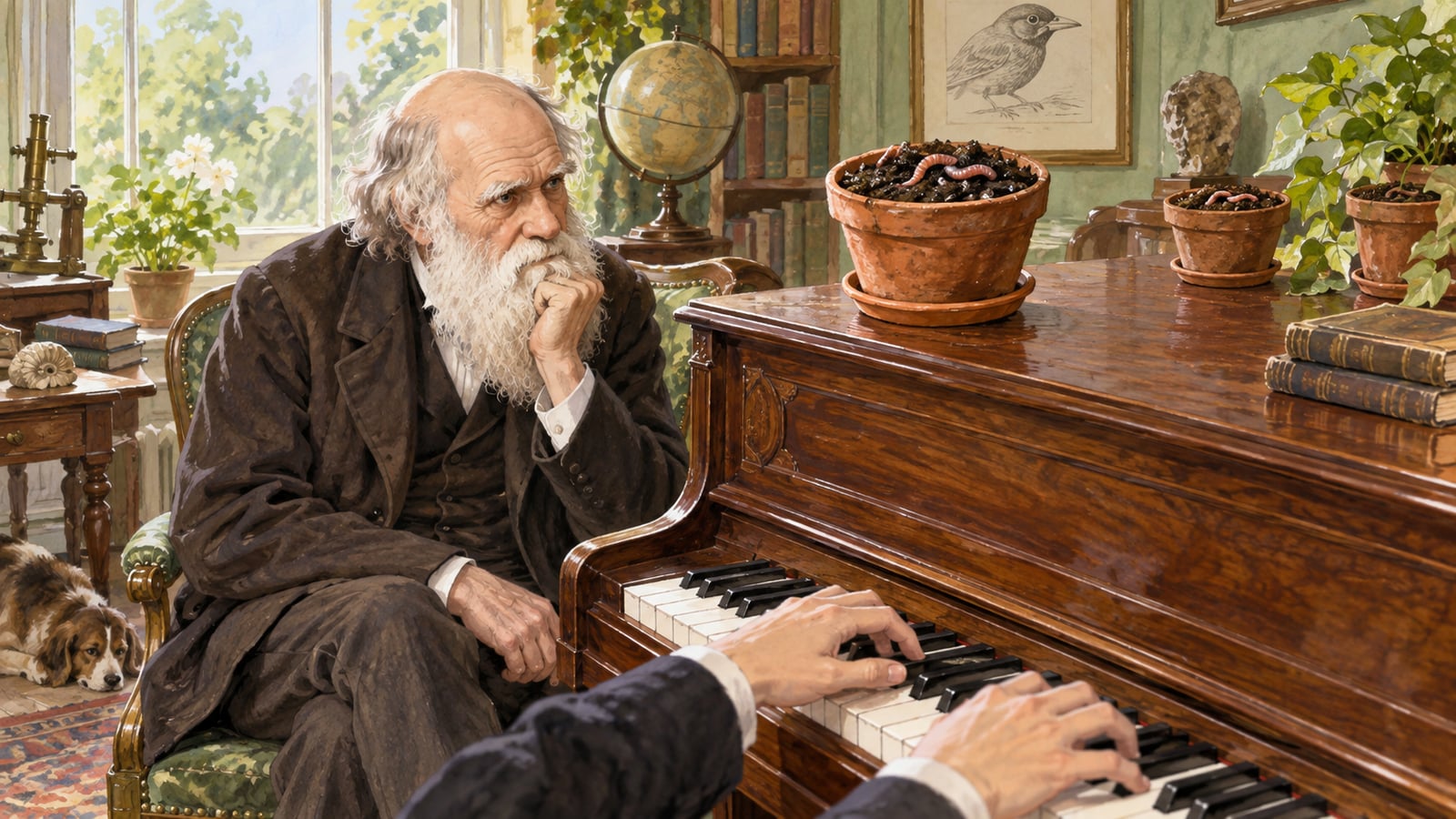
The audience showed no interest in the piano. A whistle did no better, and neither did the deep notes of a bassoon. Charles Darwin was watching earthworms in pots of soil, trying to discover what they could perceive.
Worms were a serious and longstanding interest. In 1837, Darwin had presented work on their role in forming soil. Small fragments scattered across a field could end up buried after several years. He connected that apparent sinking with the earth continually brought to the surface in worm castings. Tiny animals, working repeatedly over long periods, could change the ground.
Keeping worms indoors led him toward another question: how did these creatures experience their surroundings? He investigated their responses to light, touch, and sound. Their lack of eyes did not settle whether they could distinguish brightness from darkness. In the same way, understanding their response to noise required more than making a loud sound and waiting.
At first, the sound experiments produced little to see. A metal whistle caused no noticeable reaction. Nor did the loud, low notes of a bassoon. Shouting had no effect when care was taken to prevent the speaker's breath from striking the animals. Pots standing on a table near a loudly played piano remained equally uneventful.
Then the pots were placed on the piano itself. When a low C was struck, two worms immediately withdrew into their burrows. They emerged later, and another note sent them back inside. The important change was not the choice of a more appealing tune. It was where the pots stood.
Beside the piano, the worms had been exposed to sound traveling through the air. On the instrument, vibrations could pass through the saucers, the pots, and the moist earth to reach their bodies. Darwin distinguished an apparent indifference to airborne sound from a strong response to vibration through a solid object. What looked like the same musical performance to a human observer reached the worms in a different way.
He repeated observations on other nights and with other notes. He also compared reactions when a pot or its supporting table was lightly struck. Sensitivity varied from occasion to occasion. His account records those uneven results instead of turning the animals into reliable little mechanical toys—or treating their retreat as a musical preference.
The experiments appeared in his 1881 book on earthworms. The same work examined how worms pulled leaves into burrows, processed earth, and gradually covered objects lying on the surface. The domestic experiment belonged to a much larger investigation of what these animals did to the landscape.
Darwin was not trying to decide whether worms enjoyed a concert. He wanted to know what an apparently unresponsive animal could detect. In this case, a revealing change required moving the pot only a short distance: from beside the piano to the piano itself.
EDITORIAL RESPONSIBILITY
FactosBrain Editorial Desk
The FactosBrain Editorial Desk researched and reviewed this article under our editorial policy. We assess error reports under our corrections policy.