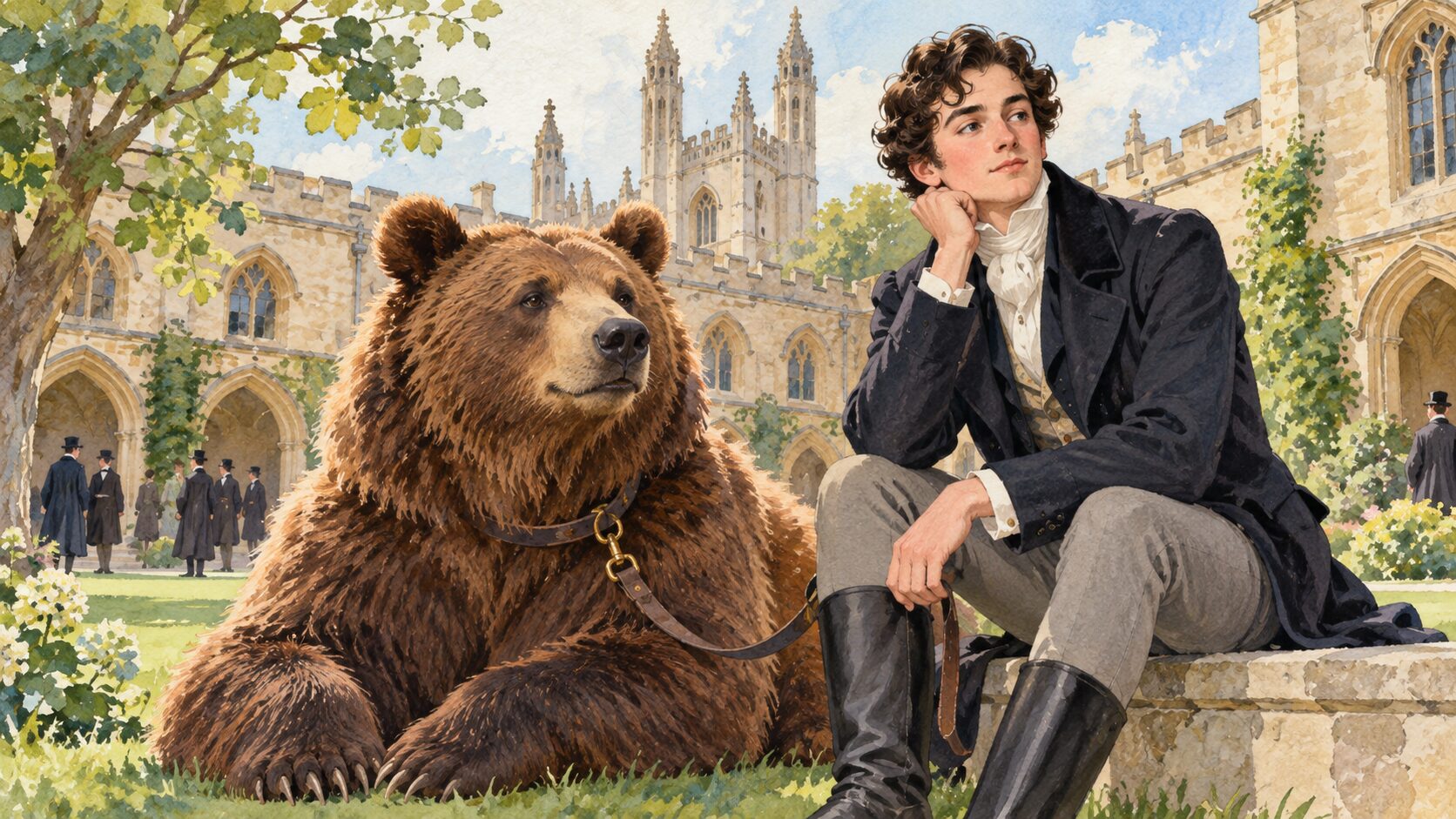
A student told he could not keep a dog brought in a bear. This happened at Trinity College, Cambridge, in 1807. The student was the nineteen-year-old Byron, who would later become a celebrated poet. In a college that prohibited dogs, he began living with a bear.
There is little sign of embarrassment in Byron's own account. Writing to his friend Elizabeth Pigot on October 26 that year, he announced that he had acquired a new friend. He described this companion as the finest in the world before revealing what it was: a tame bear.
Where does a student find a bear?
For a modern reader, obtaining the bear may seem as puzzling as bringing it to college. Its exact origin is uncertain, but the University of Cambridge identifies the nearby Stourbridge Fair as a possible place of purchase. A venue where a bear might be bought was within reach of the university town.
The fair attracted traders in horses and food, as well as showmen exhibiting animals. Coffee houses and taverns stood alongside entertainments, and collections of exotic animals drew spectators. The academic town and the business of displaying unfamiliar creatures existed in close proximity.
Byron also had the means to arrange an unusual student life. In 1805, the year he entered Cambridge, he wrote to his sister that he had an annual allowance of £500, a servant and a horse. He enjoyed his independence, comparing himself to a German prince. Two years later, his household included a bear.
An academic future for the bear
Not everyone understood what the animal was doing there. In his letter to Pigot, Byron reported being asked what he intended to do with it. His answer was that the bear should compete for a fellowship.
A fellow belonged to the college's academic community. Having answered a ban on dogs by bringing in a bear, Byron was now proposing an academic position for his companion. He offered no lengthy explanation of the joke. Instead, he recorded its reception in a short sentence: the answer had not delighted them.
Byron did not quickly abandon the joke. The following year, his unusual college companion became a subject of magazine satire. The proposed academic career would soon make another appearance too.
Mock the bear, hear from its owner
In June 1808, the Satirist published a parody titled ‘Lord B----n to his Bear.’ It borrowed from Byron's poetry to imagine him singing to the animal. The bear had moved beyond his private correspondence: other writers were using it to ridicule him.
A review of his poetry in the same magazine that August brought the bear up again, mocking its owner as a bear-leader. A discussion of his writing had drawn in his eccentric choice of pet. Byron's new friend had become an easy target for a critic.
Byron replied in the postscript to the second edition of his verse satire English Bards and Scotch Reviewers, published in 1809. He accused the writer Hewson Clarke of attacking both him and his bear. Unable to identify any other reason for Clarke's hostility, he suggested that the critic had a personal quarrel with the animal.
He defended the bear as an innocent creature unable to defend itself, and supplied a mock explanation for its failed academic career. The jealousy of its Trinity contemporaries, he claimed, had prevented its success. This was a taunt aimed at his critic, not an account of a real fellowship competition: Byron had turned ridicule of his bear into a story of injustice against it.
A bear to the right, a wolf to the left
The animal also appeared in accounts of Newstead Abbey, Byron's home after Cambridge. His friend Charles Skinner Matthews stayed there and described the visit in a letter to his sister in May 1809. Playing with the bear was among the household's pastimes.
Matthews also supplied a playful guide for anyone approaching this extraordinary house. Come in broad daylight, he advised, with your eyes open. At the hall steps, a wrong turn to the right would bring you within the bear's grasp. Turning left offered an even worse prospect: there was a wolf in that direction.
EDITORIAL RESPONSIBILITY
FactosBrain Editorial Desk
The FactosBrain Editorial Desk researched and reviewed this article under our editorial policy. We assess error reports under our corrections policy.