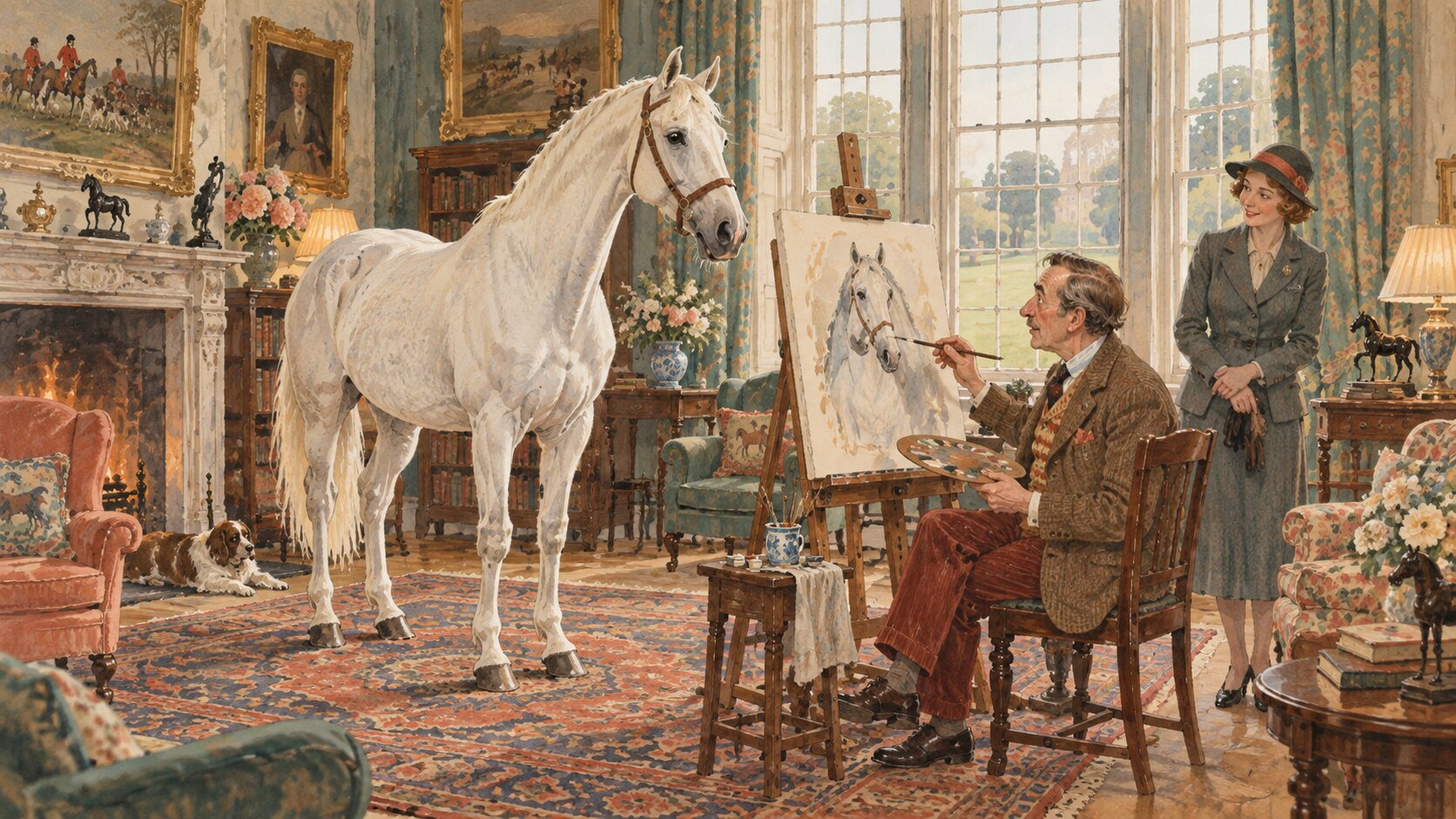
A horse stands inside a furnished room, all four feet beyond the doorway. A seated man paints at an easel in front of it. This is Lord Berners painting Moti, the horse belonging to his guest Penelope Betjeman, who sits nearby. The photograph puts an unmistakably large animal in an unmistakably domestic setting.
Moti is also remembered as a visitor entertained to tea at Faringdon House, Berners’ English country home. In the painting photograph, the mirrors, wall lights and patterned rugs remain in place. There is no stable dressed up as a sitting room. The horse has entered the room where the owner works on his picture.
Berners was a composer, painter and writer. The unusual welcome was part of a life occupied with making things: music, theatrical designs and fiction populated by recognizable versions of his friends. The people he entertained and the work he produced were often connected.
During the 1930s, he lived at Faringdon with his younger lover Robert Heber-Percy, known as the Mad Boy. Writers, musicians and artists visited the home they shared. The circle included H. G. Wells, Salvador Dalí and Nancy Mitford. For some guests, the visit would lead to more than a story about their host’s entertaining habits.
Outside, Berners put his tastes on display by having pigeons dyed pink and other colors. Heber-Percy’s granddaughter, the writer Sofka Zinovieff, recalled that the colored birds were still there when she first visited years after Berners’ death. They made the grounds look as though some of their decorations had acquired wings.
The house was also a place to work. Choreographer Frederick Ashton and conductor Constant Lambert spent weekends there devising a ballet scenario with Berners. The result was A Wedding Bouquet, first performed in 1937. A house party had helped assemble a production.
Its starting point was writing by another visitor, Gertrude Stein. Inspired by one of her plays, Berners wrote the music and created the designs, while Ashton supplied the choreography. The guest list became a set of practical contributions to the same work.
The wedding in the ballet runs into disorder. The bridegroom’s past affairs intrude on the celebration, a guest gets drunk, and troubled relationships disturb the party. Stein’s words were initially sung by a chorus. Berners’ scenery and costumes accompanied his score: the painter who welcomed a horse into his house also designed the surroundings of an entire stage wedding.
Berners, in turn, became material for someone else’s work. Nancy Mitford based Lord Merlin in The Pursuit of Love on him. The fictional aristocrat had colored birds and a hilltop folly, taking recognizable features of Berners’ surroundings into a novel.
The real tower stood on Faringdon Hill. Berners commissioned Gerald Wellesley to build it in 1935. He also enjoyed altering photographs, and on a surviving postcard of the tower he appears transformed into an angel, complete with wings.
EDITORIAL RESPONSIBILITY
FactosBrain Editorial Desk
The FactosBrain Editorial Desk researched and reviewed this article under our editorial policy. We assess error reports under our corrections policy.