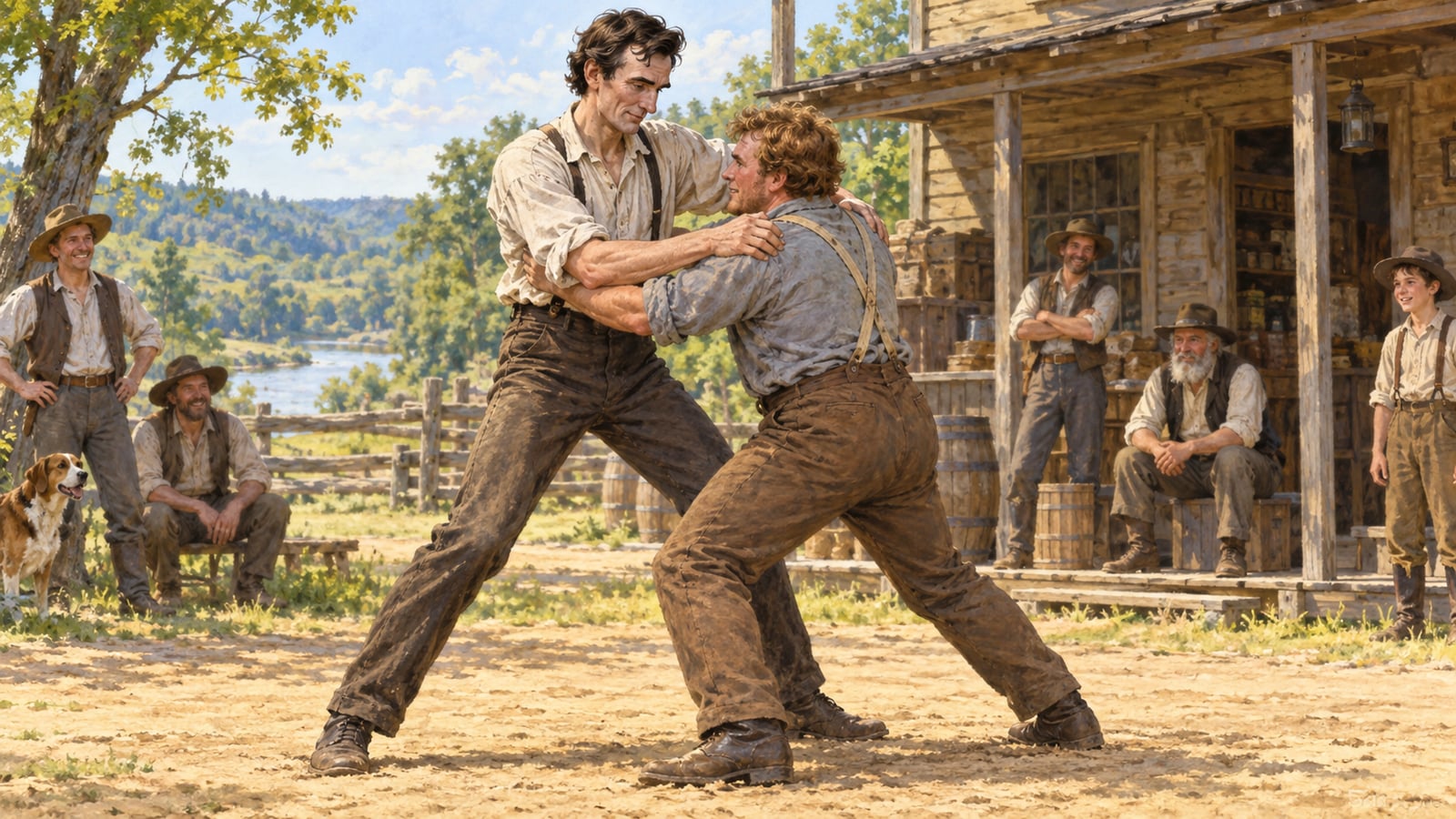
A shopkeeper's enthusiasm helped put his employee in an awkward position. Denton Offutt praised the young Abraham Lincoln's abilities, including his strength, to people who already had a local champion of their own. In New Salem, Illinois, in 1831, that was an invitation to a contest.
Lincoln was twenty-two, still making his way in the village and working for Offutt. He was neither a president nor a lawyer. Later accounts describe his employer as an extravagant admirer who advertised what Lincoln could do. Once the boasting became a challenge, however, it was the employee who had to provide the demonstration.
Jack Armstrong led the young men associated with nearby Clary's Grove. They were known for testing newcomers through races, wrestling, and rough encounters. Claims that a stranger could beat anyone were unlikely to remain casual conversation. Wagers and spectators could turn somebody else's praise into a public obligation.
The match does not survive as a reliable sporting scorecard. Recollections gathered long afterward differ in their details. Some describe a prolonged struggle in which neither man could throw the other; some introduce foul play and a threatened fight. Ward Lamon's 1872 biography recounts Lincoln proposing that they stop while bystanders urged Armstrong to continue. Such scenes belong to later testimony, not a contemporary blow-by-blow report.
The Papers of Abraham Lincoln project judges that the contest probably ended in a draw. That leaves less room for a clean, cinematic victory, but the aftermath is interesting in its own right. Armstrong became Lincoln's friend.
Lincoln stayed with him for a time and borrowed his horse. He voted for Armstrong as constable that August. The following year, Armstrong served as a sergeant in Lincoln's company during the Black Hawk War. The relationship extended into practical support and shared service, well beyond the spectacle of two men testing their strength.
It also reached the next generation. After Jack's death, his son William Duff Armstrong faced a murder charge, and Lincoln served as a defence lawyer. The family that had welcomed him during his early years remained part of his life after he entered a different profession.
The wrestling story is memorable because it puts a future president in an unexpected setting. Yet it does not need an unquestionable victory to have an ending. The newcomer and the local strongman who tried to throw one another eventually found themselves on the same side.
EDITORIAL RESPONSIBILITY
FactosBrain Editorial Desk
The FactosBrain Editorial Desk researched and reviewed this article under our editorial policy. We assess error reports under our corrections policy.