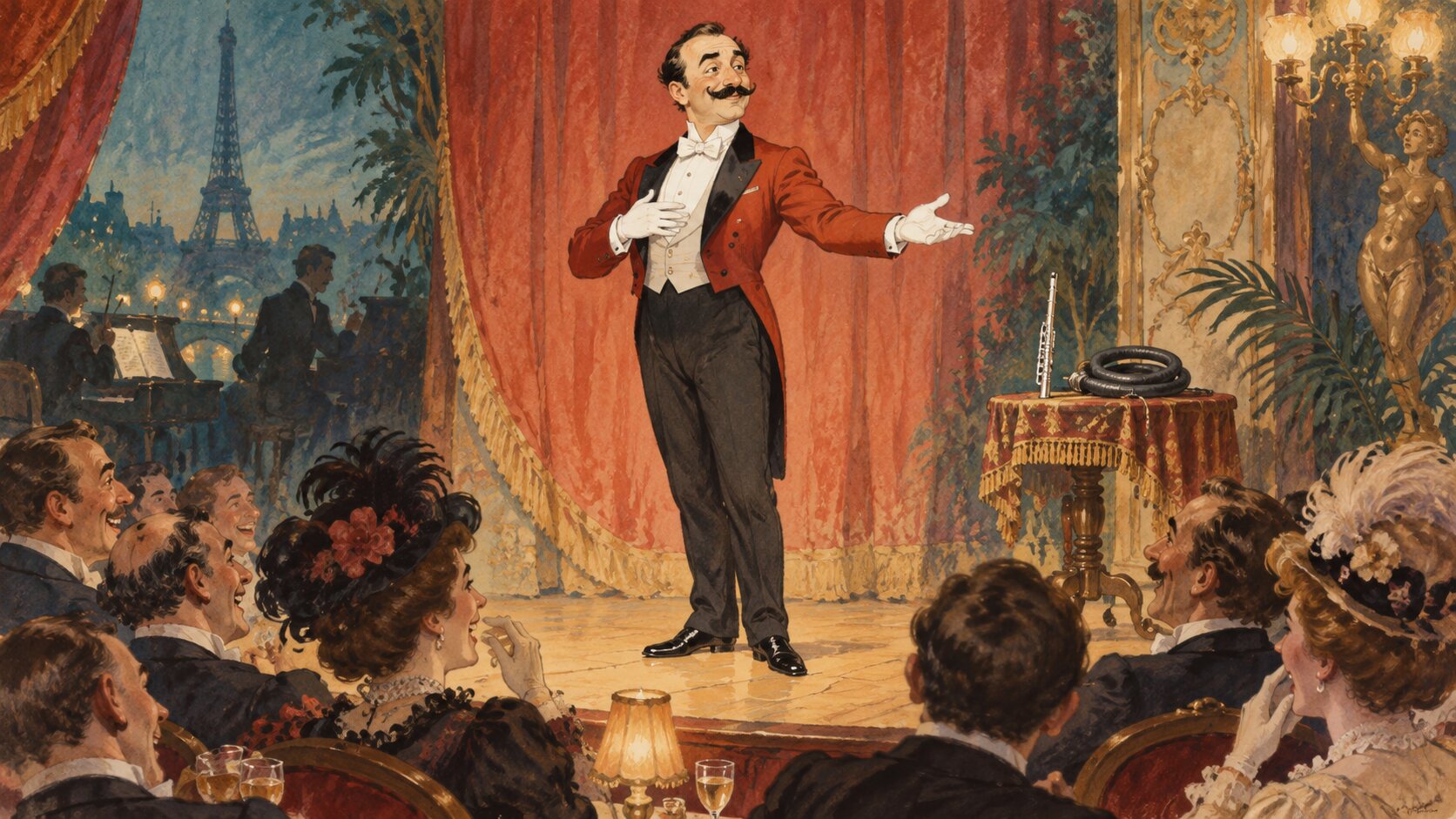
Joseph Pujol dressed carefully for his performance: a red jacket, white bow tie and white gloves. The sounds he offered his audience came from his backside. In the Paris of the 1890s, this smartly dressed entertainer became a Moulin Rouge attraction under the name Le Pétomane, a stage name announcing his specialty in passing wind.
It was a routine, rather than one embarrassing noise stretched into a career. Pujol distinguished delicate sounds from loud, forceful ones and assigned them characters and situations. The Moulin Rouge offered unusual attractions alongside dancing and songs. His particular instrument required no separate case to carry it onstage.
For another part of the act, he connected a flute to a rubber tube and supplied the air to play it. One tune was the familiar French song ‘Au clair de la lune.’ The audience could join in. The point was no longer simply that a man had made an unexpected noise: he could arrange successive sounds into a recognizable performance.
Contemporary doctors observed that the act did not depend on storing up ordinary intestinal gas. Pujol drew outside air into his body through his anus and then expelled it. The doctors described changes in abdominal effort and anal sphincter tension as altering the sounds' intensity and pitch. The advertised joke was farting; the material used for it was air he had deliberately taken in.
Doctors investigated that distinction. In 1892, Marcel Baudouin published observations after attending performances and examinations. His report began with the suspicion that the audience was hearing a trick. The medical observers wanted more than an account of an entertaining evening: Pujol demonstrated his actions repeatedly for them.
They observed a bodily ability rather than concealed stage machinery. Baudouin also reported that the expelled air lacked the familiar smell of intestinal gas because it had spent only a short time inside the body. What the theater sold under a comic name became something the doctors tried to describe and explain.
The Moulin Rouge had a more immediate reason to value it. Pujol brought in customers and became one of its signature attractions. Publicity called him the only artist who did not pay authors’ royalties. Even the source of his music became part of the advertising joke.
The business arrangements were less playful. Pujol established his own Théâtre Pompadour company and pursued performances outside the venue. The Moulin Rouge successfully sued him for breach of contract in 1894. A performance built around a bodily noise now had earnings and contractual rights worth fighting over.
The Moulin Rouge introduced a female replacement who produced similar sounds with bellows hidden under her skirt. Pujol challenged the replacement act in court in 1898 and lost. For an audience, the sound was an invitation to laugh. For the performer and the theater, it was also an attraction neither wanted the other to take away.
EDITORIAL RESPONSIBILITY
FactosBrain Editorial Desk
The FactosBrain Editorial Desk researched and reviewed this article under our editorial policy. We assess error reports under our corrections policy.