Larry Walters took a BB gun into the sky because he intended to come down. It was part of his landing equipment: shoot a few balloons, reduce their lift and let the chair descend. On July 2, 1982, he set out from a California backyard with that solution ready beside him.
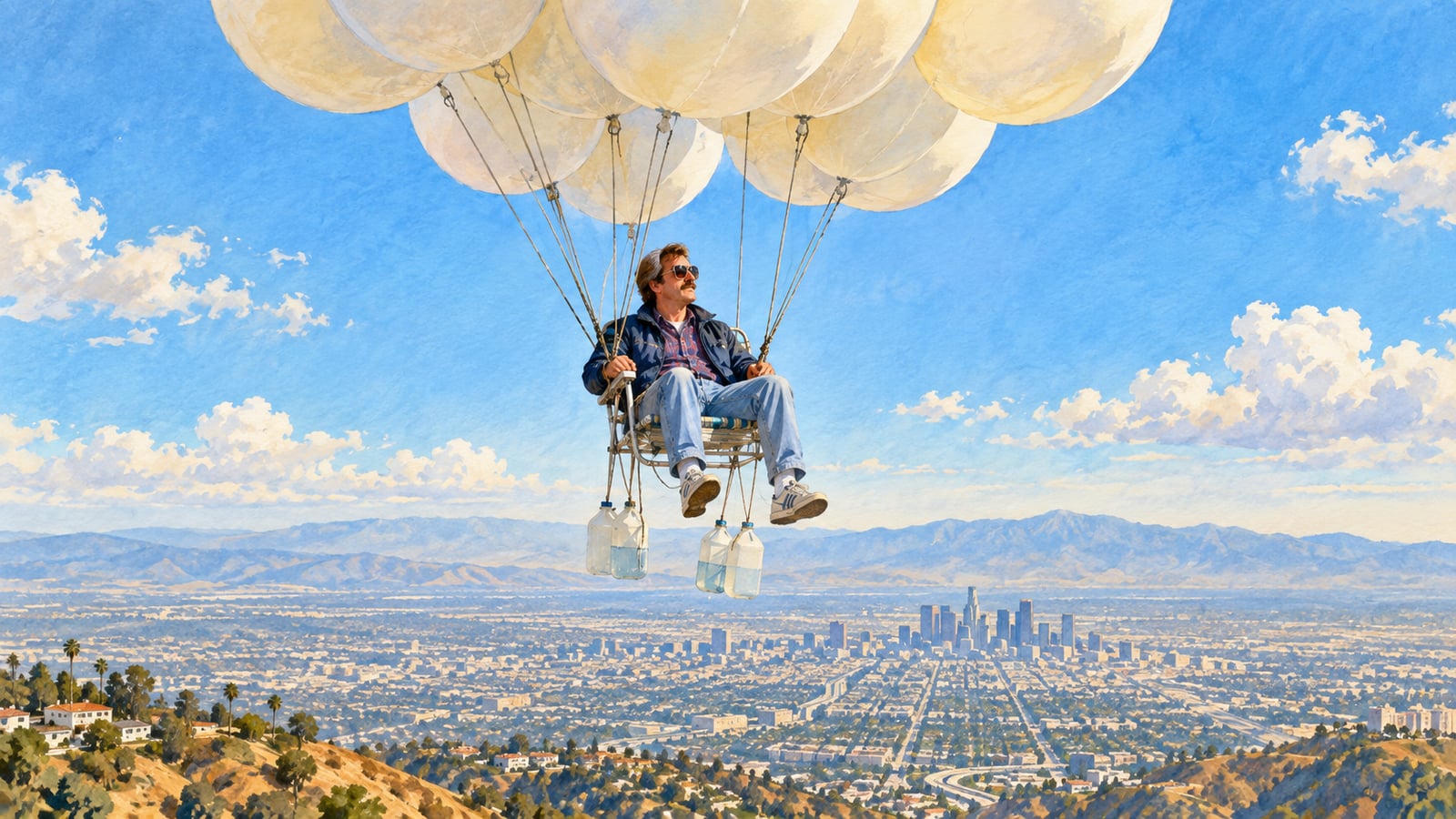
His aircraft consisted of an aluminium lawn chair suspended beneath forty-two helium-filled weather balloons. Water containers attached to the chair provided ballast. There were no wings or engine. The balloons supplied the upward pull, while the chair, its occupant and its load supplied the weight.
Walters was a truck driver, not a licensed balloon pilot. The difference between getting off the ground and controlling what happened next soon became clear. His chair was tethered to a car. When one restraining cord was released, the other snapped under the strain, and the chair rose rapidly.
It reached about 16,000 feet, or 4,880 metres. This was far beyond a leisurely view over the neighbourhood roofs. Commercial pilots reported an extraordinary sight to air traffic control: a man sitting in a chair in the sky. His improvised balloon had entered airspace used by other aircraft.
At that altitude, the chair was still only a chair. There was no cabin to keep out the cold or supply a comfortable atmosphere. Walters faced freezing temperatures and less oxygen, with little more control over his situation than the equipment he had brought from the backyard.
He shot some balloons to begin descending. When the descent became too fast, he released water to lighten the load. These were adjustments in opposite directions: remove lift to go down, remove weight to slow the fall. A balloon that had been punctured could not be inflated again during the flight.
Then Walters dropped the gun. He had not secured it to the chair. The tool prepared for his return reached the ground before he did, while he continued drifting. There was no engine to steer him toward a convenient landing place, and no runway lined up beneath his feet.
Power lines finally interrupted the flight in Long Beach. The dangling rigging became caught, causing a brief local power outage. Walters survived, but the chair's arrival created a problem for aviation officials as well as for the electricity supply. An ordinary garden seat had become an aircraft by leaving the garden.
The authorities pursued violations involving controlled airspace, licensing and the safety of his craft, and imposed fines. Proving that the chair could fly was not the same as having permission to fly it. Once airborne, his private experiment shared the sky with people who had not agreed to take part.
After landing, Walters gave the chair to a neighbourhood boy, Jerry Fleck. Fleck kept it. Decades later, the surviving chair, ropes and water containers entered the collection of the Smithsonian's National Air and Space Museum, where conservators could examine the equipment rather than rely only on the unlikely story.
The object had earned its place among aircraft without acquiring wings or an engine. Someone had actually sat in it, risen three miles above the ground and returned. It was still recognizably a lawn chair. It now also had a flight history.
EDITORIAL RESPONSIBILITY
FactosBrain Editorial Desk
The FactosBrain Editorial Desk researched and reviewed this article under our editorial policy. We assess error reports under our corrections policy.