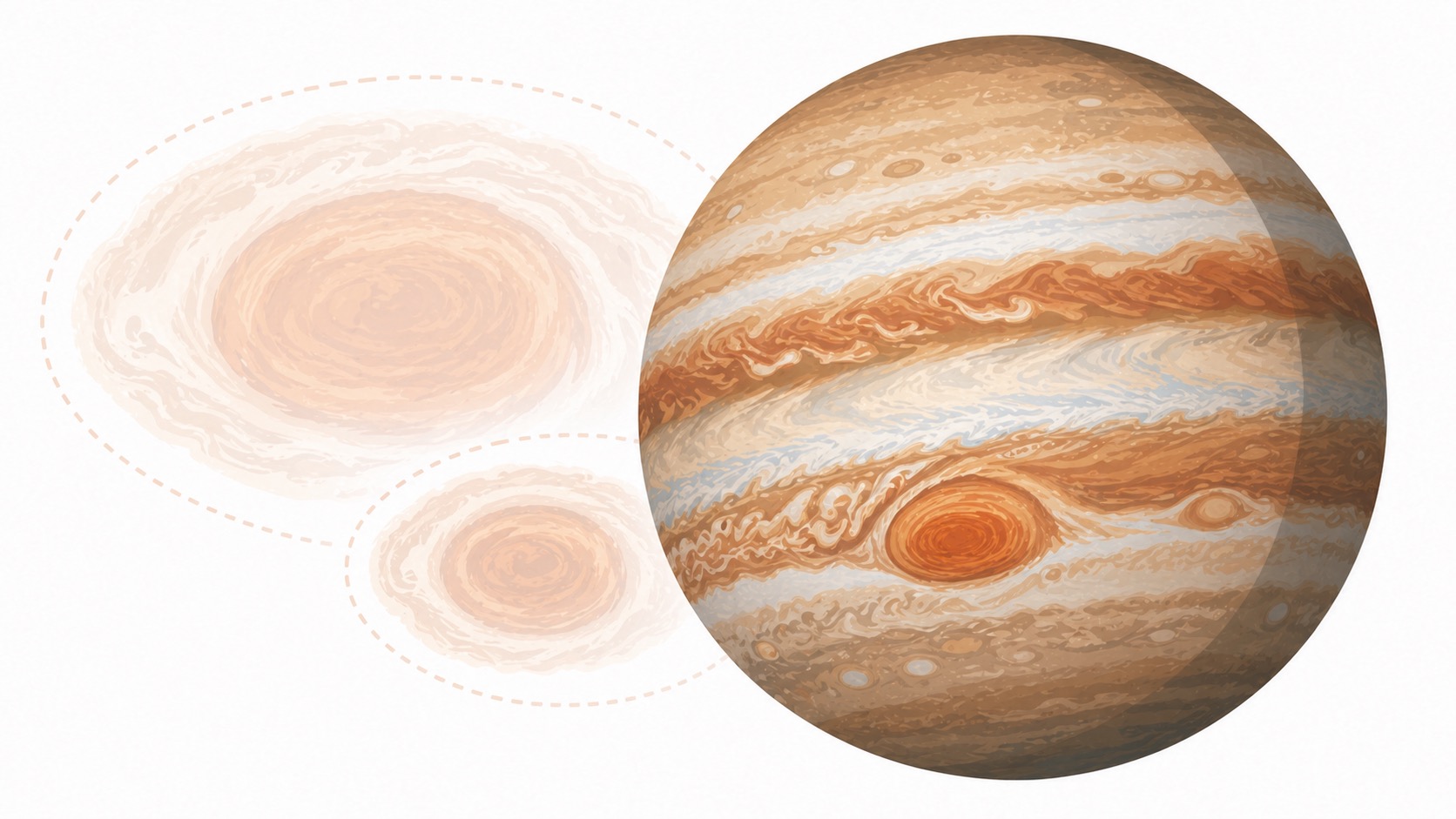
Jupiter's Great Red Spot is a vast anticyclonic storm, a high-pressure vortex whose winds rotate counterclockwise in the planet's southern hemisphere. It has survived far longer than any familiar terrestrial storm because it exists in a huge, rapidly rotating atmosphere without a solid surface beneath it to provide the same kind of friction that weakens weather systems on Earth.
The storm is embedded between powerful jet streams moving in opposite directions. Those flows help confine the vortex, while interactions with smaller storms can transfer energy and alter its shape. Jupiter's fast rotation strengthens the large-scale organization of atmospheric motion, allowing long-lived bands and vortices to persist.
Long-lived does not mean unchanged. Historical measurements show that the Great Red Spot has contracted dramatically from the broad oval recorded in the 19th century. Modern spacecraft and Hubble observations have also tracked changes in wind, color, height and internal structure. It remains comparable to or wider than Earth, but its dimensions depend on the date and measurement method.
The phrase “raging for hundreds of years” needs a qualification. Astronomers observed a reddish spot in the 17th century, but there is a gap in observations before the current Great Red Spot was documented regularly from the 19th century onward. The two may represent the same storm, but uninterrupted identity across that gap is not proved.
Its red color is another open question. Compounds lifted from deeper clouds may react with sunlight and atmospheric chemicals to produce reddish material, but researchers have not settled on one complete recipe. Color changes do not necessarily map directly to storm strength, so a darker or paler appearance is not a simple health gauge.
The Great Red Spot lasts because Jupiter supplies an environment where a giant vortex can be confined and repeatedly energized, yet no storm is literally eternal. Its continuing shrinkage makes it a changing laboratory for planetary weather. The most accurate wonder is not that it has remained frozen for centuries, but that a dynamic storm can preserve its identity while constantly evolving.
EDITORIAL RESPONSIBILITY
FactosBrain Editorial Desk
The FactosBrain Editorial Desk researched and reviewed this article under our editorial policy. We assess error reports under our corrections policy.