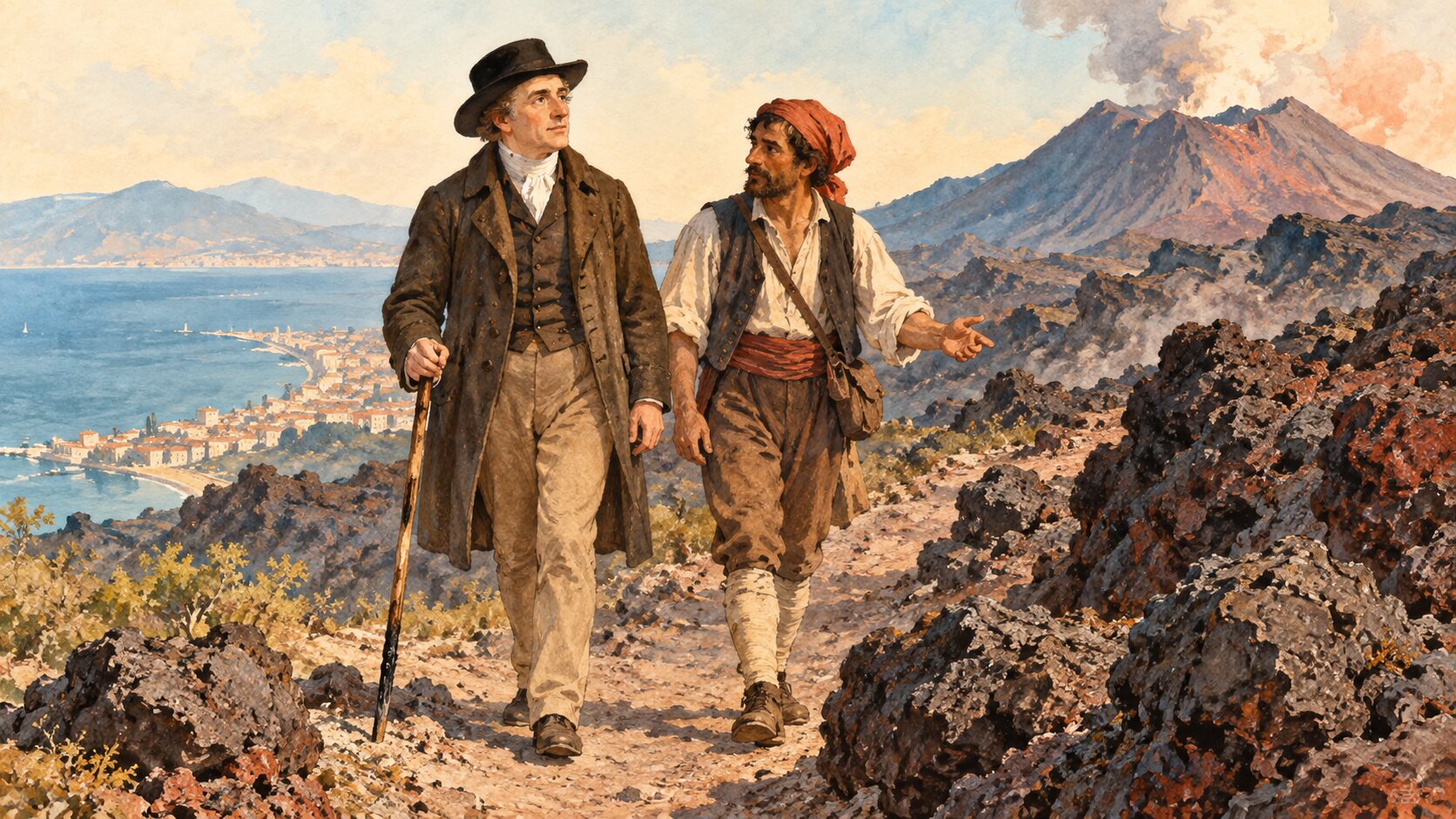
James Holman's souvenir from Vesuvius was a scorched walking cane. His guide had directed it towards the flames, charring its lower portion. Holman wrote that he kept it as a memorial. He had travelled up the volcano without being able to see the fire.
A former officer in the Royal Navy, Holman had lost his sight at about twenty-five after illness. He later travelled through Europe, including France and Italy. In Naples, he decided to visit Vesuvius. Friends tried to discourage the ascent. When he asked how other people climbed it, they replied that those people could see their way. He answered that he expected to feel his own.
His cane served more purposes than supporting his weight. Holman used the echoes of its taps to navigate. He examined things through touch and gathered information from people describing what was around him. On the mountain, too, he accepted guidance while choosing ways to inspect what he could for himself.
In his European travel narrative, he leaves Naples in the afternoon with a friend and hires a local guide below the mountain. Donkeys are available to carry visitors much of the way up. The party chooses to walk, so that Holman can acquire a more accurate idea of the road.
The going becomes progressively worse. Loose volcanic dust is mixed with sharp stones. Ash enters Holman's shoes and irritates his feet, forcing him repeatedly to take them off and empty them. His account of the climb includes the mountain as a practical inconvenience underfoot.
At the burning part of the mountain, the guide takes his arm. Fire and smoke emerge between the stones they walk on, and they hear crackling beneath their feet. Holman admits thinking about possible accidents. He also records the confidence he takes from following a careful guide.
They cannot stay there long: the footing is too hot and the sulphurous vapour too strong. Before retreating to a firmer, cooler spot, the guide directs Holman's cane towards the flames. The object used to find his way acquires the scorch marks that he will keep as a souvenir.
Holman wants to continue to the rim of the larger, upper crater. The guide refuses unless they wait for dawn. The moon is setting, and continuing would expose them to darkness before they arrive. Their arrangements make waiting inconvenient, so they turn back. The visit in Holman's own account stops short of the higher crater he hoped to reach.
Touch could not give him unrestricted access everywhere else, either. Earlier, in the Vatican sculpture galleries, he had to approach the statues in turn and hear descriptions of them. Soldiers stationed in the rooms prevented visitors from touching the works. Holman admits that he occasionally examined a statue by stealth when told a soldier's back was turned.
His travel therefore depended partly on the people available to describe what he encountered. He later explained how continually questioning others on the spot helped him collect details he could not inspect visually. The heat he felt on Vesuvius and the appearance of a sculpture described to him reached his notebook by different routes.
People also helped turn those observations into writing. Holman kept a rough diary and separate notes on particular subjects. He preferred dictating to a friend who could act as a scribe. When no one was available, he could use his own writing apparatus, though he found it more laborious than dictation. The diary was not always current: entries could fall several days, or even a fortnight, behind.
Holman was frequently asked what use travel could have for someone unable to see. In A Voyage Round the World, he answered with a question about travel writers generally: did any traveller see everything he described, and did not every traveller depend on other people for much of the information he collected?
EDITORIAL RESPONSIBILITY
FactosBrain Editorial Desk
The FactosBrain Editorial Desk researched and reviewed this article under our editorial policy. We assess error reports under our corrections policy.