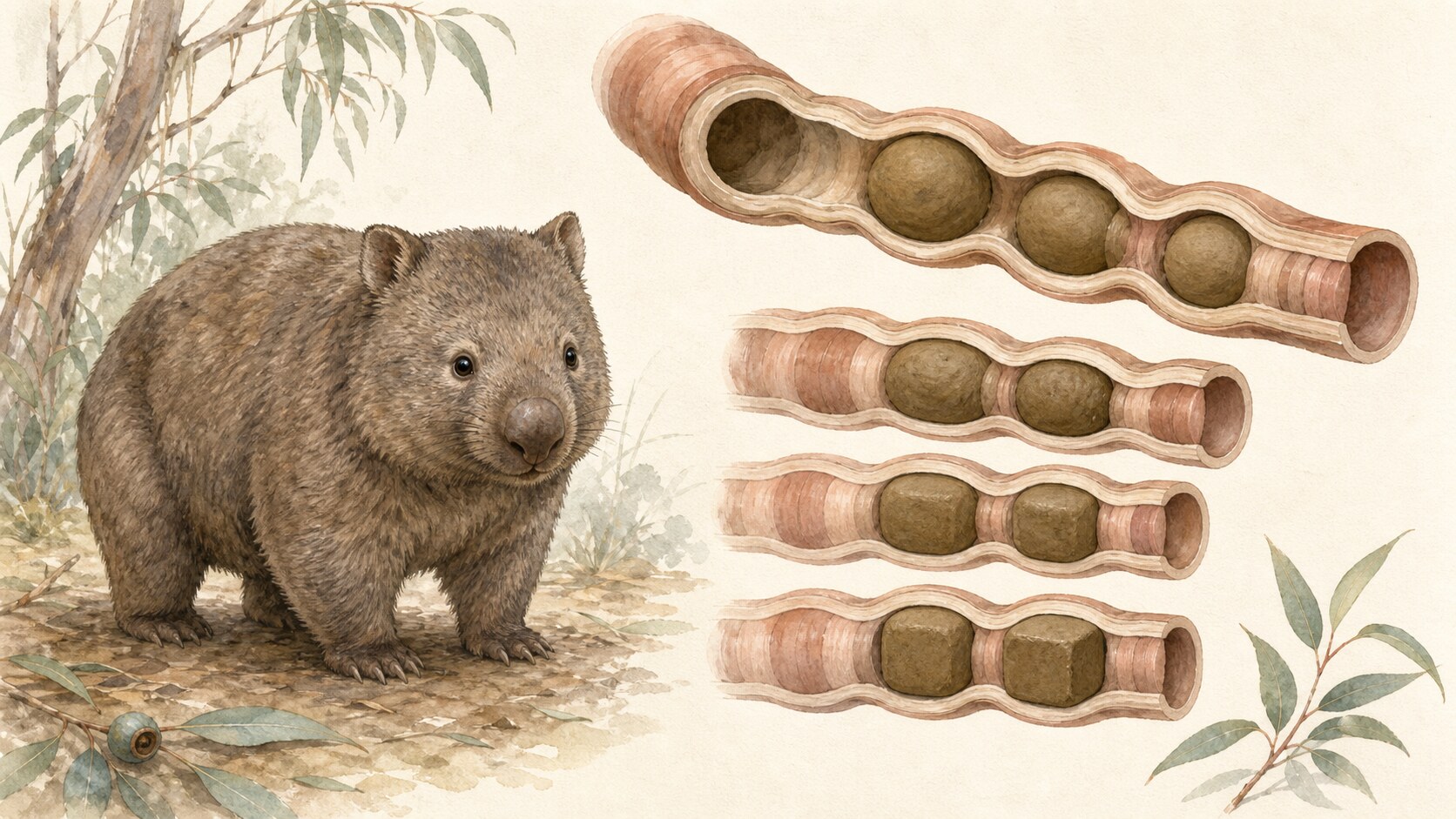
A wombat's cubic droppings are not stamped by a square anus. The shape develops before defecation, in the final part of the large intestine. As digested material moves slowly and loses water, different sections of the intestinal wall stretch and contract by different amounts, forming flatter faces and sharper corners.
Researchers examined wombat intestines and inflated sections to measure how readily the walls expanded. The circumference was not equally flexible in every direction. More compliant regions alternated with stiffer regions, so pressure inside the bowel could deform its contents unevenly rather than preserving the round cross-section common in many other animals.
As muscular contractions move material forward, softer wall regions stretch farther while stiffer regions yield less. A physical model developed by the researchers showed how repeated differences in deformation can create four areas of distinct curvature. The bowel does not slice a finished lump like a die; it gradually reshapes the material as it travels.
Water content is also essential. Wombats recover water efficiently, and their feces become unusually dry during the long passage through the colon. A material that is too fluid cannot retain corners, while one that is already rigid cannot be reshaped easily. The feces must deform when stress exceeds a threshold yet hold the resulting form afterward—a combination described by yield stress and viscoelastic behavior.
The function of the shape requires more caution. Wombats place scent-marking droppings on visible rocks, logs and other raised sites. Researchers have proposed that an angular piece is less likely to roll away from those positions. That idea is plausible and often repeated, but experiments have not established that preventing rolling was the evolutionary cause of cubic feces.
Not every dropping is a perfect geometric cube, and shape can vary with an animal's hydration and condition. The important mechanism lies in material physics rather than the shape of the exit. Uneven intestinal elasticity, muscular contractions, slow transit and water removal work together, allowing soft living tissue to mold an angular object inside the body.
EDITORIAL RESPONSIBILITY
FactosBrain Editorial Desk
The FactosBrain Editorial Desk researched and reviewed this article under our editorial policy. We assess error reports under our corrections policy.