Most intercontinental Internet traffic travels through fiber-optic cables on the seabed, not through satellites. Even a wireless phone connection may join terrestrial and subsea fiber after reaching a cell tower. The International Telecommunication Union says submarine cables carry about 99 percent of global Internet traffic, supporting finance, cloud services, video calls and other real-time communication.
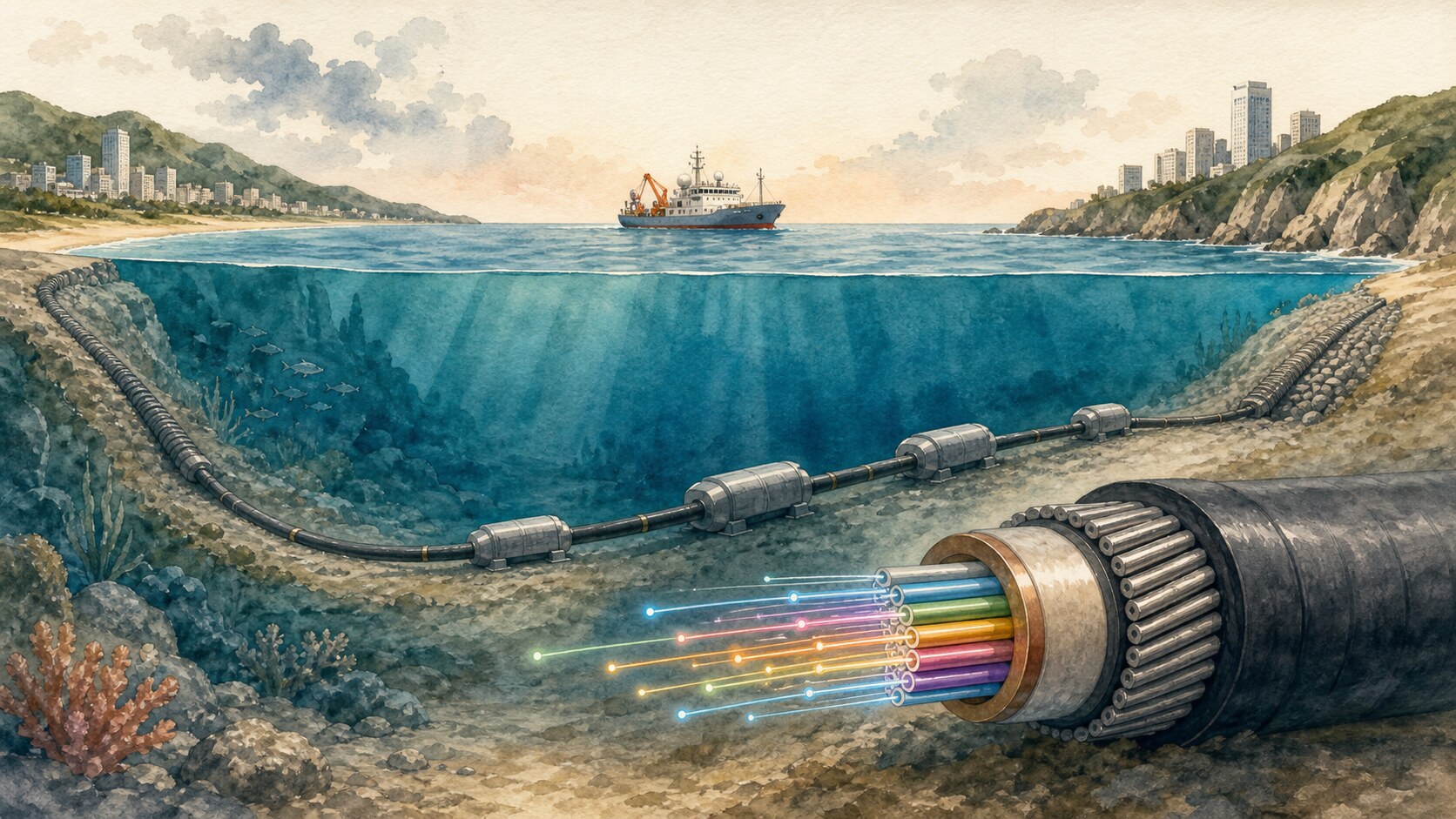
At a cable landing station, transmission equipment converts data into patterns carried by laser light. Thin glass fibers guide that light across the ocean, while wavelength-division systems place many colors of light—and therefore many channels—on the same fiber. Equipment at the far landing station receives the optical signals and converts them into data that terrestrial networks can route onward.
Light travels efficiently through glass but still weakens and distorts over great distances. Ocean-crossing systems contain repeaters at intervals to amplify the optical signal. A metallic conductor inside the cable supplies those repeaters with direct-current power from shore. Each system may contain several fiber pairs, and its usable capacity also depends on terminal equipment and how many optical channels are activated.
Protection changes with location. Across much of the deep ocean, a cable can be roughly as wide as a garden hose and rest directly on the seabed. Near coasts, where anchors and fishing gear pose greater risks, additional steel armor may be added and the cable may be buried. Marine surveys choose routes that avoid unstable terrain, busy anchoring areas and other known hazards where practical.
Faults still occur. Accidental human activity—especially fishing and anchoring—is a much larger cause than the popular shark-bite story, while earthquakes and submarine landslides can also break cables. Network operators spread traffic across multiple systems so that available routes can carry data around a failure. Repair ships locate the fault, recover the cable, splice the damaged section and return it to the seabed.
A request to an overseas website does not necessarily remain on one fixed cable. Routers forward data according to the destination and currently available network paths, with subsea fiber handling the ocean segment. Satellites remain valuable for remote coverage and some distribution tasks, but fiber offers enormous capacity at low cost per bit. That combination keeps submarine cables at the center of international Internet infrastructure.
EDITORIAL RESPONSIBILITY
FactosBrain Editorial Desk
The FactosBrain Editorial Desk researched and reviewed this article under our editorial policy. We assess error reports under our corrections policy.