Look a little closer
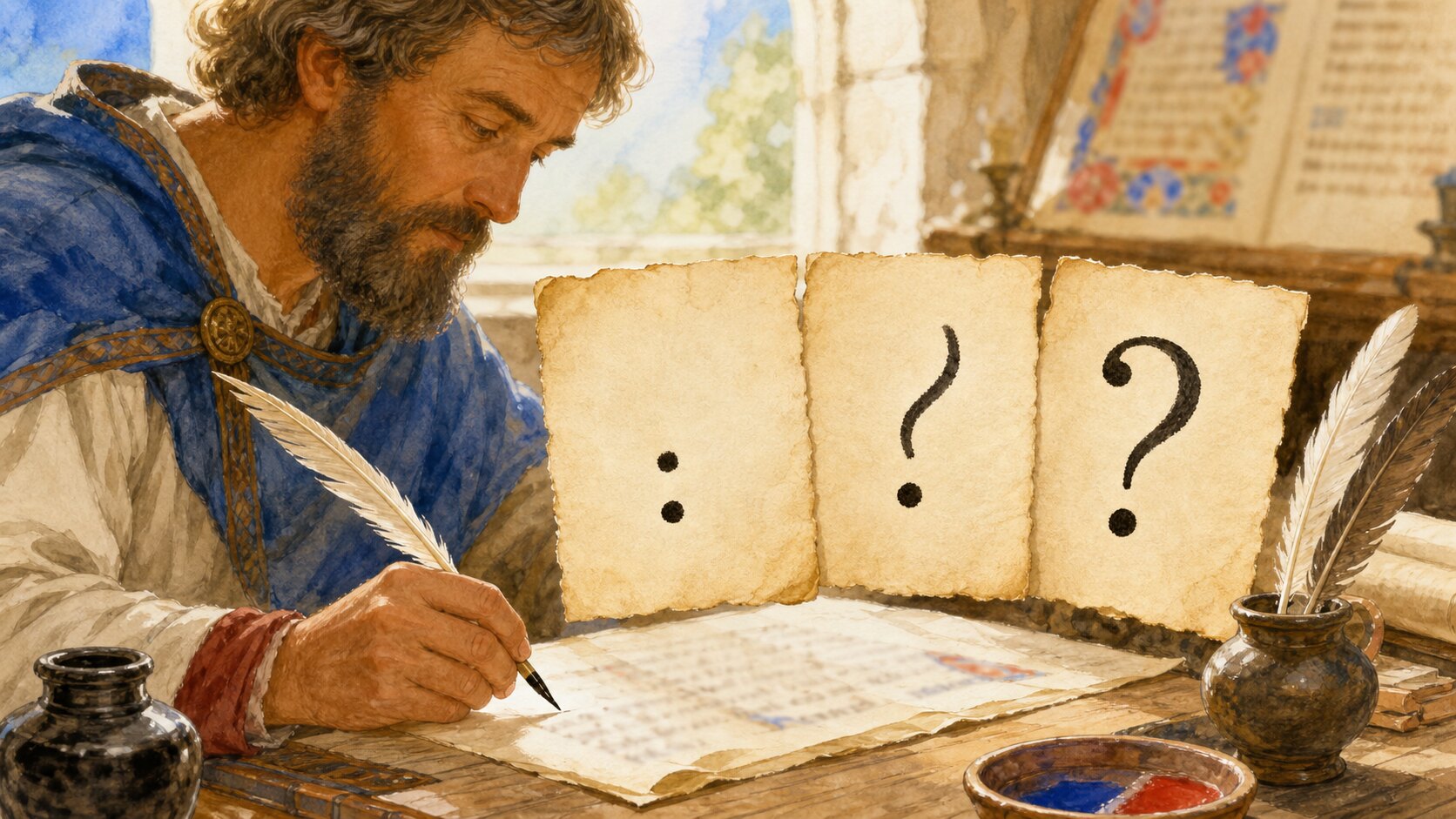
The modern question mark was not designed in one stroke by a known inventor. It developed over centuries from medieval scribal signs that helped readers supply interrogative intonation when reading aloud. By the late eighth century, Latin manuscripts used a punctus interrogativus with a rising, wavy stroke above a point. Repeated copying, changing scripts, and eventually type design gradually pulled that family of shapes toward the familiar curved hook and separate dot.
Ancient texts did not automatically carry a modern punctuation system. Some writing traditions separated neither every word nor every sentence, and a trained reader recovered structure from grammar and context. A question word or unusual word order could announce an interrogation, but a yes-or-no question might resemble a statement on the page. Early marks were therefore often closer to performance cues than silent grammatical fences: they helped a reader decide where to pause and how to shape the voice.
The effort to mark questions was not a single invention confined to Latin script. Syriac biblical manuscripts from the fifth and sixth centuries contain a vertical pair of dots, later called the zawga elaya, above a word near the beginning of certain questions. Cambridge manuscript scholar Chip Coakley has proposed it as the earliest surviving question mark because it warns readers about sentences that would otherwise be ambiguous. There is no demonstrated line of descent from those dots to the Latin question mark, however; the systems probably developed independently.
Within Latin manuscript culture, a system of signs called the positurae took shape during the Carolingian period. The Oxford Handbook of Latin Palaeography describes this era as the beginning of a new punctuation system, while scholarship on Latin New Testament manuscripts distinguishes a new punctus interrogativus among signs built from points and strokes. Its early form could resemble a rising zigzag or tilde above a dot. It looks related to the modern mark, but it was not yet one fixed glyph reproduced everywhere.
The upper stroke may have suggested a movement of the reading voice. Medieval punctuation frequently organized degrees of pause and rhetorical delivery rather than mapping grammar exactly as school rules do today. Yet it is safer to call the line an intonational cue than a literal graph of one universal rising pitch. Questions do not rise in every language or context, and surviving signs vary by century, region, manuscript, and hand. The evidence records a changing practice, not a single designer's specification sheet.
That is why the appealing story about the Latin word quaestio deserves caution. In the tale, scribes abbreviate it to qo, place the q above the o, and slowly transform the stack into a hook over a dot. The sequence is memorable, but a continuous manuscript trail for those intermediate forms has not been established. Documented Carolingian interrogation signs offer firmer evidence. Alcuin of York is also sometimes named as the inventor because he helped reform learning and writing at Charlemagne's court, but no decisive evidence assigns the symbol to him alone.
Printing did much to make the mark look stable. A handwritten stroke could change angle, length, curvature, and dot placement every time a scribe lifted a quill. A printer instead needed a durable piece of type that could be reused and combined predictably with letters on a line. As printers and punchcutters selected and copied regional forms after the Renaissance, the hooked upper stroke and detached dot became conventional. Typefaces still preserve variation: the curve may be open or tight, the terminal blunt or bulbous, and the dot round, square, or diamond-shaped.
Neither shape nor placement is universal across writing systems. The Unicode Standard records a modern Greek question mark that has the shape of a semicolon. Arabic-script typography uses a question mark curved in the opposite direction, visually suited to right-to-left text. Spanish places an inverted opening mark at the beginning of the questioned span and the familiar closing mark at its end, allowing a reader to prepare the interrogative reading before reaching the final character. Each convention solves the same communicative problem within a different graphic and linguistic system.
The curve cannot therefore be traced confidently to an ear, a cat's tail, or two stacked letters simply because those pictures look persuasive now. What the record supports is more interesting: writing communities needed to preserve a cue that speech supplies and bare words can lose. In Latin-script Europe, a dotted, curved sign used in reading practice changed through many hands and was disciplined by print into today's form. The question mark is less a drawing of curiosity than a small fossil of the reader's vanished voice.
EDITORIAL RESPONSIBILITY
FactosBrain Editorial Desk
The FactosBrain Editorial Desk researched and reviewed this article under our editorial policy. We assess error reports under our corrections policy.