Look a little closer
A submarine uses main ballast tanks for the large transition from surface buoyancy to submergence, then combines variable ballast, trim tanks, and diving planes for precise control underwater. The aim is not to remain heavily negative and keep falling, but to approach neutral buoyancy, where average density is close to that of seawater. Motion past winglike control surfaces can then steer the boat upward or downward efficiently.
Buoyancy is the upward force equal to the weight of displaced water. A submarine's strong pressure hull retains nearly the same external volume as depth increases, so the water displaced by that sealed structure changes little. If total weight is less than the buoyant force, the boat tends to rise; if it is greater, the boat sinks; if they are nearly equal, small vertical motions are easier to control. Depth keeping manages this small difference alongside hydrodynamic forces.
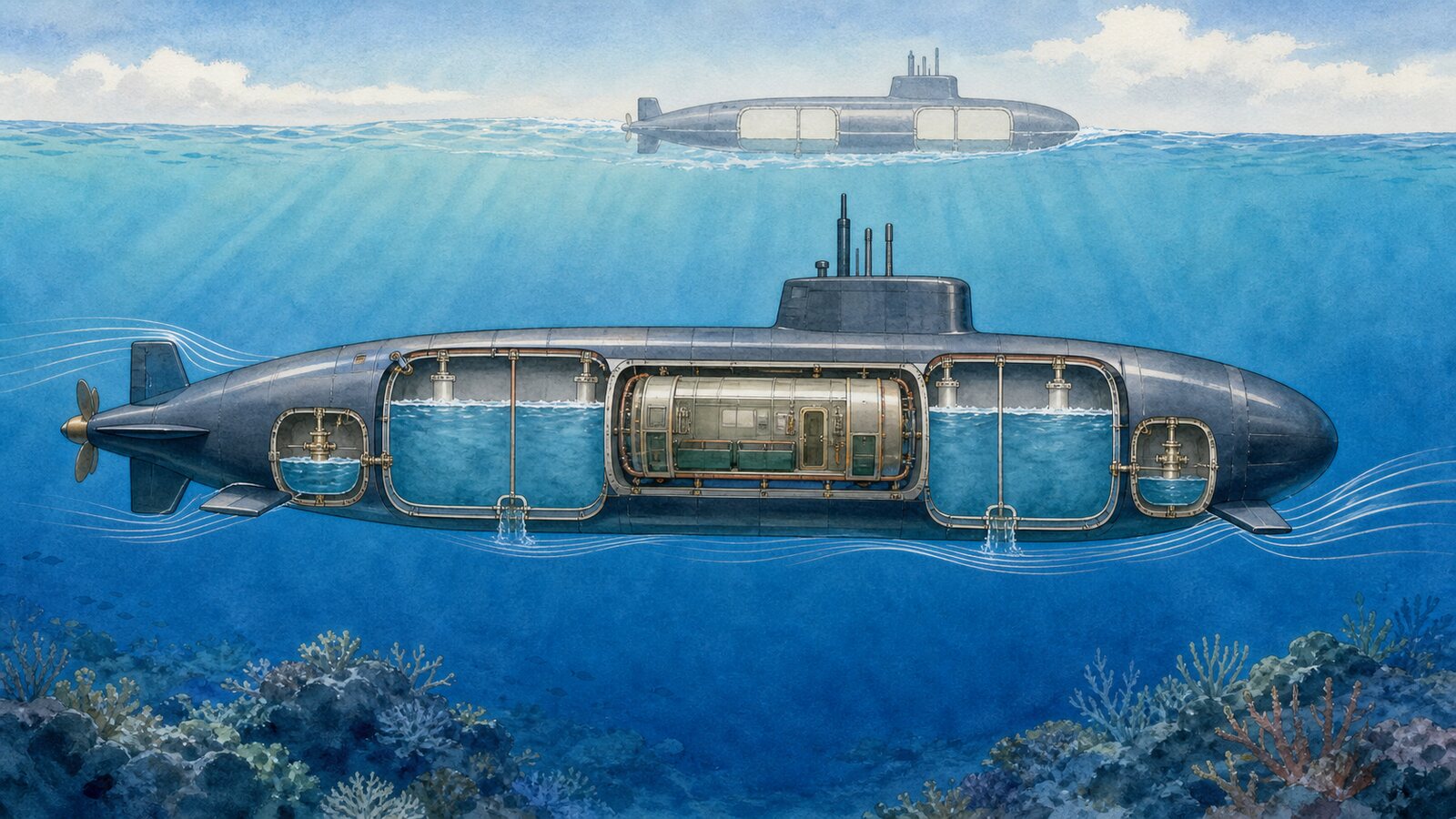
At the surface, air in the main ballast tanks excludes seawater and provides reserve buoyancy. To dive, upper vents open so the air can escape while seawater enters through flood openings below. Once flooded, these external tanks no longer displace the volume of water that their air previously kept out, so effective buoyancy falls. The familiar phrase that water simply makes the submarine heavier is useful shorthand, but loss of air-filled displacement better describes an open-bottom main tank.
This distinction separates the pressure hull from the hydrodynamic outer casing. The sealed pressure hull houses people and machinery and contributes displacement, while some spaces outside it—including main ballast tanks during submerged operation—communicate with the sea. The smooth visible outline is not one enormous empty air bottle. Buoyancy depends on which volumes actually exclude surrounding water at that moment.
After submergence, the crew does not normally make every small depth change by repeatedly flooding and blowing the large main tanks. They are the coarse surface-to-submerged system and remain flooded during underwater operation. Smaller variable-ballast or depth-control tanks adjust carried water to compensate for changes in stores, fuel, equipment, personnel, or seawater density. These corrections bring the boat close to neutral rather than setting it on a continuous uncontrolled descent.
Neutral buoyancy does not guarantee that a submarine will hang forever at one geometric point without control. Salinity and temperature alter the density of surrounding water, pressure can produce small structural effects, and movement of mass aboard changes the balance. Currents and vertical water motion add disturbances. Depth, vertical rate, and attitude therefore require ongoing measurement and modest corrections instead of one permanent tank setting.
When the submarine moves forward, diving planes—also called hydroplanes—provide the active steering force. Tilting these short wings changes the pressure and momentum of water passing around them, producing an upward or downward force. Stern planes strongly influence pitch, rotating the bow toward a climb or dive, while forward or sail-mounted planes assist depth and attitude depending on the design. With very little forward speed, their hydrodynamic authority becomes correspondingly weak.
Fore-and-aft balance, or trim, is distinct from total buoyancy. A boat can have weight equal to buoyant force yet pitch because its center of gravity and center of buoyancy are not properly aligned. Moving water between forward and aft trim tanks shifts the center of gravity and corrects the angle. Like an aircraft managing both altitude and pitch, a submarine must control depth and attitude together to travel level without wasting energy.
To surface, the boat can use its planes and propulsion to establish an upward path while restoring positive buoyancy. Compressed air admitted to main ballast tanks drives water out through the lower openings; the renewed air volume displaces seawater and the submarine rises. A rapid high-pressure emergency blow is an important safety capability, but stored air is not a routine motor for every minor depth adjustment. Available air and the greater ambient pressure at depth both constrain the process.
A fish-bladder analogy can reverse the mechanism if it suggests that adding air makes a submarine dive. More air in a main tank excludes more seawater and increases positive buoyancy; flooding that space removes the reserve. Nor does a full-size submarine ordinarily hover by leaving each large tank at some simple halfway mark. Static buoyancy, longitudinal trim, forward speed, and hydrodynamic plane forces have separate jobs and are coordinated by the control system and crew.
Underwater operation is therefore less like allowing a ship to sink than balancing a massive body at an adjustable equilibrium. Main tanks switch between the surface and submerged conditions, smaller tanks correct weight and center of gravity, and diving planes shape the path through moving water. Separating those functions lets a vessel of thousands of tonnes hold a shallow periscope depth or a deeper cruising level, then climb or descend at a controlled angle instead of merely bobbing or dropping.
EDITORIAL RESPONSIBILITY
FactosBrain Editorial Desk
The FactosBrain Editorial Desk researched and reviewed this article under our editorial policy. We assess error reports under our corrections policy.