Look a little closer
A spider avoids sticking to its own web not because its whole body is immune to glue, but because different threads have different jobs and the spider controls contact with claws and precise movements. On a typical orb web, it travels mainly on dry structural silk. When it must touch a capture thread, it limits the area and duration of contact. A surface coating may provide extra protection in some species, but it is not a complete universal answer.
The first misconception is that every strand is sticky. Spiders can draw task-specific protein fibers from several silk glands. Strong, relatively dry dragline silk can form a safety line, frame, and radial spokes, while a separate spiral may carry adhesive for retaining flying prey. Not every spider builds an orb, and not every capture web uses liquid glue. The familiar bicycle-wheel web of an orb-weaver is simply the clearest model for studying the question.
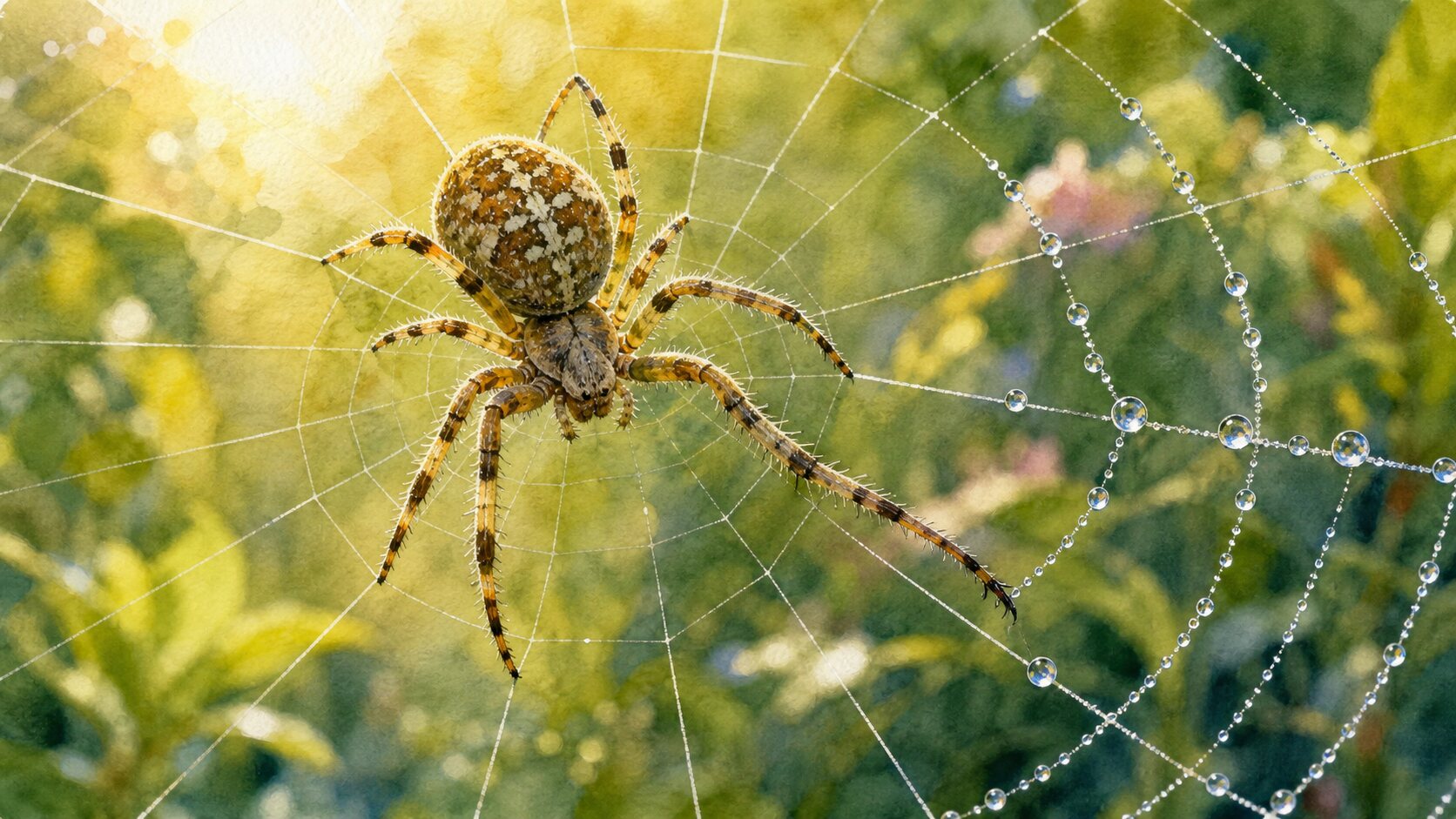
In an orb, frame lines and radii make a load-bearing scaffold. Winding across them is a capture spiral bearing microscopic glue droplets that adhere to hairs and surfaces on an insect. The radii transmit vibrations from an impact toward the hub and double as paths for the spider. The web is therefore not a uniform sheet of flypaper. It is a composite device that combines dry roads with an adhesive trap.
The construction sequence preserves this distinction. An orb-weaver first establishes its frame and spokes, then lays a wide, non-sticky auxiliary spiral that supports movement and spacing. During the final phase it moves inward while replacing much of that guide with a denser capture spiral. Even species with limited vision can locate and tension threads through touch. From the moment it builds the web, the spider's movements distinguish the scaffold it can grip from the trap it is depositing.
Specialized feet help it handle individual lines. Many web-building spiders use movable claws at the tips of their legs to hook, hold, and release silk. Bristles around the foot divide contact into small points instead of pressing a broad surface into a glue droplet. Orb-weavers commonly have a third tarsal claw that assists in controlling threads. Foot anatomy varies across spider lineages, however, so one claw arrangement should not be presented as the mechanism of every species that uses silk.
Technique matters because adhesion depends on contact area, force direction, and time. A spider hooks and peels away from a strand rather than planting a wide pad and pulling straight against the glue. It moves sequentially, so a brief mistake need not attach several legs at once. A flying insect arrives with momentum and may strike multiple turns of the capture spiral with its body, wings, and hairs. Its struggling can create still more contacts. The spider approaches a known structure one controlled foothold at a time.
A chemical non-stick coating remains a qualified part of the story. In one set of experiments, untreated orb-weaver legs detached from capture threads more readily than legs whose surfaces had been washed, indirectly supporting a protective organic material. Dense setae and grooming may help distribute such material. Yet the coating's chemistry, importance in a moving animal, and distribution among species are not fully resolved. The popular picture of all spiders painting themselves with a magic oil claims more than the evidence warrants.
Spiders can still become stuck. One foot brushing glue is very different from an abdomen, wings, and several limbs becoming wrapped across many sticky lines. A spider may keep support on dry silk and carefully reduce the contact, whereas intercepted prey can compound its problem by thrashing. Web adhesive is not permanent either. Rain, wind, dust, and age diminish performance, and many orb-weavers consume damaged silk to recover material before rebuilding sections or the entire web.
The useful answer is a system, not a single trick. Dry radii carry load, transmit vibration, and provide routes; the capture spiral retains prey; claws, bristles, and controlled steps let the builder move between them. A surface coating may add another margin of safety in some spiders. Once an orb web is understood as several materials coordinated with specialized behavior, there is no paradox in the trap's maker walking across it.
EDITORIAL RESPONSIBILITY
FactosBrain Editorial Desk
The FactosBrain Editorial Desk researched and reviewed this article under our editorial policy. We assess error reports under our corrections policy.