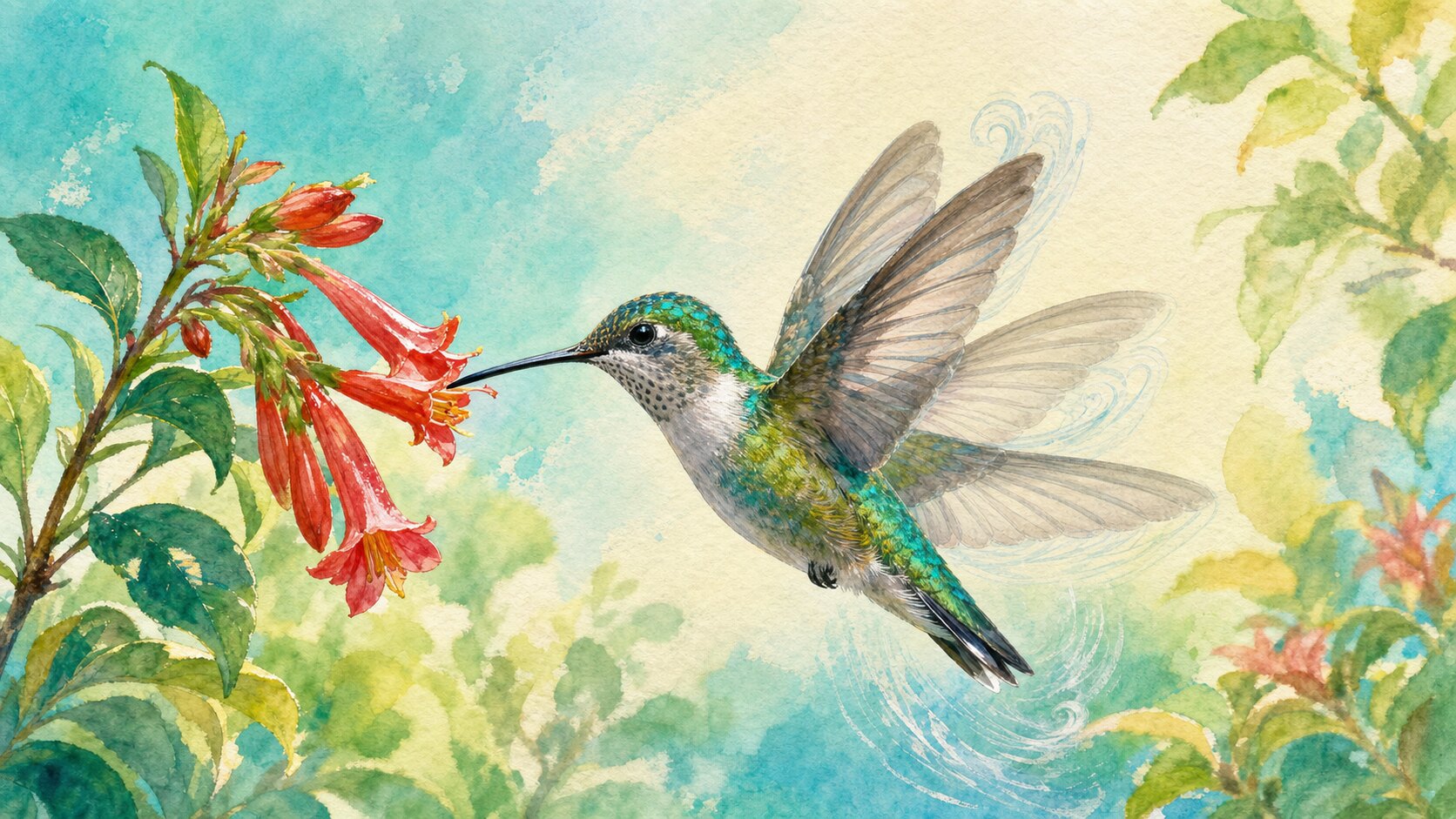
A hummingbird hovers by doing more than flapping its wings up and down. It rotates them through the shoulder and sweeps them back and forth, continually accelerating air downward. When the upward aerodynamic force averages out to the bird's weight, it can hold its position without moving forward.
Most birds produce most of their lift on the downstroke and partly fold or unload the wing on the upstroke. A hummingbird's skeletal proportions and unusually mobile shoulder let it rotate the wing so that it maintains a useful angle to the air on the return stroke. The wingtip's flattened figure-eight-like path emerges from this rotation and back-and-forth sweep.
The two halves of the stroke are not equal, however. Measurements of airflow around hovering hummingbirds found that the downstroke supplies about 75 percent of weight support and the upstroke about 25 percent. Hummingbirds gain lift in both directions as insects do, but they still fly with an asymmetrical bird wing and retain a distinctly bird-like bias toward the downstroke.
Wingbeat speed alone is not the whole mechanism. Air can roll into a stable vortex along the wing's leading edge instead of flowing smoothly over it. This leading-edge vortex helps lower pressure above the wing and boosts lift. By adjusting wing angle and the timing of rotation during every cycle, the bird redirects those aerodynamic forces with remarkable precision.
Hovering is energetically expensive. The bird must keep accelerating a mass of air beneath its body while powering rapid wingbeats with large flight muscles. It therefore visits energy-rich nectar sources frequently and changes stroke amplitude and posture as wind, elevation and feather condition change. Even gaps left during molt can alter wing performance and require compensation.
The same machinery also enables movement. By tilting the stroke plane and body, the bird directs part of the aerodynamic force forward or sideways, allowing rapid acceleration, lateral motion and backward flight. Hovering is not a separate locked mode. It is one point in a continuous range of control, reached when horizontal forces average out while vertical force balances weight.
A hummingbird is not hanging motionless from the air. It is continuously replacing the support that gravity takes away, stroke after stroke. Rotating wings push air during both the forward and return sweeps, while vortices and fine changes in angle keep the force aimed correctly. The apparent stillness in front of a flower is an intensely active, repeatedly rebuilt balance.
EDITORIAL RESPONSIBILITY
FactosBrain Editorial Desk
The FactosBrain Editorial Desk researched and reviewed this article under our editorial policy. We assess error reports under our corrections policy.