Hangeul was not merely adapted from a script already in use. It was deliberately designed around an analysis of Korean speech sounds. The Annals of King Sejong record the creation of 28 letters in 1443, and the explanatory edition of Hunminjeongeum, published in 1446, sets out principles for their shapes and use. That surviving explanation makes the design unusually well documented.
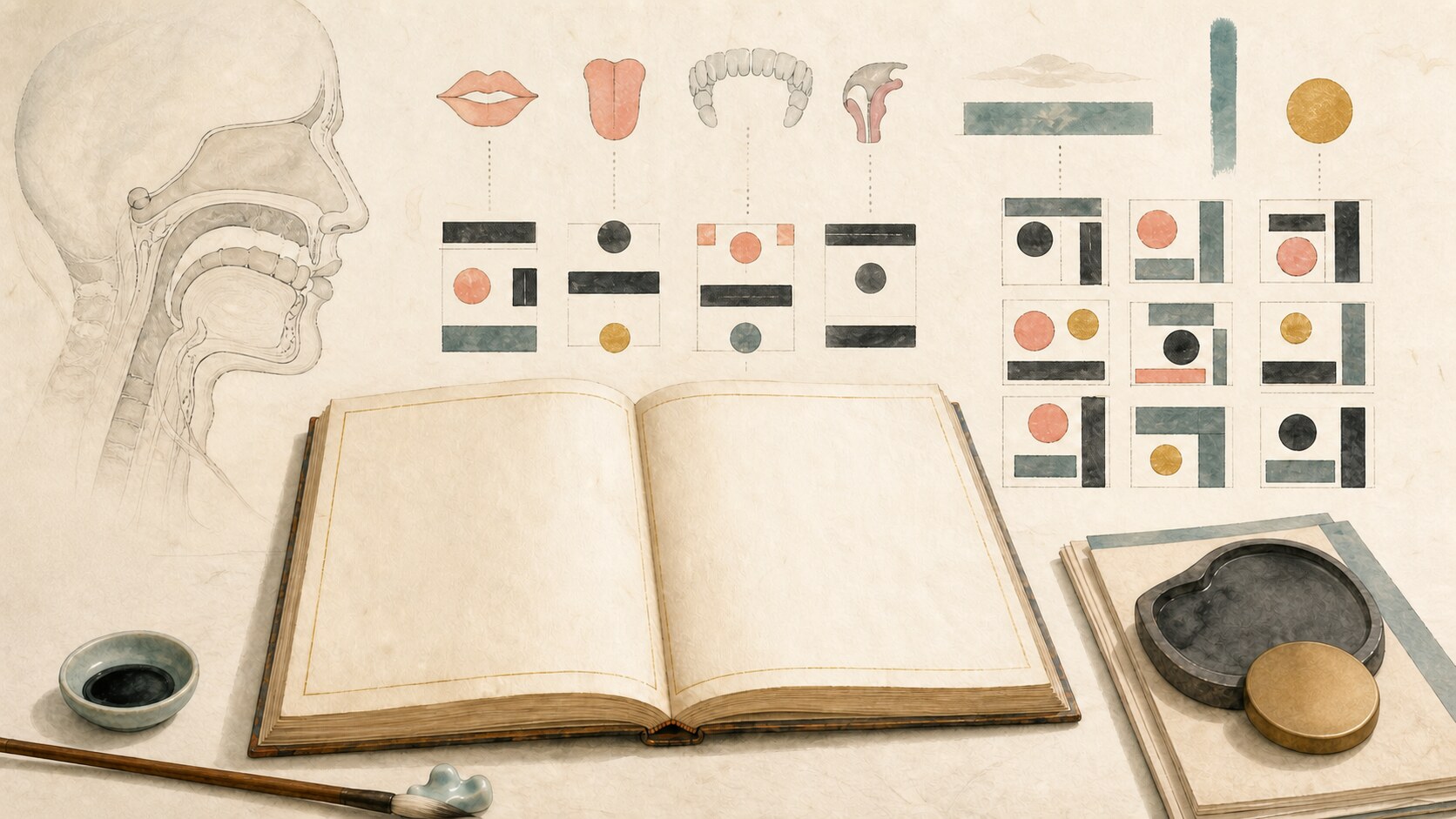
Five basic consonants—ㄱ, ㄴ, ㅁ, ㅅ and ㅇ—were based on speech organs or places of articulation. For example, ㄴ depicts the tongue touching the upper gum, ㅁ represents the mouth, and ㅇ reflects the throat. A letter’s shape therefore carries a clue about where its sound is formed rather than serving as an arbitrary mark.
Several related consonants were made by adding strokes to a basic form. The relationship between ㄱ and ㅋ, for instance, makes related sounds visibly resemble each other while an added stroke distinguishes them. Not every modern consonant follows one simple formula, but the basic-shape and added-stroke system shows that the inventory was organized to display phonetic relationships.
The original vowels began with three elements: a dot for heaven, a horizontal stroke for earth, and a vertical stroke for humanity. Placing these elements above, below, inside or outside one another produced vowels corresponding to forms such as ㅗ, ㅜ, ㅏ and ㅓ. Further combinations expanded the set. The design joins observations about sound with the cosmological ideas of its fifteenth-century setting.
Hangeul letters are also arranged into syllable blocks. In 한, the consonant ㅎ, vowel ㅏ and final consonant ㄴ form one compact visual unit, yet each component still represents a separate speech sound. This gives Hangeul an alphabetic structure while allowing readers to see the boundaries and internal shape of a Korean syllable.
The original Hunminjeongeum contained 17 consonants and 11 vowels. Some letters later fell out of ordinary use, so introductory accounts of modern Hangeul usually count 14 basic consonants and 10 basic vowels. The difference between 28 historical letters and 24 modern basic letters reflects changes in use, not a contradiction in the original record.
Calling Hangeul systematic does not mean that Korean grammar, spelling or pronunciation becomes effortless. A writing system records a language; it does not erase the language’s history and exceptions. Hangeul’s distinctive achievement is narrower and more concrete: a small set of shapes links vocal anatomy, relationships among sounds, contemporary philosophy and syllable structure, with the design principles preserved in the script’s own fifteenth-century explanation.
EDITORIAL RESPONSIBILITY
FactosBrain Editorial Desk
The FactosBrain Editorial Desk researched and reviewed this article under our editorial policy. We assess error reports under our corrections policy.