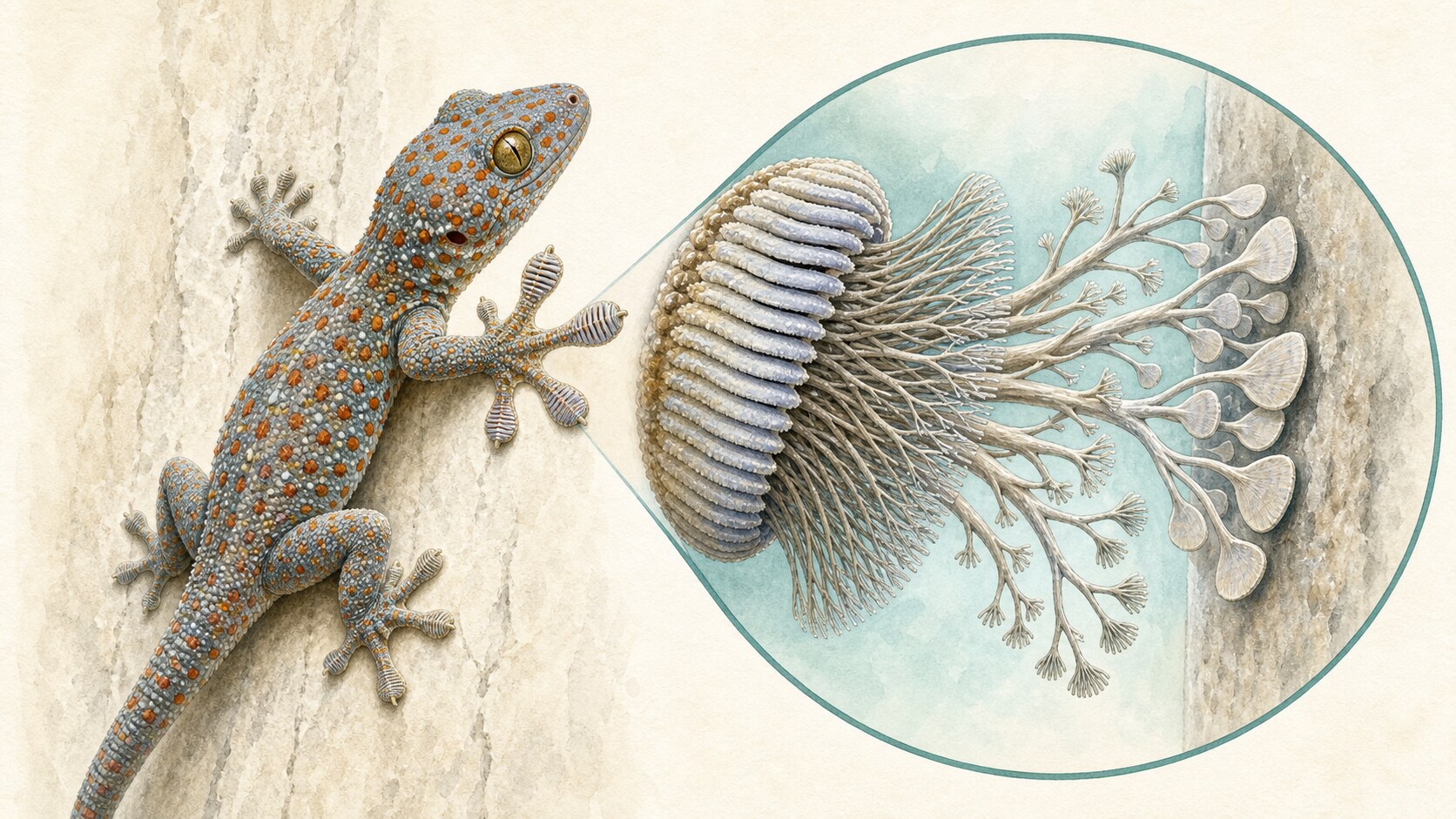
Geckos run across smooth walls and ceilings without glue or suction cups. Their advantage is a hierarchical structure under the toes. Broad ridges divide into vast numbers of hairlike setae, and each seta branches into much smaller, flattened tips called spatulae. Together, these compliant tips create extensive close contact with a surface.
At molecular-scale distances, the tips experience weak attractions known as van der Waals forces. Momentary variations in the charge distribution of atoms and molecules attract nearby particles. The force at any single contact is tiny, but millions of simultaneous contacts add up to enough adhesion to support a gecko's weight.
The foot does not behave like pressure-sensitive tape that simply sticks when pressed down. A gecko places a toe and applies shear along the surface, aligning the setae and increasing effective contact. It then curls or peels the toe at a particular angle to release contacts from an edge. Attachment and detachment can therefore alternate rapidly during a stride.
This mechanism differs from suction. Gecko adhesion can work without an air-pressure seal, and measurements on different materials are consistent with intermolecular forces at the setal tips. It is not based on secreting a liquid adhesive either, so an animal does not need to deposit and replace a sticky chemical at every footstep.
The system also has a degree of self-cleaning. During repeated steps, some dirt particles remain more strongly attached to the walking surface than to the setae and are shed. That does not mean every contaminant disappears immediately. Water films, oils, large particles and unsuitable roughness can reduce the true area of close contact and weaken performance.
Not every gecko has an identical adhesive foot. Toe-pad development varies with lineage and habitat, and claws remain important on rough terrain. Adhesion also depends on how well microscopic tips conform to surface texture, as well as humidity and surface chemistry. “Geckos stick to anything” is a useful shorthand, not a universal rule.
Dry adhesives and robotic grippers inspired by gecko feet aim for more than maximum holding force. Their valuable combination is strong contact when loaded in one direction, easy release when peeled, and repeated use without wet glue. A gecko foot turns individually weak molecular attractions into reliable movement through enormous contact area and precise mechanical control.
EDITORIAL RESPONSIBILITY
FactosBrain Editorial Desk
The FactosBrain Editorial Desk researched and reviewed this article under our editorial policy. We assess error reports under our corrections policy.