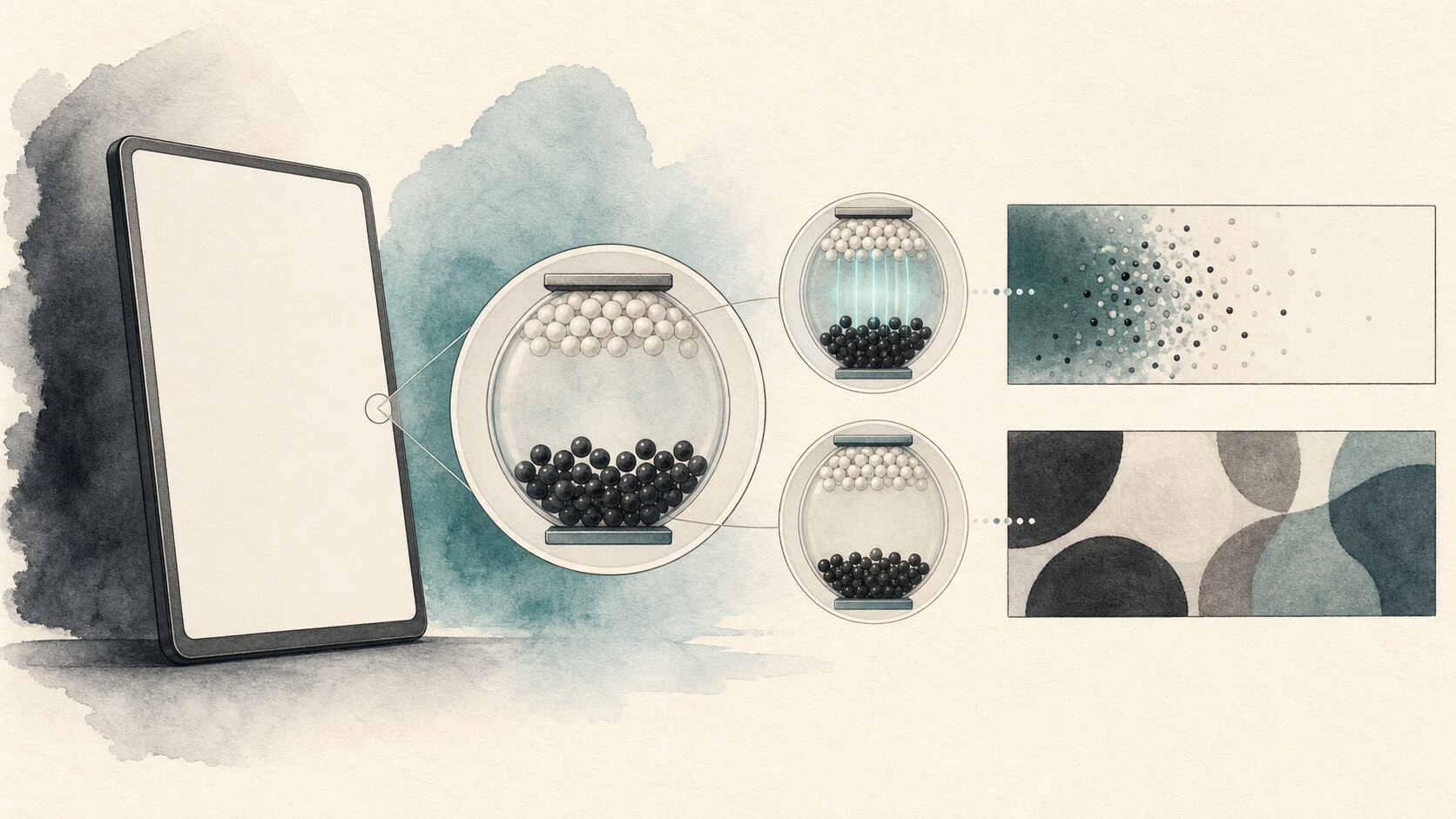
Electronic ink can leave a page visible without continuously powering every pixel because the chosen pigment arrangement is stable. An electric field moves particles when the image changes; after the voltage is removed, they do not immediately drift back. This ability to retain either optical state is called bistability.
A widely used black-and-white electrophoretic film contains millions of microcapsules roughly comparable to a human hair in diameter. Clear fluid inside each capsule holds white and black pigment particles with opposite electrical charges. The precise charge assignments and physical construction can differ among particular ink systems.
A thin-film-transistor backplane controls an electrode at each pixel. Depending on the field's direction, one particle type travels toward the transparent viewing surface while the other moves away. The pigment gathered at the front is visible to the reader, allowing that area to appear white or black.
Unlike an emissive screen, e-paper normally reflects ambient light from its pigments. It can therefore look paper-like in a bright room. An e-reader visible in darkness usually has a separate front light, however, and that light, its processor and wireless hardware can consume energy even while the displayed page remains unchanged.
Interactions among the particles, liquid and capsule surfaces help hold the selected arrangement after the field disappears. The display film therefore needs no continuous refresh to preserve a static image. Moving to another page or altering part of the screen still requires carefully timed voltage waveforms that drive particles to new positions.
Gray levels can be created by controlling particle movement and voltage pulses instead of sending every particle fully to one extreme. A device may flash through black and white during a full refresh to erase remnants of the previous arrangement and establish an accurate new one. Faster partial updates trade some image quality for speed and may leave ghosting.
Color e-paper uses several approaches. Some designs put color filters over a reflective layer, while others selectively move multiple colored pigments within a pixel. Although the construction varies, the energy-saving idea is shared: change the optical state only when needed, then retain its physical arrangement, a particular advantage for documents that remain on screen.
EDITORIAL RESPONSIBILITY
FactosBrain Editorial Desk
The FactosBrain Editorial Desk researched and reviewed this article under our editorial policy. We assess error reports under our corrections policy.