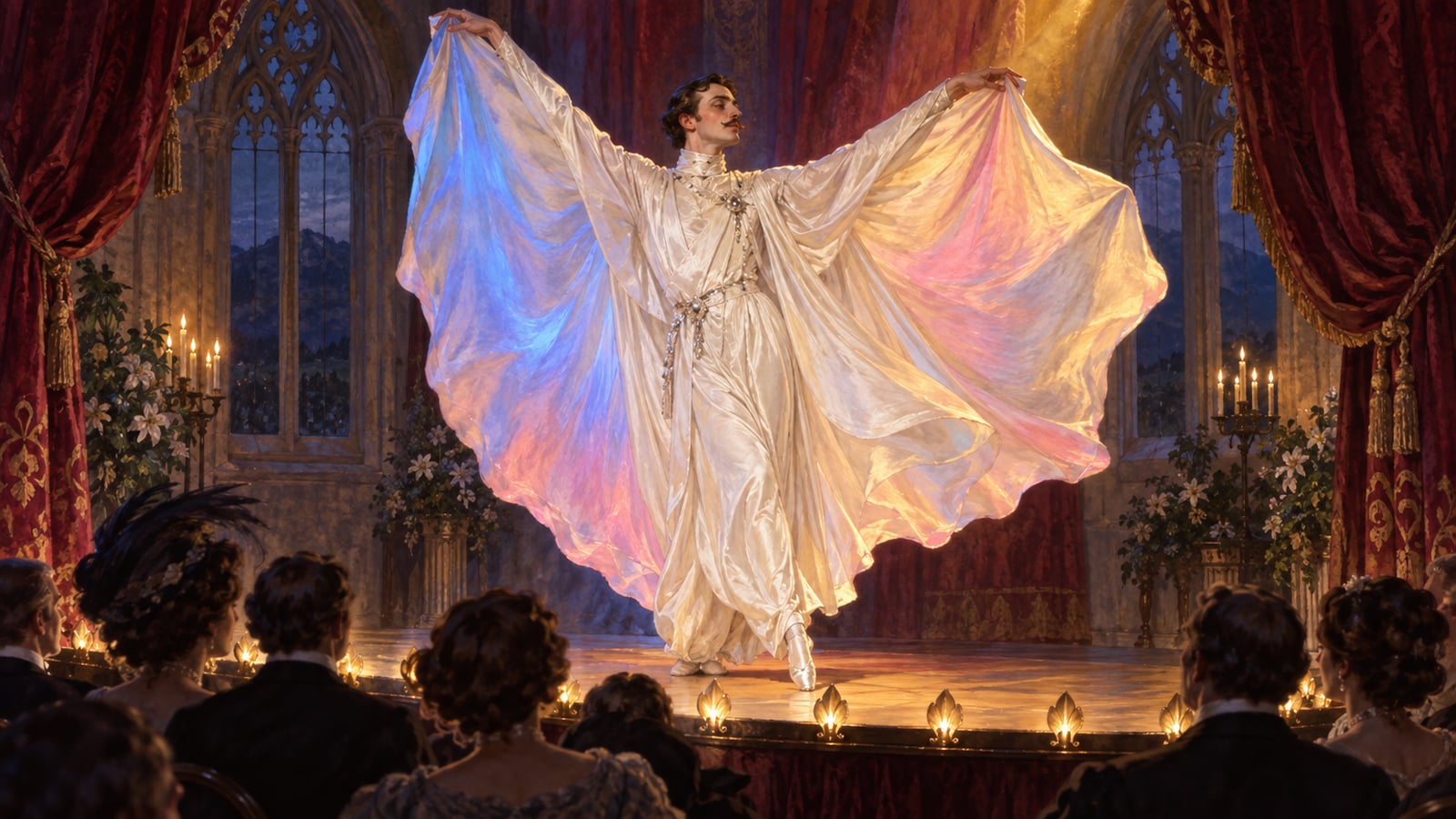
There was a theatre inside the house, and its owner was onstage. Henry Paget, fifth Marquess of Anglesey, spread his white silk costume as colored light played across it. His Butterfly Dance helped earn him the name “the Dancing Marquess.” He did not stop at arranging entertainment for guests. He became an attraction himself.
He had the resources to build a stage. In 1898, aged twenty-three, Paget inherited the title and family estates, including Plas Newydd in Wales. He called the house Anglesey Castle and transformed the performance space in its former chapel into the Gaiety Theatre. With 150 seats, it gave him a place to select the productions, choose his costumes and appear before an audience at home.
Friends, servants and neighbors took part in his early performances. In 1901 a professional company joined him. His repertoire included popular productions such as Aladdin and Red Riding Hood, with elaborate costumes for his roles. Theatre historian Viv Gardner cites a fellow performer's diary noting that he wore different costumes every night. This was not a hobby satisfied by one good outfit.
Nor were the seats reserved for aristocrats. Local tradespeople, servants, students and visitors could attend without paying. Productions taken to other venues sometimes raised money for charity. Paget also handed out postcards showing himself in costume. The owner of the house supplied both the performance and a picture to take away.
Reactions differed. Reports praised his dancing, while his bejeweled appearances also invited ridicule. Meanwhile, spending on clothes, jewels and luxuries continued. When he became insolvent in 1904, one theatrical paper defended his stage interests. Jewellery and other purchases, it argued, had cost him far more dearly, while the company had supported charitable causes. Even at the time, “a nobleman who danced away his fortune” did not satisfy every observer.
The sales to settle his debts turned the house into another attraction. Clothing, jewels and cars came up for purchase alongside ordinary household items, including pots and buckets. Buyers and sightseers arrived. Costumes once displayed onstage were now awaiting new owners.
The auction acquired a performer of its own. In contemporary reports quoted by Gardner, an employee known as Jerry modeled the clothing: a pale green overcoat, a short cream outfit, a wrap lined in pink. People laughed as the clothes were shown and sold. The collection Paget had assembled to display himself continued to draw an audience after he had gone.
Some garments returned to a proper stage. Vesta Tilley, famous for performing male roles, bought waistcoats from the sale and wore one in performance. Its previous ownership was publicized. A garment Paget had used to adorn himself became part of another artist's portrayal of a fashionable man.
Paget left before the sales and never returned to the house. He died in 1905, aged twenty-nine. Photographs preserve the winged headgear, jewels and theatrical costumes. The man who had owned the stage and the wardrobe was gone, but the appearances he had worked so hard to create remained. Pictures of the kind he once distributed to his audiences became some of his clearest surviving traces.
EDITORIAL RESPONSIBILITY
FactosBrain Editorial Desk
The FactosBrain Editorial Desk researched and reviewed this article under our editorial policy. We assess error reports under our corrections policy.