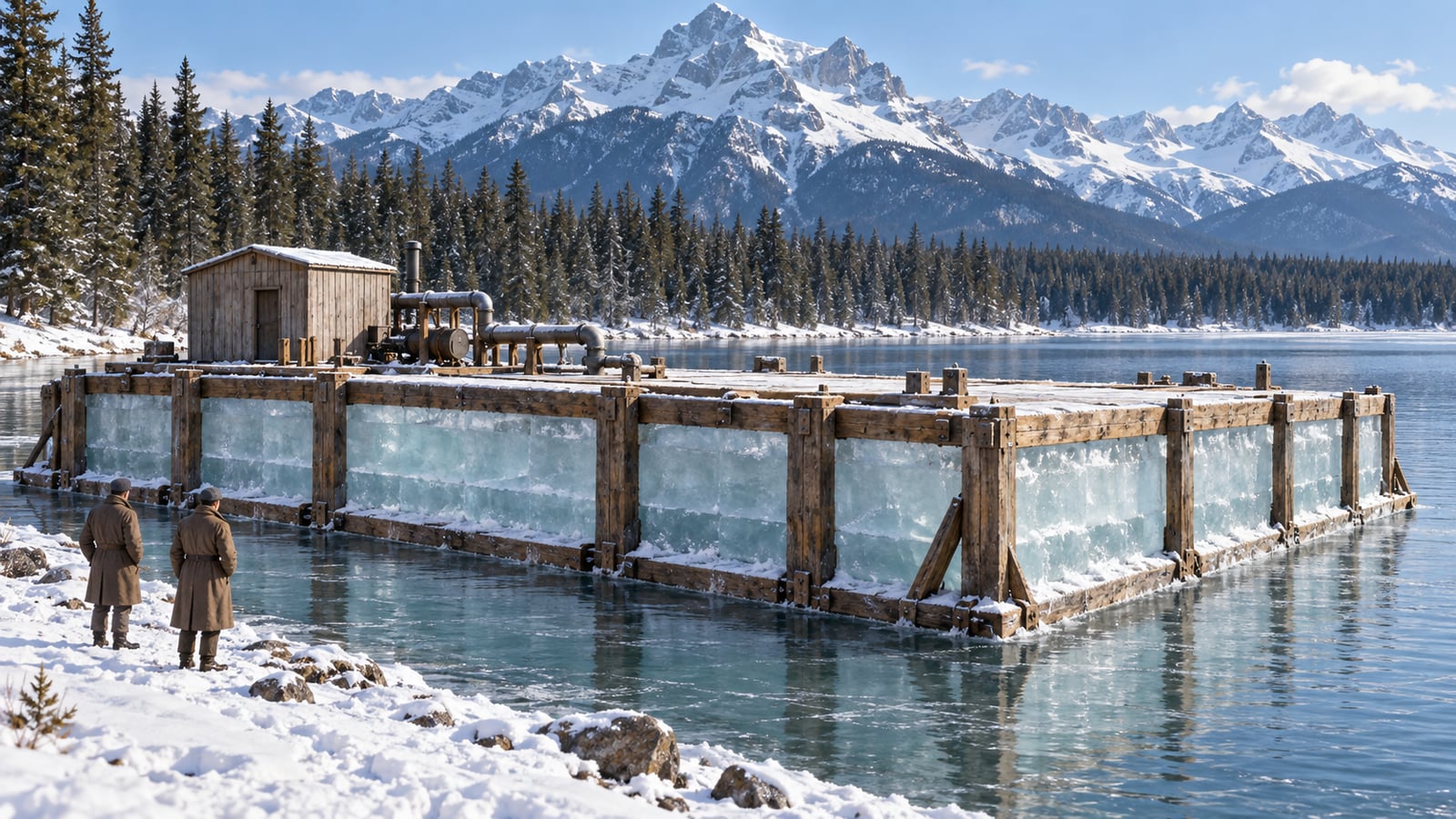
In 1943, a secret structure took shape on Patricia Lake in Canada. A wooden frame, insulation and refrigeration equipment surrounded an unusual building material: ice. This was a test for a ship. Beyond the small structure on the lake lay a much larger ambition—to put an airfield in the middle of the Atlantic, aboard an enormous frozen vessel.
The idea addressed a real wartime gap. German submarines attacked supply ships crossing the ocean, while aircraft operating from land could not cover the entire route. A floating air base could bring protection to waters beyond their reach. Project Habbakuk was an attempt to supply that missing piece of geography.
The British inventor Geoffrey Pyke proposed building with ice. Natural icebergs offered too little exposed surface, however, and broad sea-ice floes were too thin for Atlantic conditions. Research turned to pykrete, water frozen with wood pulp. It resisted breaking under impact much better than ordinary ice, giving the improbable proposal something solid to work with.
Mountbatten backed the project, and Churchill pressed for action. Canada's research leader, Chalmers Mackenzie, was less enthusiastic. His diary records frustration at the scheme's high-level support. Nevertheless, he organized the work. The advocates wanted their ship; the scientists had to establish what building it would involve.
The refrigerated lake structure remained frozen through summer. Maintaining an ice hull was possible. Building an ocean-going carrier was another matter. Mackenzie reported that the timetable could not be met, while projected costs exceeded the original expectations. Cheap material did not automatically produce a cheap ship.
Size brought further problems. Under sustained loads, pykrete could slowly deform. The proposed vessel had to hold its shape, move and steer, as well as stay afloat. Insulation and cooling equipment were necessary, and propulsion and steering added their own demands. Choosing ice had not removed the need for machinery or industrial resources.
Meanwhile, longer-range aircraft, escort forces, bases and better detection offered other ways to protect Atlantic shipping. The question was no longer simply whether an ice carrier could be built. Was it worth diverting people and materials from other wartime work to build one? No full-sized Habbakuk followed.
On Patricia Lake, the ice melted after the refrigeration equipment was removed. The remaining wooden structure sank. Memorial markers at the shore and underwater commemorate the experiment. The project intended to provide an airfield far out at sea left its physical remains at the bottom of a Canadian lake.
EDITORIAL RESPONSIBILITY
FactosBrain Editorial Desk
The FactosBrain Editorial Desk researched and reviewed this article under our editorial policy. We assess error reports under our corrections policy.