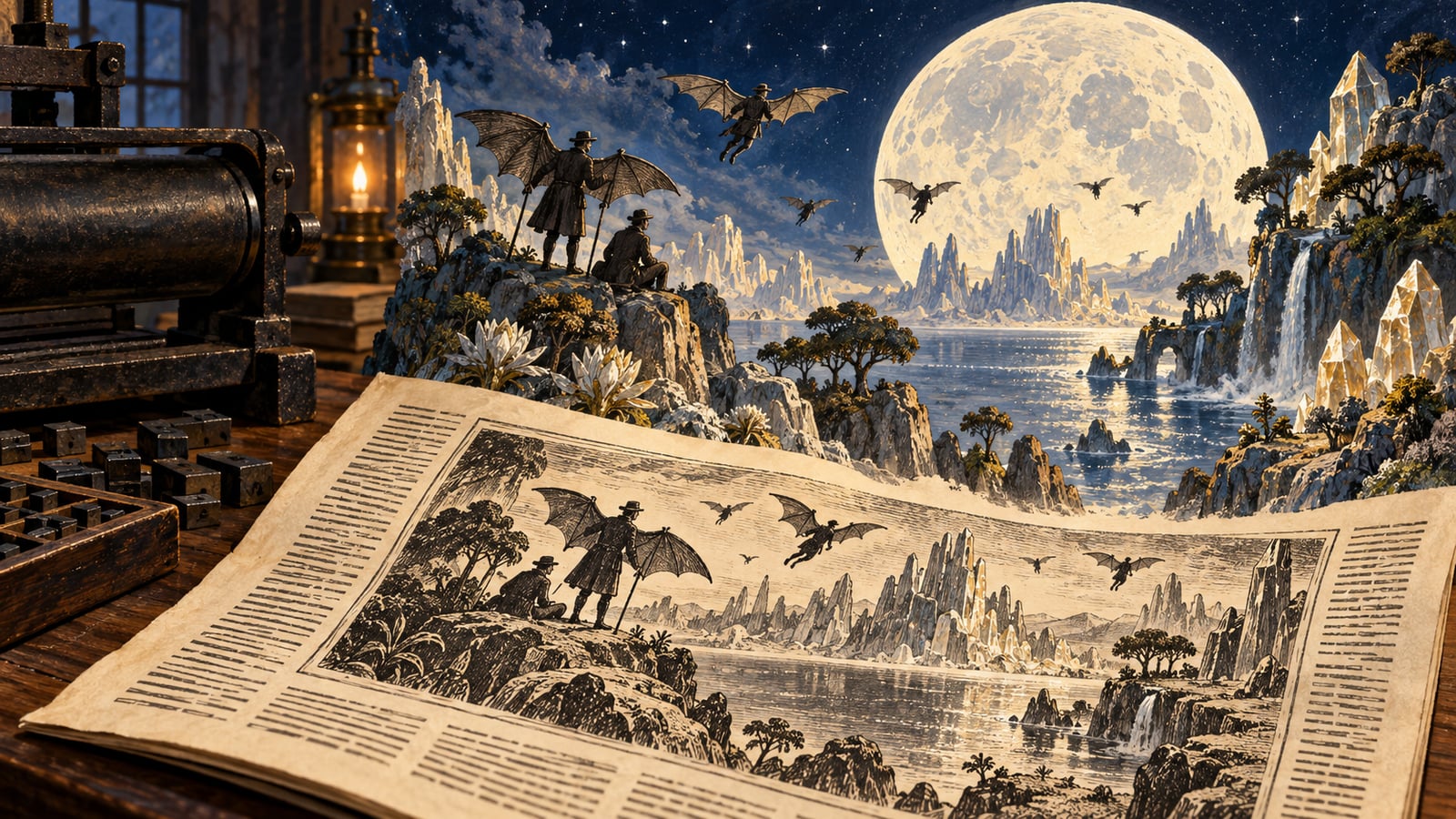
In August 1835, New York's Sun began publishing extraordinary astronomical news. The celebrated British astronomer John Herschel had supposedly trained a new telescope on the moon from southern Africa. Forests covered parts of the landscape, and animals wandered through them. By the fourth installment, winged people had entered the picture.
The story did not begin with bat people. Before taking readers to the moon, it introduced the telescope. It explained why greatly magnified images grew dim and why existing instruments had reached their limits. Herschel, it claimed, had overcome the difficulty by combining a telescope with microscope technology. After the technical discussion came the enticing conclusion: things previously invisible could now be seen.
Numbers helped give the invention weight. Its lens supposedly measured 24 feet across and weighed nearly seven tons. The first casting had flaws, so the makers tried again. Teams of oxen helped transport the immense apparatus to its destination. The account supplied manufacturing difficulties and logistics before asking readers to accept the discoveries. A machine that took so much effort to build seemed ready to justify the trouble.
This was not Herschel's real telescope. He genuinely was conducting astronomical work in southern Africa, but the article surrounded that fact with inventions. The supposed source, a colleague named Dr. Andrew Grant, was fictional. Presenting the report as material taken from a British scientific journal added another layer of distance and authority. The New York paper appeared to be passing along news from a remote observatory.
Once the equipment was established, the scenery came into view. There were forests, lakes and unusual mountains. The animals were familiar enough to imagine, but different enough to belong to another world. Some resembled bison; others had a single horn. The beavers lacked tails and walked on two legs. They carried their young in their arms, and smoke rising from their dwellings supposedly indicated that they could use fire.
The narrative then advanced from lunar animals to humanoids with broad, membranous wings. Its observers examined their appearance and behavior and assigned a Latin name: Vespertilio-homo, or man-bat. Naming and classifying the imaginary creatures made their introduction resemble the announcement of a newly identified species.
Even this revelation came with something withheld. Certain habits were so remarkable, readers were told, that they should first appear in Herschel's forthcoming book. The missing details became another sign of apparent restraint. This was supposedly only the portion of a much larger discovery that the correspondent had permission to share.
An accident interrupted the observations. The great lens had been left in the wrong position, allowing the morning sun to set the observatory on fire. The device that made the wonderful discoveries possible now supplied a reason for stopping them. Once repairs were complete, the story explained, the moon was unavailable for observation and attention turned to other planets. The fire, like the creatures, belonged to the newspaper narrative rather than Herschel's actual expedition.
The public was not uniformly convinced. Winged people encouraged skepticism, and by August 29 rival papers were calling the account a hoax. The argument carried the story into still more newspapers. Believers could follow an astonishing discovery; doubters could follow an astonishing claim and the people willing to accept it.
The series is generally attributed to Sun journalist Richard Adams Locke. When accused at the time, he replied that he had not made the discoveries, sidestepping the question of whether he had written them. A reprint published in 1859 placed his name on the title page beneath The Moon Hoax. What had first appeared as news of Herschel's findings was now being sold as the story of discoveries a newspaper had invented.
EDITORIAL RESPONSIBILITY
FactosBrain Editorial Desk
The FactosBrain Editorial Desk researched and reviewed this article under our editorial policy. We assess error reports under our corrections policy.