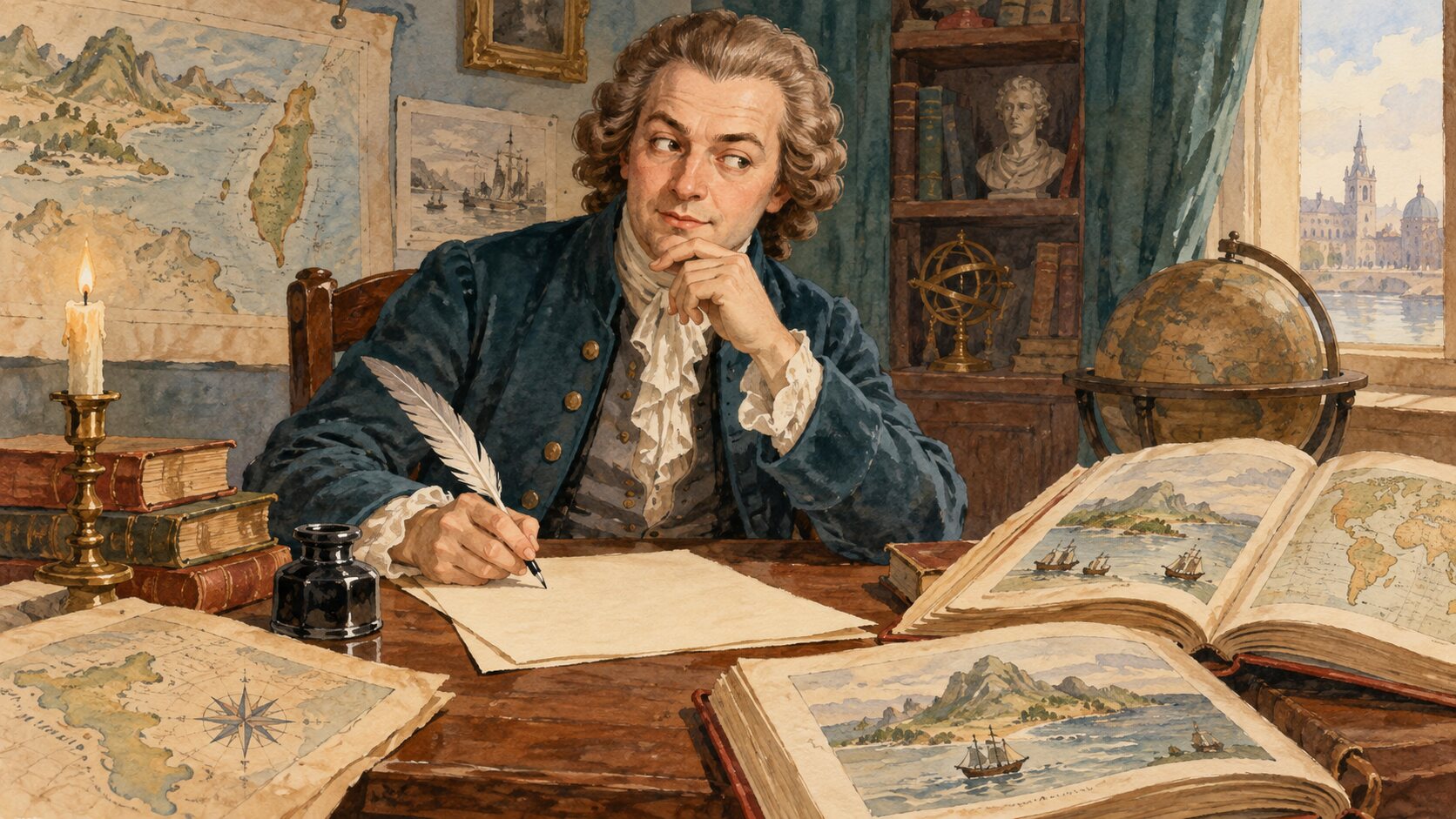
A book about Taiwan published in London in 1704 offered readers twenty letters of the island's supposed alphabet. They were to be read from right to left. The author explained how changes in vocal pitch distinguished verb tenses, and supplied a translation of the Lord's Prayer. All this linguistic evidence had been invented by the author, George Psalmanazar.
Psalmanazar was European. After reaching England in 1703, he presented himself as a native of Formosa, the name Europeans then commonly used for Taiwan. He claimed a stronger position than a visitor describing a journey: he was supposedly explaining the country in which he had grown up.
His performance included eating raw meat and sleeping upright, habits offered as signs of a foreign upbringing. They were part of his impersonation, not a record of how people in Taiwan lived. He was making himself resemble the distant foreigner his audience might imagine.
In his later memoir, he admitted how little he had known about East Asian writing. Assuming that an eastern script would run from right to left like Hebrew, he devised characters to suit that idea. He initially neglected to give the letters names and filled that gap after encountering people who knew enough to ask.
He also practised writing them. A man apparently struggling with his own native script would not be convincing, so he altered characters, worked out ways of joining them and introduced abbreviations. He recalled inventing answers to unexpected questions about his homeland, then storing satisfactory replies in his memory.
Before the journey to England, the military chaplain William Innes put the supposed language to a test. According to Psalmanazar's memoir, Innes asked him to translate a passage from Cicero. Psalmanazar wrote it down and explained it. Then Innes asked him to translate the same passage again on another sheet.
The two versions did not match. Psalmanazar had improvised words without enough time to remember them. He wrote that no more than half the words in the second version were present in the first. When Innes pointed out the difference, he expected exposure and a complete break between them.
In Psalmanazar's account, that was not what happened. Innes instead indicated that he should prepare more carefully, and later helped bring him to England. Despite faltering when asked to translate the same passage twice, Psalmanazar continued using his Formosan identity.
In London, Innes required a more substantial translation. Psalmanazar rendered the Church of England catechism into his invented Formosan and presented it to the bishop of London. He described setting out his own characters alongside the words in Roman letters and an interlinear Latin version. A reader could follow the meanings across the unfamiliar text.
His memoir says people examining the translation considered the language regular, grammatical and distinct from the languages they knew. Some concluded that it could not be an invention by someone so young. Linguistic elaboration had become a reason to accept the very identity the earlier translation exercise had undermined.
The identity grew into a book on Formosan history and geography. Its imaginary society had a twenty-month year, religious ceremonies, clothing and political institutions. He had invented more than words: he supplied the society that was supposed to use them. These descriptions were fiction published under Taiwan's name, not documentation of the island's inhabitants.
There were sceptics from the beginning. A Jesuit missionary who had worked in China challenged his claims before the Royal Society. Psalmanazar attacked the critic in his book's preface, presenting the objections as retaliation for his own attacks on the Jesuits. European religious divisions entered the dispute over who knew the distant island.
As objections continued, support for his identity diminished. Psalmanazar eventually acknowledged the deception and wrote a memoir for publication after his death. Issued in 1764, it described the manufacture of his letters and translations and the moments when the performance had faltered.
The title began Memoirs of ****, Commonly Known by the Name of George Psalmanazar. Even in the book admitting his false homeland and false language, four asterisks stood where his real name might have appeared.
EDITORIAL RESPONSIBILITY
FactosBrain Editorial Desk
The FactosBrain Editorial Desk researched and reviewed this article under our editorial policy. We assess error reports under our corrections policy.