Does a train have to move to look as though it is moving? Near Paris toward the end of the First World War, one proposed answer was a line of light bulbs. Switch them on and off in sequence and, from the air, light could appear to travel along the ground. The model could stay where it was. Only its illumination needed to move.
This train needed no passengers. Nobody had to sit behind its windows. Its intended audience would be far above: a German pilot flying at night. If it looked like a train running through a city, it would be doing its job.
Paris was facing air raids. Its defenders could try to shoot down attacking aircraft or extinguish lights to make their targets harder to find. Another possibility was to show the pilots the thing they were looking for somewhere else. Build a false Paris outside the real one, and perhaps the bombs would fall there instead.
Mistaking one city for another sounds less plausible in the age of satellite navigation. But the pilots of 1918 had no such guidance. At night, they looked for clues below: the course of a river, railway lines and light escaping from the ground. A city was understood through the shapes that emerged from darkness, rather than through a close inspection of individual buildings.
That meant the replica did not have to withstand a visitor walking down its streets in daylight. It had to be convincing during a brief view from high above. The task was to arrange enough familiar clues on the ground for a pilot to recognize a city.
Early decoy efforts in 1917 developed into an ambitious scheme in 1918. Different areas outside Paris would imitate parts of its centre, railways and industrial districts. Sites were considered where bends in the Seine could help the resemblance. This was a plan for more than a handful of false streets: it attempted to reproduce the way a city presented itself from the air.
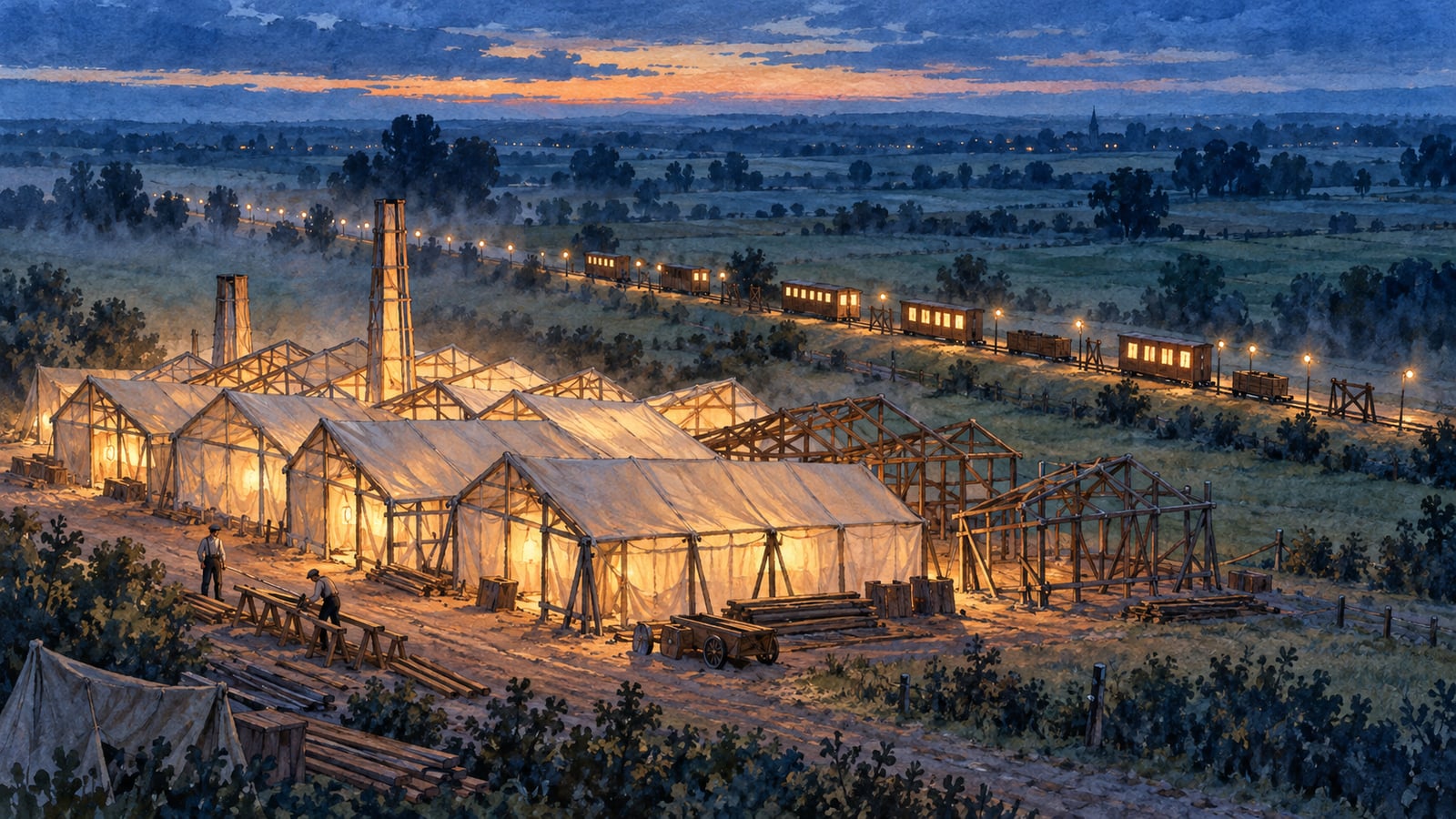
Electrical specialist Fernand Jacopozzi worked on the project. His most useful material was light. Timber frames covered with painted, translucent fabric could suggest roofs and factories when illuminated. The construction resembled scenery for a stage whose audience would be looking down from the sky.
Making everything bright would spoil the effect. Light passing through dirty factory glazing does not look like a clean, exposed bulb. The decoy lighting needed to imitate that duller glow. To be persuasive, some parts of the imitation had to look less distinct.
A working industrial district also needed signs of activity. White, yellow and red lights, together with artificial vapour, were intended to suggest illuminated workplaces. Nothing actually had to be manufactured inside. The pilot only needed to see traces of a factory at work after dark.
The railway required an impression of movement. Wooden train models could carry lights where a distant observer would expect windows, while a long sequence of bulbs was designed to imitate travel. The train's weight and engine noise were irrelevant to this particular audience. What mattered was whether the light below looked like a train going somewhere.
The scheme never became a complete second Paris. Only parts were built, including installations near Villepinte to the northeast, while much of the proposed city remained a plan. The war ended in November 1918, removing the reason to finish it. There is no demonstrated success in which the decoy drew an enemy bombing attack away from the capital.
Accounts published after the war, including magazine coverage in 1920, brought the scheme to wider attention. The false city had needed lights suggesting that people lived and worked there more than it needed houses anyone could occupy. Part of the stage was built. The performance it was meant for never properly took place.
EDITORIAL RESPONSIBILITY
FactosBrain Editorial Desk
The FactosBrain Editorial Desk researched and reviewed this article under our editorial policy. We assess error reports under our corrections policy.