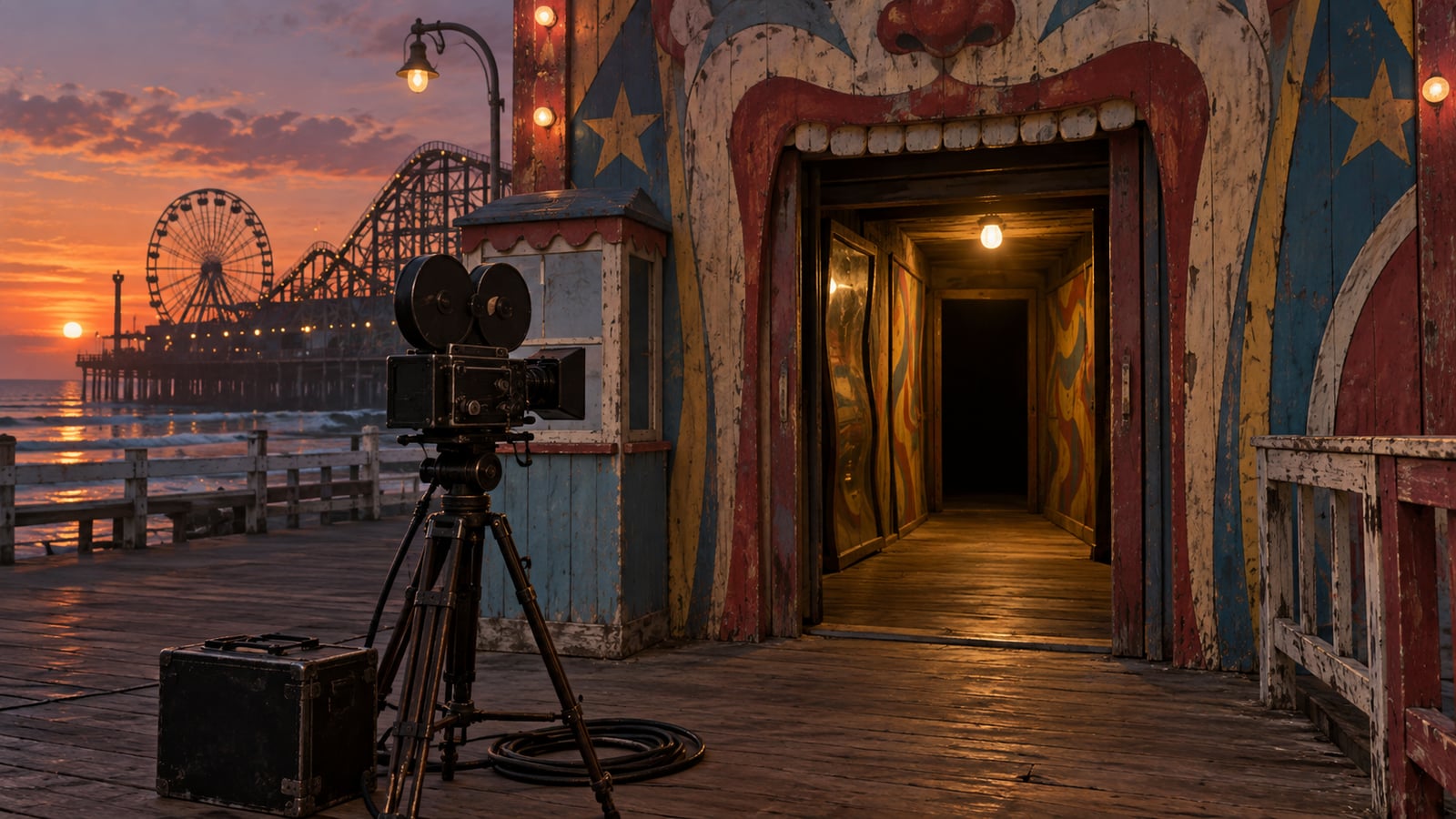
The crew was trying to move a prop. In 1976, The Six Million Dollar Man was filming at a Long Beach amusement park, where a figure hung inside a funhouse. When its arm came off, human bone was exposed. This was not a dummy made to look like a dead person. It was the remains of one.
The man had not died at the amusement park. He was identified as Elmer McCurdy, an outlaw killed in an Oklahoma shootout in 1911—65 years earlier. The investigation therefore faced an unusual question. How had someone who died so long ago ended up being treated as scenery for a television shoot?
The route began at a funeral establishment. An undertaker embalmed McCurdy, but no relative collected the body. Instead of burying it, the undertaker charged visitors five cents to see it. At this stage, its identity as a corpse was the attraction. People paid because they were looking at a real dead outlaw.
Several years later, men claiming to be relatives obtained the remains with a promise of burial. They were carnival promoters. McCurdy went on exhibition instead, passing between owners and traveling attractions. Over the following decades, the body became separated from its name and history. Eventually, owners regarded it as a dummy.
By the time the television crew encountered it, the remains had spent years being displayed, painted and moved. Their human origin had been forgotten by those using them in the funhouse. The broken arm prompted a new examination. What had been handled as an old prop became a matter for medical examiners and investigators.
Objects found with the remains, including an old coin and ticket stubs, helped investigators trace their history. Establishing identity required more than examining the body: it also meant following the places where it had been exhibited. The route after death was a substantial story in its own right. The supposed dummy regained the name Elmer McCurdy.
His living career has often been presented as a series of foolish failures. Research at the Oklahoma Territorial Museum challenged that characterization. Blowing safes apart was a crude method, but not an eccentric mistake unique to McCurdy; other criminals used similar tactics. The bizarre story of his remains had also helped turn his earlier life into a collection of comic anecdotes.
In 1977, McCurdy was buried in Summit View Cemetery in Guthrie, Oklahoma. Sixty-six years separated his death from that burial. In between, his body had been displayed, sold and transported from place to place. The location attached to his name was finally a cemetery address, rather than the next stop of an attraction.
EDITORIAL RESPONSIBILITY
FactosBrain Editorial Desk
The FactosBrain Editorial Desk researched and reviewed this article under our editorial policy. We assess error reports under our corrections policy.