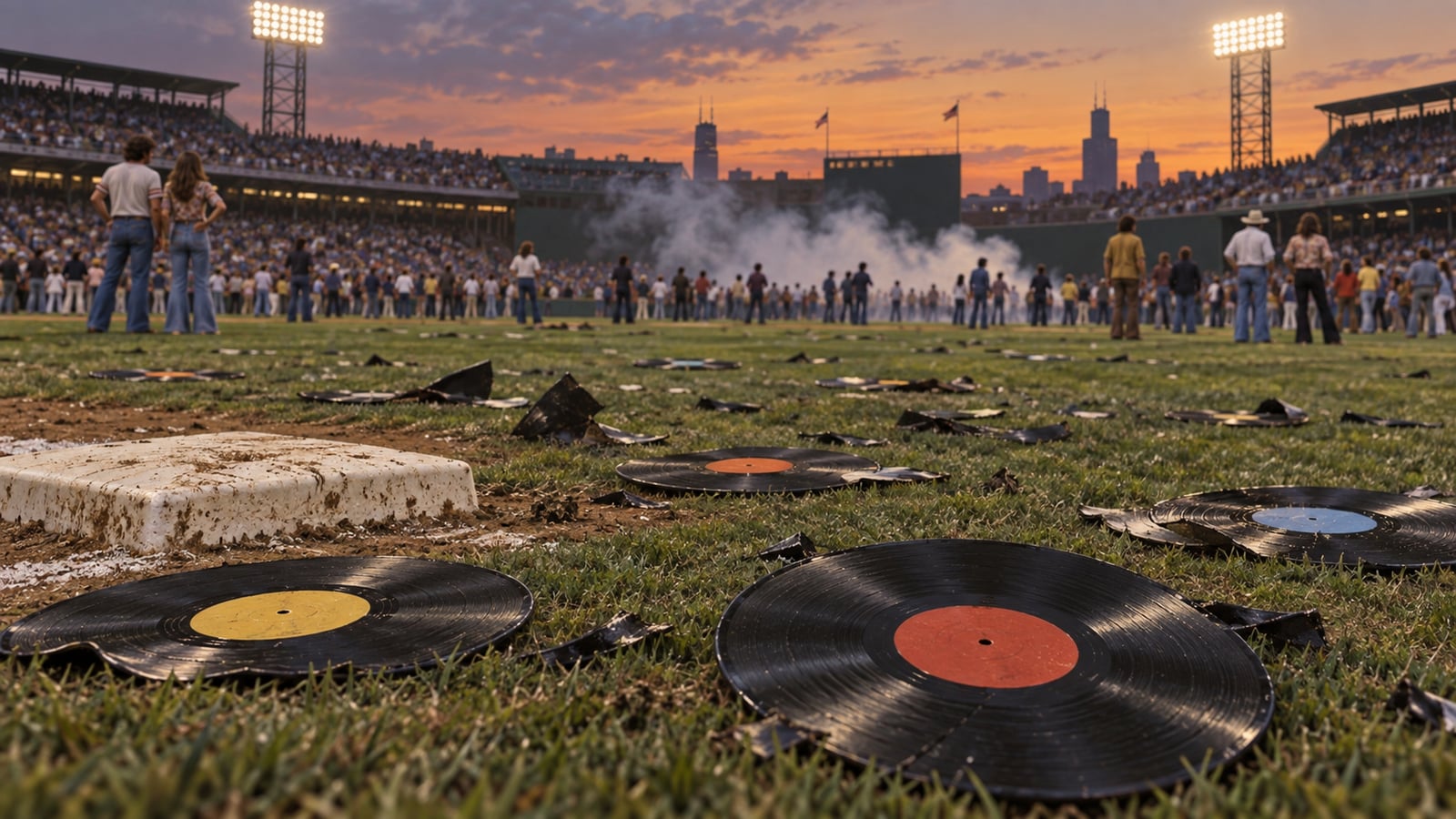
A disco record was the price of a discount. Bring one to Comiskey Park on July 12, 1979, and admission cost 98 cents. The records would be collected and blown up between two scheduled games involving the Chicago White Sox and Detroit Tigers. The club had found an unusual way to fill the interval—and hoped to fill some seats too.
Radio DJ Steve Dahl supplied the attraction. He had lost a job when his station switched to disco, then built an audience attacking the music at a rival station. White Sox promotions director Mike Veeck saw an opportunity. People who would not ordinarily come for baseball might come to watch records being destroyed.
They came in extraordinary numbers: the official attendance was 47,795, with more people unable to get inside. But some of those admitted kept their records. During the first game, discs and firecrackers were already landing on the field. Before the demolition had begun, its raw material was interrupting the baseball.
Detroit won that game 4–1. Then came the advertised spectacle: a crate of records in the outfield was detonated. Clearing the debris should have been followed by another game. Instead, spectators began climbing down onto the field. Thousands poured into the space where the players were preparing to resume.
Security was also occupied with people trying to enter from outside. On the field, intruders took bases, damaged the batting cage and started a fire. Owner Bill Veeck appealed for everyone to return to their seats. Attempts to calm the crowd failed. Police eventually cleared the playing area, but that did not restore the damaged ground.
The second game became a White Sox forfeit, recorded as a 9–0 Detroit victory. The Tigers had earned their first win by playing baseball. They received the second without taking a turn at bat. An entertainment devised to bring people to the game had made the game impossible.
For teenage usher Vince Lawrence, the night carried another meaning. The Black aspiring musician later recalled people bringing records by Black artists that were not disco at all. One man broke a record in front of his face. Dahl disputed interpretations of the event as deliberately bigoted; Lawrence's experience nevertheless went beyond a disagreement about musical taste.
Lawrence also salvaged records that night and continued playing them afterward. He later co-wrote “On and On,” an early Chicago house track. While others had come to destroy dance records, a future dance-music maker went home with records he could use.
EDITORIAL RESPONSIBILITY
FactosBrain Editorial Desk
The FactosBrain Editorial Desk researched and reviewed this article under our editorial policy. We assess error reports under our corrections policy.