Take a train to see a train wreck. In Texas in 1896, a railroad offered precisely that excursion. It was not transporting sightseers to an accident that had already happened. The collision would be arranged after the audience arrived.
The promoter was railroad employee William George Crush. His company had old locomotives and a reason to attract more passengers. Send two engines toward each other and the public could witness something extraordinary. The company would sell the journey to and from the spectacle.
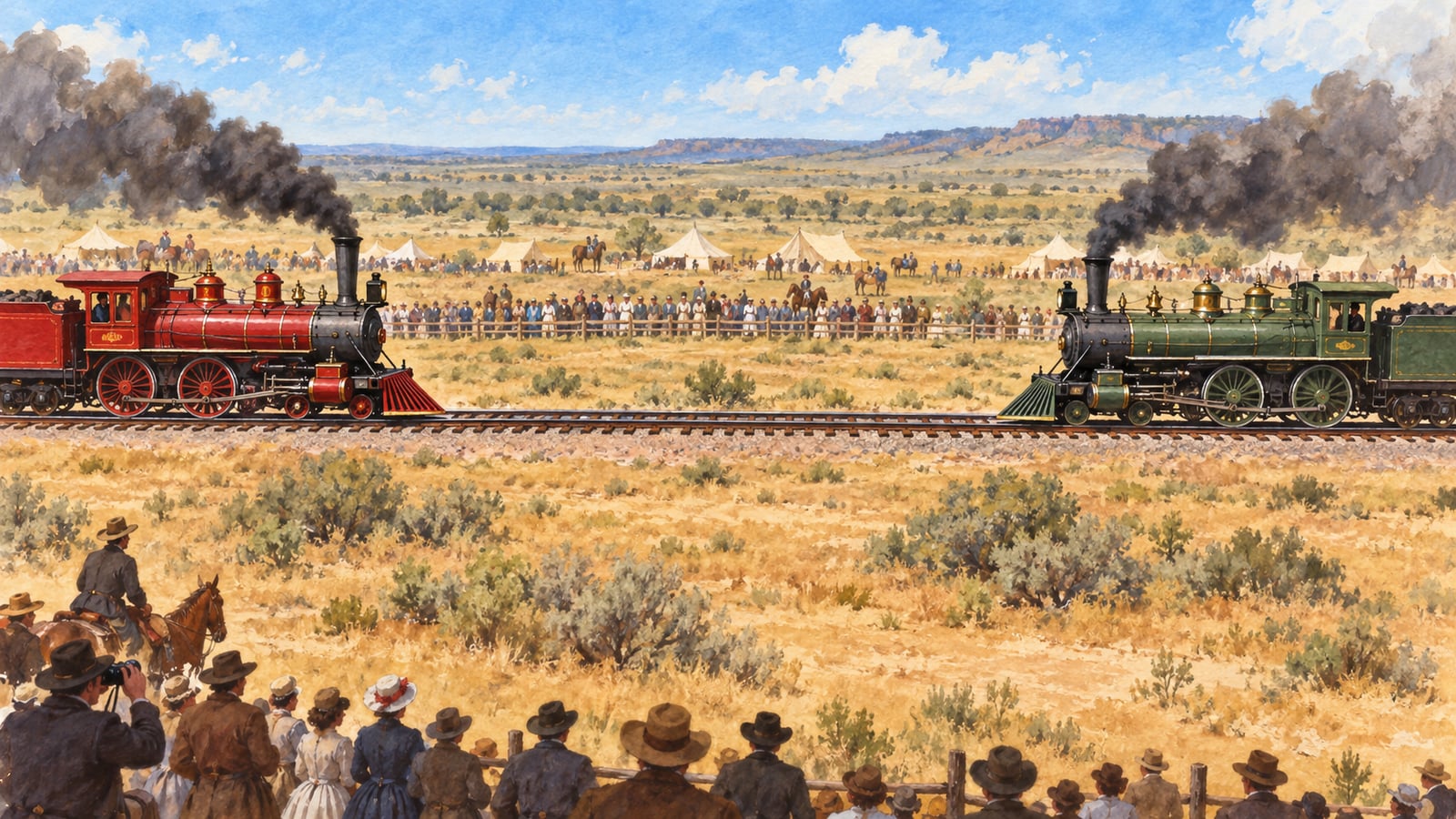
The doomed engines became advertisements in advance. One was painted green, the other red, and they were displayed in towns before their final meeting. Notices and newspaper coverage promoted the coming event through the summer. The public could see the machines that would later be destroyed.
Crush chose a valley north of Waco, close to the company's existing route. Workers laid a separate collision track and built facilities for spectators, reporters and telegraph messages. Food and drink stalls and other attractions turned the site into something more than a place beside the rails. A one-day event acquired a temporary town.
The town was named Crush, after its organizer. On September 15, excursion trains delivered tens of thousands of visitors. People picnicked and listened to speeches while they waited. Before demonstrating how dramatically it could destroy equipment, the railroad demonstrated how efficiently it could assemble a crowd.
Keeping that crowd at a distance was supposed to make the display safe. But two steam locomotives were more than heavy objects moving toward each other: their boilers contained pressure. Would the engines simply crumple, or would the boilers burst? The safety of the spectacle depended on what happened immediately after the advertised collision.
In the afternoon, the engines were positioned to face one another. Crush gave the starting signal from horseback. The trains accelerated and their crews jumped clear before impact. With nobody left aboard to stop them, the two machines closed the remaining distance.
The engines collided, and the boilers exploded. Pieces of metal flew toward the spectators. People were killed and injured, and a photographer lost an eye. Distance had not provided the protection the organizers expected. What the crowd had come to watch had reached the crowd itself.
The company settled claims using money and railway passes. Crush was dismissed and then rehired; his career with the railroad did not end with the disaster. The event had certainly attracted attention, but attention alone was a poor measure of what had happened.
Recovery crews removed the larger wreckage, while souvenir hunters carried away smaller pieces. The visitors went home, and the temporary stalls and tents came down. The town created to accommodate the collision disappeared with the event. It had existed to bring people to a single moment on the track.
Photographs, accounts and a piece of music survived. Scott Joplin commemorated the event in a march. The idea of turning unwanted engines into an unforgettable spectacle had worked in one sense: the collision was remembered. In the surviving images, however, the audience belongs to the story as much as the wreckage. These were the people who had travelled there believing the destruction would remain safely in front of them.
EDITORIAL RESPONSIBILITY
FactosBrain Editorial Desk
The FactosBrain Editorial Desk researched and reviewed this article under our editorial policy. We assess error reports under our corrections policy.