Mount Everest is the familiar answer to the question of the world's highest mountain because that question normally means highest above mean sea level. By that measurement, Everest is the highest summit. Ask instead which summit lies farthest from Earth's center, and the answer is Ecuador's Chimborazo. The statements do not compete with one another. They begin from different reference points and therefore describe different kinds of height.
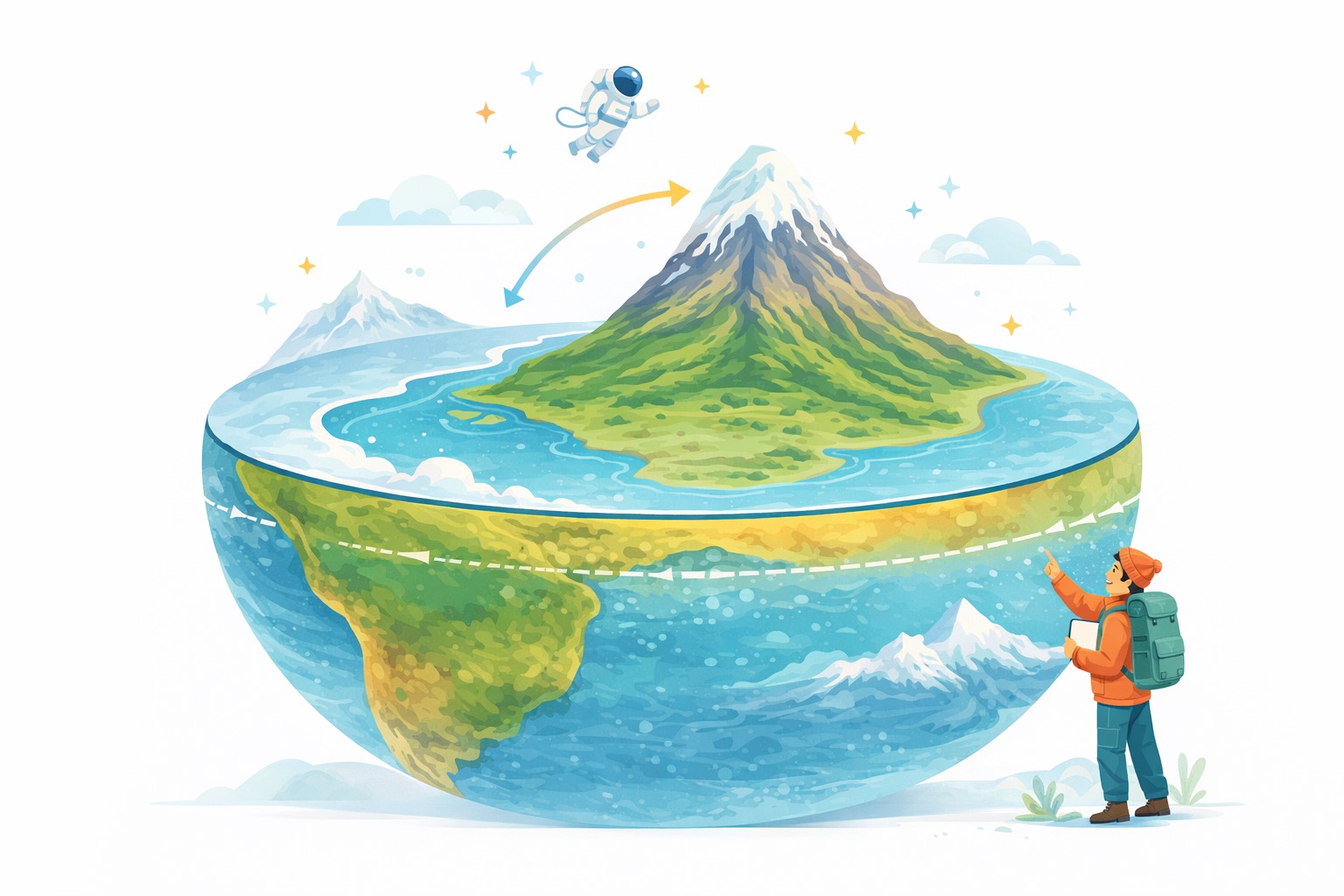
The distinction starts with Earth's shape. Earth is not a perfect sphere; it is closer to an oblate spheroid, slightly wider around the equator and flatter toward the poles. Over long periods, rotation and gravity together produce that equatorial bulge. The effect is small compared with the planet's overall size, but it matters when comparing mountains separated by many degrees of latitude. Geodetic reference systems such as WGS 84 model this flattened shape for mapping and navigation rather than treating Earth as an exact ball.
Chimborazo stands roughly one degree south of the equator. Its summit is about 6.3 kilometers above sea level, more than 2.5 kilometers lower than Everest. Yet its starting surface is already much farther from Earth's center. The extra radius near the equator outweighs the difference in elevation, so NOAA and NASA describe Chimborazo's summit as more than two kilometers farther from Earth's center than Everest's summit. The surprise comes from adding two distances: the local radius of Earth and the mountain's elevation above it.
Mean sea level deserves attention here as well. It is not simply a flat waterline extended across continents. Because Earth's gravity field varies from place to place, elevation is tied to a gravity-based reference surface that approximates the level the ocean would take if it could extend beneath land. This is an extremely useful common baseline for maps, climbing, engineering, and aviation. Distance from Earth's center is a different geometric measurement that includes latitude, Earth's shape, and elevation together.
For that reason, calling Chimborazo simply the mountain closest to space is catchy but imprecise. Space does not begin at one sharp shell around the planet; the atmosphere thins gradually. The commonly cited Kármán line is not the same question as distance from Earth's center, either. Launch performance, atmospheric density, and orbital motion are not decided by the highest nearby summit. Chimborazo's distinction is a result of geodesy, not a shortcut into spaceflight.
A simplified numerical picture shows why the result reverses. The difference between Earth's equatorial and polar radii is larger than the elevation of a single mountain, and Chimborazo and Everest stand at very different latitudes. Chimborazo begins farther outward, while Everest's greater elevation is not enough to erase the entire difference. A real ranking is more careful than that sketch. Geodesists must define the summit as a point, use consistent elevation data, and specify the reference ellipsoid and gravity-based height system. Being near the equator does not automatically make every location farther than every higher-latitude location; local elevation and exact position still matter. Chimborazo wins only after all of those conditions are considered together.
Several measurements can therefore produce several legitimate champions. Everest is the highest summit above mean sea level. Chimborazo is the summit farthest from Earth's center. Measured from its submarine base to its peak, Mauna Kea in Hawaiʻi has an exceptional total height. These measures answer different practical questions: elevation supports maps and aviation, geocentric distance describes planetary geometry, and base-to-peak height describes the scale of a volcanic edifice. Rather than asking which mountain is the single true winner, it is more accurate to ask where the ruler starts. Chimborazo makes that hidden choice visible and, in doing so, reveals the shape of the planet beneath every mountain.
EDITORIAL RESPONSIBILITY
FactosBrain Editorial Desk
The FactosBrain Editorial Desk researched and reviewed this article under our editorial policy. We assess error reports under our corrections policy.